Why No Indian Politicians Go To Jail For Corruption
Let’s start with a statistic that ought to enrage every Indian:
6%. It’s the conviction rate for criminal cases against Indian Members of Parliament and the State’s Members of Legislative Assemblies, as reported by the Central Government in September 2018 to the Supreme Court of India. Of the 3,884 criminal cases against sitting and former MPs and MLAs, cases so serious that if convicted, they would not be able to stand in elections for six years, only 38 convictions were recorded. Meanwhile, 560 were acquitted. The remaining thousands? Still pending. And some for more than 20 years.
Let that sink in
Almost 4000 cases. Thirty-eight convictions. A nation of 1.4 billion people watching it happen, and wondering how.

This is not an accident. This is a system, with its procedural booby-traps, institutional handcuffs and structural loopholes, that ensures that it is almost impossible to prove, beyond reasonable doubt, that a powerful Indian politician is corrupt. And in this piece, we are going to expose all the tricks, the techniques, the tools, and the ways that India’s law protects the politicians who are supposed to be protected by it.
The Magnitude Of The Problem The Stats
To explain how, let’s first explain how much
In the last national election, the 2024 Lok Sabha elections, 46% of the newly elected MPs (251 of the 543) had criminal cases pending, according to the Association for Democratic Reforms (ADR). This is the highest percentage since India became a democracy. To illustrate this: in 2004, this figure was 23%. In 2009, it was 30%. In 2014, 34%. In 2019, 43%. Not only is it not dropping, it’s increasing.
Of the 251 MPs with declared cases, 170 (31%) had declared serious criminal charges, including charges of murder, attempted murder, kidnapping and cases of crimes against women. A hundred and seventy parliamentarians. Serious charges. Sitting in India’s Parliament.
And now the mind blowing stat: the chance of a candidate with declared criminal cases winning the 2024 Lok Sabha elections was 15.3%. A candidate without any criminal charges? Just 4.4%. It’s not that voters do not know, they vote for known criminals because of or despite their criminal record. “Muscle power” in Indian politics exists, it is well-documented and it will be more prevalent in every successive election.

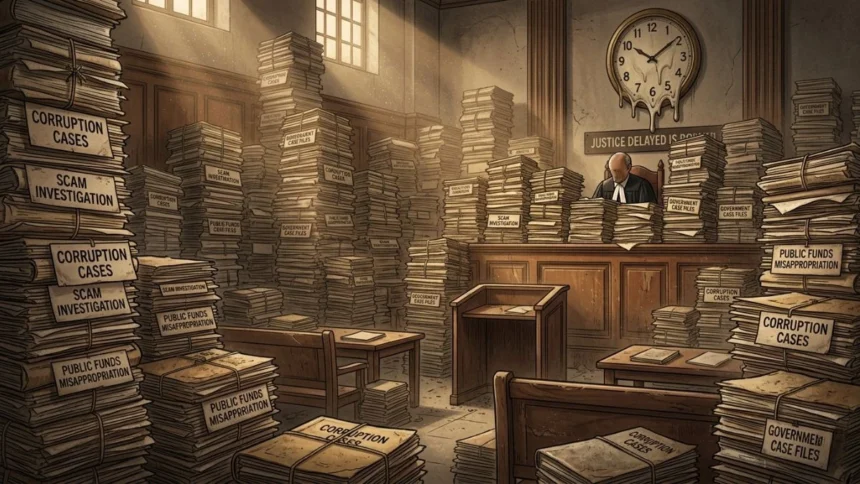
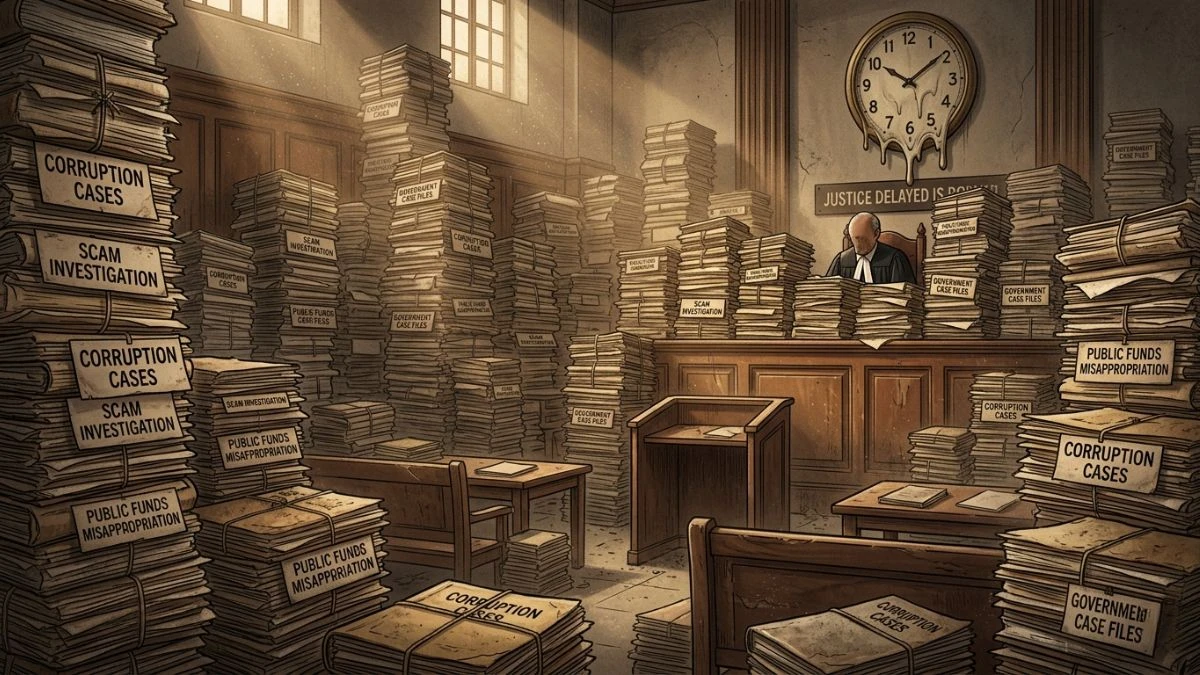
This year, according to the CVC’s annual report 7,072 cases of corruption investigated by the CBI were pending trial in courts, with 606 of those cases older than 20 years. Twenty years. The child who was born when the case was filed, is now a voter. And the accused politician? Still contesting elections. Still winning.
The Law Prosecution Sanction
The following is the crux of this article, take note:
In India, to prosecute a public servant (either past or present) for corruption, the government has to sanction it.

This is known as “Sanction for Prosecution” – and is entrenched in Section 19 of the Prevention of Corruption Act, 1988 as well as Section 197 of the Code of Criminal Procedure. This, on paper, is good: it ensures that frivolous and politically motivated cases do not get filed against honest officials in the service of the people, making difficult decisions.
But in reality, it is a great shelter for corrupt people.
Here is how it works. Suppose the CBI has evidence that a minister is guilty of corruption. The CBI cannot just take the chargesheet to court. It has to present the evidence to the government, that is, the same political party that the accused is a part of, or a member of, and seek sanction to prosecute. The government can either sanction or refuse to sanction the prosecution.
And governments are unlikely to be keen to prosecute their own.
In a landmark case in 1997, the Supreme Court, in Vineet Narain vs. Union of India, sought to resolve this by imposing a three-month deadline for granting sanction. But there was a problem: the Court left a gaping hole as to what to do if the government didn’t respond in three months. Silence is golden. Time goes on, the government remains silent, the case dies.
And so, the 2018 Amendment to the Prevention of Corruption Act has provided an extra layer of protection for politicians in Section 17A: before the CBI can even investigate an allegation of corruption against a current or former MP or MLA who has committed the act “while discharging official duties”, it needs to have the sanction of a competent authority. This is not the sanction to prosecute, it’s a sanction to investigate. Double Locked.
The CBI conundrum India’s most domestically trained watchdog
The Prosecution Sanction is the main gate, the CBI is the dog on a leash.
India’s Central Bureau of Investigation is established by the Delhi Special Police Establishment Act, 1946, which puts the organization under the Ministry of Personnel, Public Grievances and Pensions, a ministry that is a part of the executive of the same government that theoretically CBI investigates.
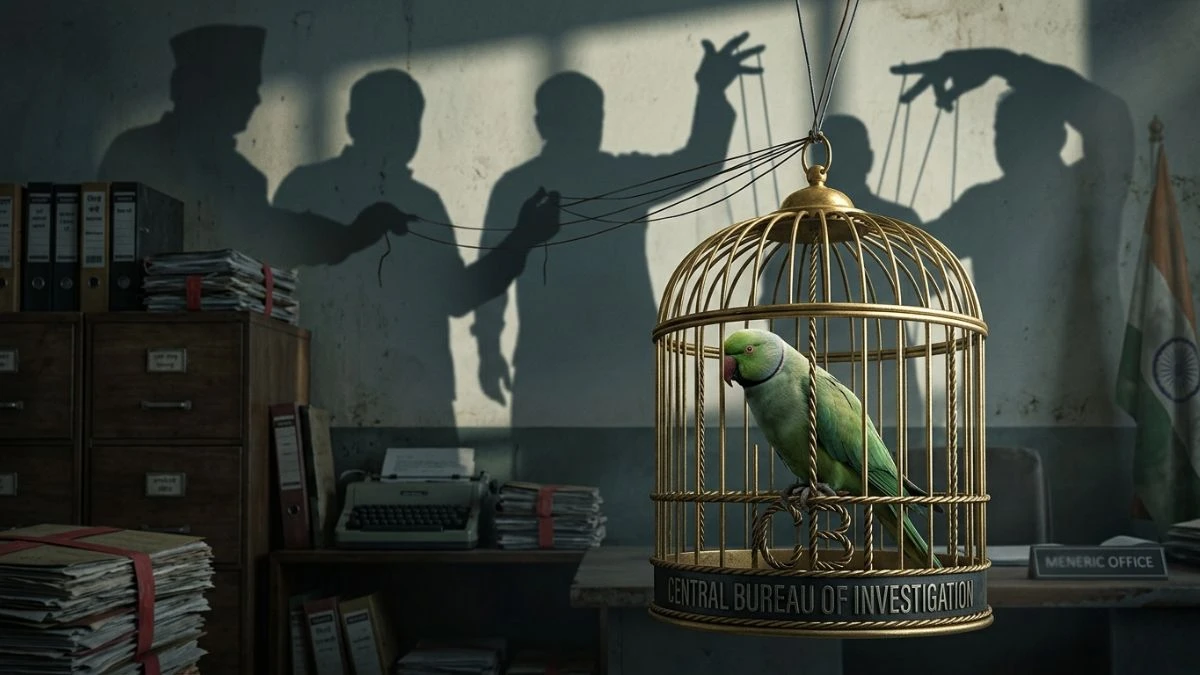
Former CBI heads and officers have spoken out on political interference. Former joint director B.R. Lall has written in his book Who Owns CBI about the way cases are interfered with. The Supreme Court itself famously referred to the CBI in a 2013 judgment as “a caged parrot speaking in its master’s voice”, a searing indictment by the country’s highest court on the independence of the country’s premier investigative agency.
Several state governments (most notably West Bengal, Rajasthan, Maharashtra and others in the past) have revoked “general consent” for the CBI to operate in their states. This effectively paralyses the CBI’s investigation of state political corruption in those states, as it can’t begin work without special permission.
The powers of governments to direct and decide which cases the CBI must investigate and the CBI’s need to seek sanction from governments to prosecute mean the entire chain of investigation is politically infected from start to finish.
The Trial Delay Labyrinth
Let’s assume, despite all the odds, that a case passes the sanction test and lands in the courts. Congratulations. You are in the second half of the corruption shield: the overloaded and procedural quagmire of the Indian judiciary.
At the last count, India has more than 50 million cases in all its courts. The Supreme Court has a backlog of hundreds of thousands of cases. In such a context, a powerful politician with deep pockets and a strong team of lawyers can make a corruption case drag on for decades using a legal tactic: appeals for stay, locus standing, lack of jurisdiction, challenge to the prosecution sanction, bail applications, appeals to the bail granting and bail denial, challenge to the credibility of witnesses, request for adjournment.
All are perfectly legal acts of due process. But when you layer them on top of each other and file them in order, you end up with a trial that goes nowhere. Witnesses die or turn hostile. Evidence degrades. Public memory fades. And the politician remains elected.
The Supreme Court was aware of this and, in 2017, directed the establishment of 12 fast-track courts to try criminal cases involving MPs and MLAs, at a cost of ₹7.8 crore. But the outcome was poor: six months later only 40% of the cases were transferred to these courts, and of these only 11% had been decided.
The 2018 Prevention of Corruption Amendment Act sought to fix this by requiring trials to be completed within two years, extendable for a maximum of four years, in six-month increments. Sounds like a good idea. However, extensions are common, and no court has the capacity to ensure speedy trials while keeping up with its workload.
The Witness Hostility Problem
In India, hostile witnesses in high profile corruption cases are expected.
When the politician being accused is the one in control of the patronage network in the district or state, when he or she is connected to the local police and administration, when witnesses are regular government employees or small-scale contractors who are dependent on the system for their jobs, the pressure on them to “forget” what they saw, to go against their previous statements, or not to cooperate at all is immense.
India’s Prevention of Corruption Act demands that the complainant’s evidence be corroborated by other evidence. The courts have stated that even the recovery of the bribe is not enough to convict, demand and acceptance of the bribe must be proved. If witnesses go hostile, this evidence disappears. And so the case.
The Disqualification Loophole When Conviction is not Enough
Let’s revisit the few cases where conviction does take place.
The Representation of the People Act, 1951 states that a convicted person serving a sentence of imprisonment for two years or more will be disqualified from election. This was confirmed by the Supreme Court in the case of Lily Thomas vs. Union of India (2013) where it was held that legislators convicted should be disqualified from the moment of their conviction rather than waiting for their appeal to be heard.
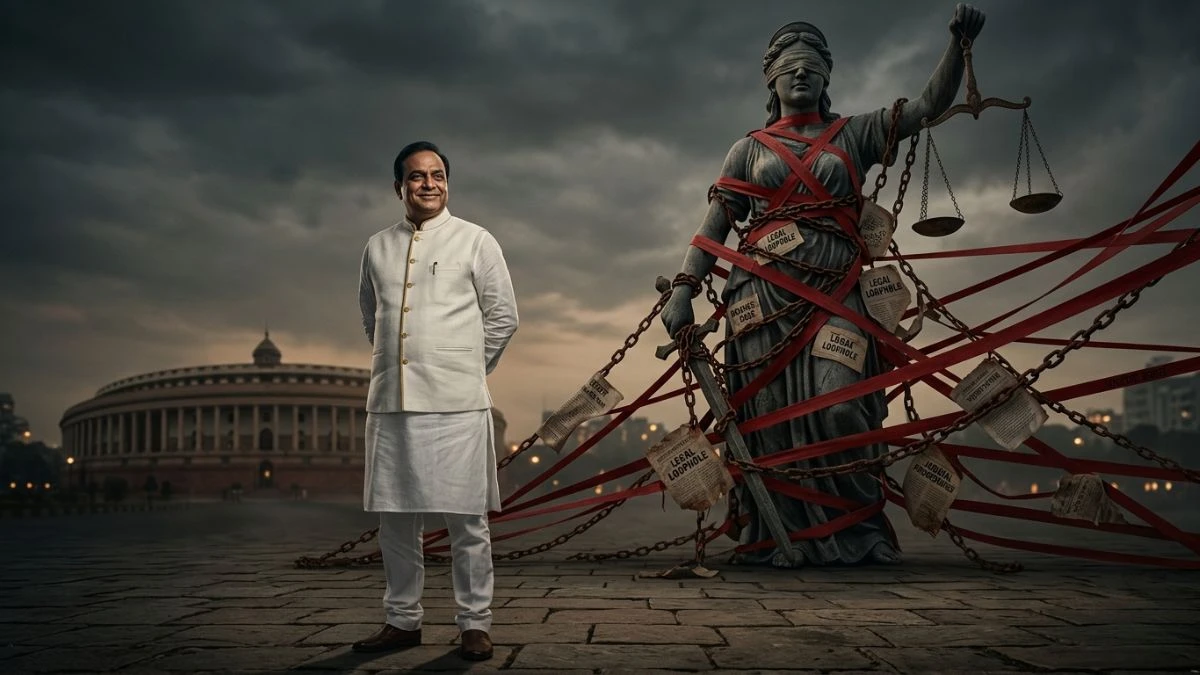
However, there is a catch – conviction in the trial court is only the first step. The convicted can challenge the conviction in the High Court, which can and often does stay the conviction. Once the conviction is stayed, the disqualification is lifted and the politician can remain in office and fight elections during the timeframe of the appeal, which can be years and decades.
Lalu Prasad Yadav, one of the most well-known politicians convicted of corruption in a big-ticket case (the Fodder Scam) was sentenced to multiple prison terms over the years. He served prison time. But even in his case, which has seen more than 20 years in the courts since the scam was exposed in the 1990s, we see the attrition effect. There are more and more cases, more and more appeals, more and more court work.
The “Cage” That Wasn’t Lokpal and Lokayukta
The proposal for the Lokpal, an independent ombudsman to investigate corruption allegations against public officials, including the Prime Minister, was debated for more than 40 years in India. In 2011-12, Anna Hazare’s Jan Lokpal movement mobilised hundreds of thousands of people to call for an independent and effective anti-corruption ombudsman.
The Lokpal and Lokayuktas Act was finally passed in 2013. It was enacted in 2014.
India’s first Lokpal was only appointed in March 2019, five years after the Act was passed. And it is still, to this day, extremely under-resourced and lacks a track record in holding senior politicians to account.
And at the state level, many Lokayuktas are mere paper tigers. In some states, the post has been vacant for many years. Where they do exist, jurisdictional overlap, lack of investigative powers and, once again, the need for government permission to prosecute mean their effectiveness is seriously curtailed.
The Electoral Bonds Shadow
In February 2024, India’s Supreme Court declared the Electoral Bonds Scheme unconstitutional, citing its curtailing the right of citizens to information and allowing corporate transactions between parties and political parties that constituted “quid pro quo”.
When the data released later by the State Bank of India was examined, it was found that a number of companies that bought large amounts of electoral bonds were under investigation or action by central enforcement agencies such as the Central Bureau of Investigation (CBI), the Enforcement Directorate (ED) or the Income Tax Department (ITD). They also received government contracts or regulatory favours during the same time period.
This is the big picture of political corruption in India, not just bribery and embezzlement but institutionalised and systemic cash flows between business and political power that are both legal and quasi-legal, making it difficult to prosecute because the currency of business was legal.
The Voter’s View of Why Criminals Win Elections
It would be wrong and lazy to blame this all on politicians and political institutions without looking at voters. The ADR figures demonstrate criminals are more likely to win elections than non-criminals. Why?
First, some constituencies don’t have good local government. In these places, a powerful politician -whatever their criminal history – is often the only person who can “get things done”: get a bed in a hospital, resolve a land dispute, help with a government program. Criminal power is a source of local service delivery that pure bureaucracies fail to offer.
Second, criminal charges are seen as politically motivated. Given that opposition politicians file criminal cases against each other on a regular basis, as is the case in India, voters become rightly cynical about whether any given chargesheet is a genuine case of criminality or political persecution. This cynicism, while justifiable, is advantageous for both the guilty and the innocent.
Third, caste, religion and community play a strong role in voting decisions, often trumping considerations of criminality. The voter may know his or her candidate has been charged with murder, but if that candidate belongs to their community and the other candidate belongs to the opposition, then tribal politics takes over.
The Data on India’s Corruption Index
India’s 2024 Corruption Perceptions Index (released in early 2025) score is 38 out of 100, with it ranking 96th on the list of 180 nations. It has improved very little in the past decade, the system is able to absorb the anti-corruption message, but produces little change. By way of comparison, India’s highest-scoring competitor in the Asia-Pacific was 84. The Asia-Pacific average was 44.
In 2008, 50% of the population reported having bribed their way to receive a government service. Although there is some evidence that digitisation of governance has helped to curb petty bribery at the “front door” of government services, systemic corruption – that is, big-ticket bribery involving large contracts, regulatory and policy decisions – is widespread.
How to Solve the Problem
Admittedly, there’s no easy fix. But the changes that experts of all political persuasions (from ADR to the Supreme Court) continually point to include:
Time-bound sanction for prosecution with deemed sanction: If the government is not able to reject the sanction for prosecution requested by CBI within a time frame, sanction should be deemed granted. The courts have gone some way in this, but require legislative support.
CBI independence: The CBI should move beyond being a part of the executive, as the Election Commission is, with its director appointed by a collegium.
Timely corruption trials: Not only recommended time frames for trials but procedural rules that restrict the number of adjournments in cases involving legislators and that escalate the cases to higher courts if the time frames are exceeded.
Better scrutiny of candidates: The Supreme Court has repeatedly asked political parties to provide written explanations for the candidacy of persons with serious criminal charges. The parties have largely ignored these directions. A prohibition on candidates facing serious criminal charges, such as murder, rape and financial fraud, requires constitutional change but is not unheard of.
Ensuring witness protection: India has a Witness Protection Scheme, approved by the Supreme Court in 2018, but it is implemented haphazardly. Until the witnesses are protected, those in big cases will continue to go hostile.
The Uncomfortable Conclusion
Why no important Indian politician has been convicted of corruption has nothing to do with weak laws. India has the Prevention of Corruption Act, the Lokpal, the CBI, the ED, the CVC, special courts and a Supreme Court that has delivered more directives for measures to stop corruption than any other court in the world.
The reason is that all mechanisms of accountability require the sanction of the powerful and the powerful have no reason to give it. The sanction to investigate requires government approval. The sanction to prosecute requires government approval. The CBI’s independence requires government respect for convention. The length of court cases requires the government’s help in not burdening the courts with endless procedural appeals.
At the same time, the criminalisation of politics has risen from 23% in 2004 to 46% in 2024 – a 100% increase in two decades. The average assets of re-elected MPs grew by 40% in just five years (2019 to 2024), from ₹18.64 crore to ₹26.14 crore. In 2024, 93% of the elected Lok Sabha members were crorepatis.
The system is not broken. For the elites, the system is working very well.
The question for the Indian people is a simple and hard one: for how long are we to be ruled by a system that protects the corrupt, clears the powerful, and obfuscates accountability via process in concrete, while requiring the rest of us to obey every law, pay every tax and stand in every line?
There is no legal answer to that question. It has a political one.
Frequently Asked Questions (FAQs)
Q1. Have any Indian politicians ever been jailed for corruption?
Well, yes and no. There have been a few politicians who have gone to jail in India, the most notable being Lalu Prasad Yadav and V.K. Sasikala. But these are the exception in a process that results in thousands of cases filed for corruption and next to no jail time for sitting legislators. Data filed with the Supreme Court shows that out of 3,884 criminal cases against MPs and MLAs, just 38 (or 6%) ended in conviction. And many of those convicted received short jail terms or were out on bail for appeal fairly soon. For most of the politicians accused of corruption in India, the criminal justice system is not a stepping-stone to accountability, but an endless revolving door.
Q2. What is “Prosecution Sanction” and why does it protect corrupt politicians?
Prosecution Sanction is a legal provision under Section 19 of the Prevention of Corruption Act, 1988, and Section 197 of the Code of Criminal Procedure. It requires that, before a government servant (including an elected politician) can be tried for any act done in the lawful discharge of his or her duty, the government gives its provisionally written consent. The idea is that this safeguards officials from being prosecuted for noble reasons. But it means whether a case against a government official for corruption goes ahead is determined by the ruling party or government. Governments have consistently delayed sanction requests, failed to meet court-imposed timelines or refused sanction quietly, in effect stalling the case before it goes to trial. In 2018, the government added an additional requirement: sanction is now required to even investigate a current or former elected official, not just to prosecute them.
Q3. Why can’t the CBI successfully prosecute politicians in India?
The Central Bureau of Investigation (CBI) has a conflict of interest: it falls under the Ministry of Personnel, Public Grievances and Pensions, which is run by the same government it might be investigating. In 2013, the Supreme Court referred to the CBI as “a caged parrot speaking in its master’s voice”. Apart from political control at its head, the CBI is also dependent on state governments for permission to investigate cases in their jurisdictions – a permission that is often withdrawn if the state is being investigated. Moreover, the CBI requires permission from the government to file chargesheets, so even if it does complete an investigation, it could be stymied at the last moment. Former CBI officials have publicly detailed how major political cases are stymied, evidence is mishandled or investigations are terminated.
Q4. Can’t the Supreme Court of India hold people to account?
India’s Supreme Court has been one of the most active – and disgruntled – reformers on corruption. It has given directions for candidate criminal background disclosure (2002), for setting up special fast-track courts for criminal trials of politicians (2017), for time limits on corruption trials (2018 amendments) and for parties to publicly justify the nomination of candidates with criminal records (2018). But the court’s orders need the executive to execute them. Executives have been reluctant to set up special courts, parties have failed to comply with disclosure requirements, and appeals continue to thwart time limits. The court can direct, but not without the executive’s cooperation. And that cooperation, in the past, has been limited.
Q5. How can we stop political corruption in India?
There is more that individual citizens can do. In the lead-up to each election, citizens can get information about the criminal and financial records of every candidate on the MyNeta (myneta.info) website, run by the Association for Democratic Reforms and based on Election Commission affidavits. Not voting for candidates with a criminal record – even if they represent your party or caste – demonstrates that caste, religion and class identity are not more important than good governance. Donating to and supporting such organisations as the ADR and National Election Watch who collect and publish this information, builds the checks and balances of transparency. RTI requests to track the progress of corruption cases in your constituency keep cases alive. And calling for your state government to set up and fund a Lokayukta with independent investigation powers is a battle that can be fought and won in your state, before it becomes a national cause. Change is incremental, but elections can be seen as a referendum on ‘more of the same’.
Editorial Note
This is an editor’s view of this article on the established, statistical trend of immunity in Indian political corruption cases. It is not a personal attack on any politician, political party or institution. The figures stated – 6% conviction rate, 46% of MPs with criminal cases, and 7,072 pending corruption cases in the CBI – are based on the latest official reports submitted to the Supreme Court by the State, the annual report of the Central Vigilance Commission, the Association for Democratic Reforms and Transparency International. These are not disputed facts; they are numbers submitted by the State to its courts, and published by organisations that are under statutory authority or adhere to peer-reviewed academic standards.
We think political accountability does not have a political face. Government corruption has been reported under all major political parties that have governed the nation and the states – the Indian National Congress, the Bharatiya Janata Party, regional parties of both the left and the right. The legal framework that protects the corrupt has evolved over decades of government under multiple regimes, and it will take the persistent activism of an informed public – not just allegiance to a national flag – to tear it down.
Journalism that reveals failure is not cynicism. It is the minimum requirement of a democracy that wishes to live.
Disclaimer
This article is for the purpose of raising public awareness and providing educational information only. The statistics, legal and case citations have been sourced from publicly available documents from government, court proceedings, statutory reports and from reputable research bodies such as the Association for Democratic Reforms (ADR), the Central Vigilance Commission (CVC), Transparency International and PRS India. This is not legal advice and readers should seek the advice of a legal professional for any given legal issue.
This article does not make allegations of specific criminal activity by any named or unnamed person beyond those made in court or in official submissions to the government. Mentions of legal proceedings, political developments and institutional missteps are made in the context of systemic understanding, rather than character assassination.
The Editorial Note is an expression of the views of the editorial team. The factual content of this article is sourced and is not political opinion. This article is not endorsed by, paid for, or controlled by any political party, electoral campaign or government department. Any similarity to the views of any political party is purely coincidental.
All figures should be independently verified from the sources listed at the bottom of the article. The laws, court orders and statistics cited in this article are current as of the date of publication, and may have changed since.
Published in good faith under the principles of freedom of the press and free and fair reporting.
Sources: Association for Democratic Reforms (ADR) 2024 Lok Sabha Analysis, Central Government Affidavit to Supreme Court (September 11, 2018), Transparency International Corruption Perception Index 2024, Chambers & Partners Anti-Corruption Guide India 2026, Prevention of Corruption Act 1988 (amended 2018), PRS India Legislative Research, Vineet Narain vs Union of India, 1997, Lily Thomas vs Union of India 2013, CVC Annual Report 2024.