There’s a quiet shift happening in India’s job market—quiet enough that most people haven’t fully noticed it yet, but loud enough that policymakers are starting to raise alarms.
Walk into a mid-sized office in Bengaluru or Gurugram today, and you’ll notice something subtle. Teams are smaller. Tasks that once required three people are now handled by one—with the help of AI tools running silently in the background. Customer support is faster, content is generated instantly, and data analysis that once took days now happens in minutes.
Efficiency is rising. But so is unease.
The conversation around AI and Jobs in India: What Policymakers Are Warning About is no longer theoretical. It’s becoming deeply practical—and increasingly urgent.

AI and Jobs in India: What Policymakers Are Warning About — The Core Concern
At its surface, the concern seems simple: automation might replace jobs. But policymakers are not just worried about job loss—they’re worried about job transformation happening faster than the system can adapt.
India is not like smaller economies where workforce transitions can be absorbed more easily. With millions entering the job market every year, even small disruptions can create large-scale ripple effects.
What’s being flagged isn’t a sudden collapse—but a gradual mismatch.
- Jobs are evolving faster than skills
- Opportunities are shifting faster than education systems
- Demand is becoming specialized while supply remains generalized
This is where the real anxiety lies.

Why AI and Jobs in India: What Policymakers Are Warning About Is Trending Now
A few years ago, automation debates were largely limited to manufacturing. Today, AI has moved into white-collar work—writing, coding, design, finance, even legal drafting.

That changes everything.
India’s growth story has long depended on its service sector advantage—IT services, outsourcing, back-office operations. But AI is now entering exactly those spaces.
Think about it:

- Chatbots replacing entry-level customer support
- AI tools assisting or replacing junior coders
- Automated reporting reducing analyst roles
- Content generation tools affecting media and marketing jobs
This isn’t speculation. It’s already happening—quietly, incrementally.
Policymakers are warning because the disruption is diffused, not dramatic. And that makes it harder to respond to.
The Real Issue Isn’t Job Loss — It’s Job Polarization
One of the more nuanced warnings around AI and Jobs in India: What Policymakers Are Warning About is something economists call job polarization.
In simple terms:
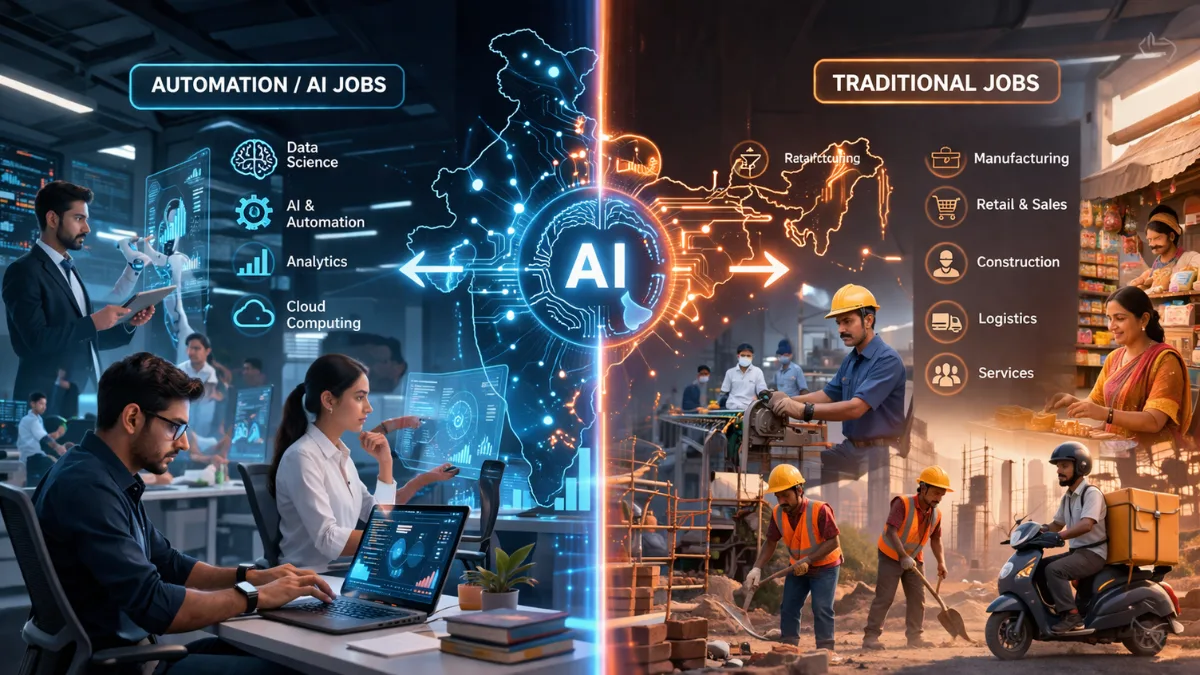
- High-skill jobs grow (AI engineers, data scientists, system architects)
- Low-skill jobs remain (manual labor, informal sector)
- Mid-level jobs shrink
And India’s workforce sits heavily in that middle layer.
Roles that involve routine cognitive work—the backbone of many urban jobs—are the most vulnerable.
This creates a strange paradox:
- Jobs are available
- But the right kind of jobs are not accessible to everyone
That’s not unemployment. That’s misalignment.
A System Under Pressure: Education vs Reality
India produces millions of graduates every year. But policymakers are increasingly pointing out a difficult truth—degree-based education is not aligned with skill-based demand anymore.
AI doesn’t eliminate the need for workers. It changes what workers need to know.
And here’s the gap:
- Colleges still teach static knowledge
- AI demands dynamic problem-solving
- Students learn tools
- Industry demands adaptability
The result?
A graduate who is technically qualified—but practically unprepared.
This is where policy discussions are intensifying—around reskilling, vocational training, and continuous learning ecosystems.
The Business Perspective: Efficiency vs Employment
From a business standpoint, AI is irresistible.
It reduces costs.
It increases speed.
It improves accuracy.
No company competing globally can afford to ignore it.
But this creates a tension.
Every gain in efficiency potentially reduces the need for manpower—especially at entry and mid levels. For a country like India, where job creation is a central economic pillar, this becomes a structural concern.
Policymakers are not anti-AI. They’re trying to balance innovation with inclusion.
Because growth without employment is not sustainable.
The Psychological Shift Nobody Talks About
Beyond economics, there’s a deeper layer to AI and Jobs in India: What Policymakers Are Warning About the psychological impact
Work is not just income. It’s identity.
When roles become uncertain:
- People hesitate to specialize
- Career paths feel unstable
- Long-term planning becomes difficult
There’s a growing sense of replaceability among young professionals.
And that changes behavior.
Instead of mastering one field, individuals start spreading themselves thin—trying to stay “relevant” rather than becoming “excellent.”
That’s a subtle but important shift in how a workforce evolves.
What Policymakers Are Actually Suggesting
Despite the warnings, the tone from policymakers is not pessimistic. It’s cautious.
The direction is becoming clearer:
1. Reskilling Over Replacement
Instead of resisting AI, the focus is on training workers to work alongside it.
2. Strengthening Vocational Education
Moving away from purely academic frameworks toward practical, industry-linked learning.
3. Encouraging AI Innovation Within India
Not just using AI—but building it. That means supporting startups, research, and domestic tech ecosystems.
4. Policy Frameworks for Ethical AI
Ensuring that adoption doesn’t widen inequality or create uncontrolled disruption.
5. Public-Private Collaboration
Bridging the gap between education institutions and industry requirements.
These are not quick fixes. They’re long-term structural shifts.
The Opportunity Hidden Inside the Disruption
There’s another side to this story—one that often gets overshadowed.
AI is not just eliminating jobs. It’s creating entirely new categories of work.
Roles that didn’t exist five years ago are now in demand:
- Prompt engineers
- AI trainers
- Data annotators
- Automation consultants
- Human-AI interaction designers
India, with its large and young workforce, has a unique advantage—if it adapts quickly.
The real question is not whether AI will change jobs.
It’s whether India can move fast enough to capture the upside.
Where This Is Headed
The conversation around AI and Jobs in India: What Policymakers Are Warning About is still evolving. But one thing is becoming clear.
This is not a crisis.
It’s a transition.
But transitions can be uneven.
Some sectors will move ahead quickly. Others will lag. Some workers will benefit. Others will struggle.
The role of policy, then, is not to stop change—but to make that transition less painful and more inclusive.
Conclusion
India stands at a delicate intersection—between demographic advantage and technological disruption.
AI is accelerating faster than traditional systems can respond. And that gap is where the real risk lies.
But it’s also where the opportunity exists.
If the country can align education, policy, and industry around this shift, the narrative changes—from fear to readiness.
Because the future of work is not being taken away.
It’s being rewritten.
Final Insight
At The Vue Times, we don’t just track trends—we decode what they actually mean for you.
AI isn’t the end of jobs in India. It’s the beginning of a more demanding, more dynamic workforce.
The real question isn’t whether AI will change your career. It’s whether you’re ready to change with it.
Frequently Asked Questions
What is the main concern about AI and jobs in India?
The primary concern is not just job loss but the mismatch between available skills and evolving job requirements due to AI-driven automation.
Will AI completely replace jobs in India?
No, AI will not eliminate all jobs. It will transform many roles and create new opportunities, especially in tech-driven sectors.
Which jobs are most at risk due to AI in India?
Routine and repetitive roles—especially in customer support, data processing, and entry-level IT jobs—are more vulnerable to automation.
How can workers adapt to AI changes?
By focusing on continuous learning, upgrading digital skills, and developing problem-solving abilities that complement AI systems.
Is AI creating new job opportunities in India?
Yes, AI is creating roles in areas like data science, machine learning, AI training, and automation strategy.