Union Budget Framed for the Long Haul
The Union Budget 2026–27 arrives at a decisive moment for the Indian economy, one that is shaped by three simultaneous transitions: a post-pandemic structural recovery, a rapidly fragmenting global economic order, and India’s own ambition to reposition itself as a manufacturing, technology, and innovation hub rather than merely a consumption-driven market.
Over the past decade, India’s economic policy has steadily shifted from welfare-heavy expenditure towards asset creation, productivity enhancement, and institutional reform. Budget 2026 is a continuation, and in many ways a consolidation, of that journey. It does not promise overnight relief or populist windfalls. Instead, it seeks to answer a harder question: how does India sustain high growth while remaining fiscally credible in an uncertain global environment?
Finance Minister Nirmala Sitharaman’s eighth consecutive budget reflects this thinking. The emphasis is on predictability, execution, and long-term confidence building, particularly for investors, manufacturers, and states responsible for last-mile delivery.
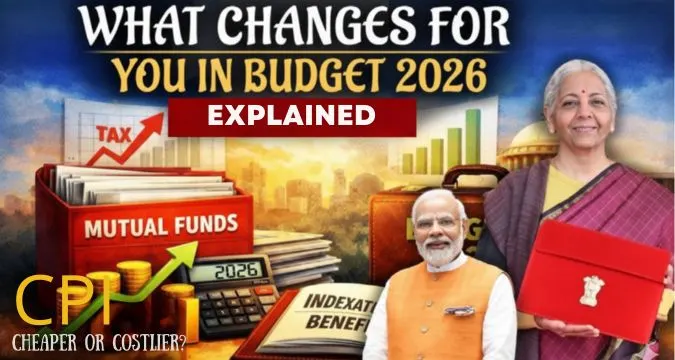
The Union Budget 2026–27 arrives at a decisive moment for the Indian economy. With global growth uncertain, geopolitical tensions reshaping supply chains, and technology redefining productivity, Finance Minister Nirmala Sitharaman’s latest budget signals a clear intent: prioritise long-term capacity building over short-term populism.

Rather than dramatic tax giveaways or headline-heavy subsidies, Budget 2026 focuses on infrastructure creation, manufacturing resilience, fiscal consolidation, and institutional reform. It positions itself as a bridge budget, connecting today’s economic recovery with India’s ambition of becoming a developed nation by 2047.
“This budget is not about instant gratification. It is about creating economic shock absorbers for the next two decades.”
-Senior Economist, New Delhi-based policy think tank
At a Glance: Budget 2026 Key Numbers
- Fiscal Deficit: ~4.3% of GDP
- Capital Expenditure (Capex): ₹12.2 lakh crore
- Total Expenditure: ~₹53.5 lakh crore
- Debt-to-GDP Ratio: ~55.6%
- Projected GDP Growth (FY27): ~6.8–7.2%
These figures underline the government’s attempt to walk a fine line between growth and fiscal responsibility.
Fiscal Strategy: Spending More, Borrowing Smarter
At the heart of Budget 2026–27 lies a clear fiscal philosophy: growth must be investment-led, but not debt-fuelled beyond control. The government continues its glide path of fiscal consolidation while refusing to retreat from capital expenditure, even under pressure to increase social spending.
The fiscal deficit for FY27 is pegged at approximately 4.3% of GDP, signalling continuity with earlier commitments to bring the deficit below 4.5% without abruptly cutting expenditure. This is particularly significant at a time when many global economies are loosening fiscal discipline to manage slowing growth.

What makes this strategy notable is not just the deficit number, but where the money is being spent. Capital expenditure has been raised to ₹12.2 lakh crore, reinforcing the government’s belief that public investment can crowd in private capital and create durable economic assets.
States remain central to this approach. Through enhanced tax devolution, grants recommended by the Finance Commission, and long-term interest-free loans, states are being empowered to execute infrastructure projects aligned with local economic strengths.
Editorial Insight: Budget 2026 treats fiscal discipline not as austerity, but as credibility capital, an asset India must preserve to finance its development ambitions over the next two decades.

One of the most striking aspects of Budget 2026 is its continued emphasis on capital expenditure. For the third consecutive year, public investment is being used as the primary lever to crowd in private investment.
Why Capex Matters
Capital expenditure, on roads, railways, ports, and logistics, has a higher multiplier effect than revenue spending. Every rupee spent on infrastructure creates jobs, improves productivity, and strengthens supply chains.
In Budget 2026:
- Nearly 47% of total capex is directed toward transport infrastructure.
- States continue to receive strong support through tax devolution and long-term interest-free loans.
Policy Insight: The budget assumes that private investment will follow public investment once demand visibility and logistics efficiency improve.
Taxation: Stability Over Surprises
Contrary to widespread speculation, no changes have been made to personal income tax slabs. Instead, the government has opted for a deeper structural reform.
The New Income Tax Act, 2025
Effective from April 1, 2026, the new law aims to:
- Simplify language and remove redundant provisions
- Reduce litigation and interpretational disputes
- Introduce cleaner, shorter return forms
- Allow longer timelines for return revision
Other Notable Tax Measures
- TCS reduced to 2% on foreign education, medical treatment, and overseas tour packages
- Tax holiday till 2047 for global cloud service providers using Indian data centres
- Rationalisation of TDS/TCS provisions
- Higher Securities Transaction Tax (STT) on derivatives trading
Market View: While long-term investors welcomed tax certainty, short-term market volatility reflected concerns over higher derivatives taxation.
Infrastructure Push: Building Economic Arteries
Infrastructure has evolved into the single most consistent theme of India’s recent budgets, and Budget 2026 reinforces this trend with renewed intensity. The objective is no longer just connectivity, but economic integration, linking production centres, consumption hubs, ports, and global markets through faster, cheaper, and greener logistics.
Railways, Roads and Urban Transport
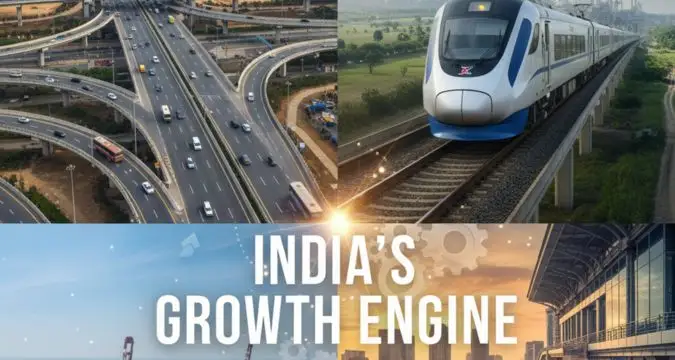
The announcement of seven high-speed rail corridors marks a strategic expansion beyond conventional railway upgrades. These corridors are designed to connect high-density economic clusters, reduce travel time dramatically, and unlock new labour markets.
Simultaneously, funding for urban mobility through City Economic Regions (CERs) recognises the growing role of cities as engines of growth. Metro rail expansion, electric buses, and integrated ticketing systems are expected to receive a significant boost under this framework.
Logistics and Freight Efficiency
India’s logistics costs, estimated at 13–14% of GDP, remain a structural disadvantage for exporters and manufacturers. Budget 2026 attempts to address this through:
- Expansion of dedicated freight corridors
- Development of multimodal logistics parks
- Addition of 20 new National Waterways
By shifting freight from roads to rail and waterways, the budget aims to reduce costs, emissions, and congestion simultaneously.
Why This Matters: Lower logistics costs directly improve India’s export competitiveness and manufacturing margins, making infrastructure spending one of the most powerful growth multipliers in the budget.
Infrastructure remains the backbone of Budget 2026.
Railways & Transport
- Seven high-speed rail corridors connecting major economic hubs
- Expansion of freight corridors to reduce logistics costs
- Urban transport funding through City Economic Regions (CERs)
Inland Waterways & Logistics
- 20 new National Waterways announced
- Focus on multimodal logistics parks and coastal shipping
Why It Matters: India’s logistics costs remain around 13–14% of GDP. The budget’s transport strategy aims to bring this closer to global benchmarks of 8–9%.
Manufacturing & Strategic Self-Reliance
Budget 2026 marks a subtle but important evolution in India’s manufacturing strategy. The focus is no longer limited to increasing output volumes; it is about owning critical segments of global value chains.
Semiconductors, Electronics and Advanced Manufacturing
The expansion of the India Semiconductor Mission 2.0 reflects lessons learned from earlier phases. Instead of focusing solely on fabrication plants, the new approach emphasises chip design, materials, equipment, and talent ecosystems, areas where India can develop comparative advantages.
The ₹40,000 crore Electronics Components Manufacturing Scheme complements this by addressing a long-standing weakness in India’s electronics sector: dependence on imported components.
Biotech, Rare Earths and Strategic Materials
With the launch of Biopharma SHAKTI and the creation of Rare Earth Corridors, Budget 2026 acknowledges that economic security and national security are increasingly intertwined. Control over critical minerals and pharmaceutical supply chains is no longer optional in a geopolitically fragmented world.
Strategic Reading: This is not protectionism; it is strategic resilience. India is positioning itself as a reliable alternative manufacturing base in a world seeking supply chain diversification.
Budget 2026 deepens India’s manufacturing push beyond assembly lines and into value-chain ownership.
High-Impact Initiatives
- India Semiconductor Mission 2.0 – strengthening design, materials, and equipment ecosystems
- Electronics Components Manufacturing Scheme: ₹40,000 crore
- Biopharma SHAKTI: ₹10,000 crore to boost biotech manufacturing
- Rare Earth Corridors across mineral-rich states
This signals a shift from import substitution to strategic capability building.
MSMEs: From Survival to Scale
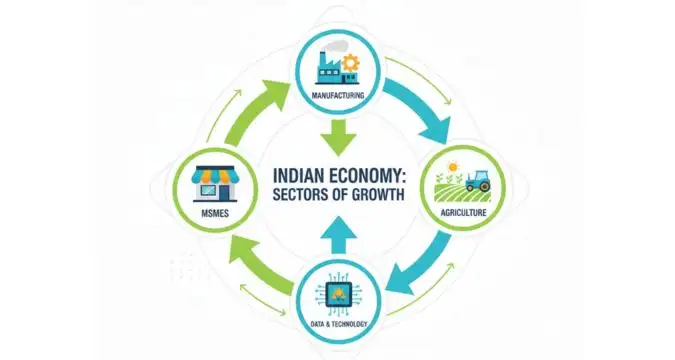
Micro, Small and Medium Enterprises are repositioned as growth drivers rather than welfare recipients.
Key measures include:
- ₹10,000 crore SME Growth Fund for scalable enterprises
- Mandatory onboarding of CPSEs on TReDS for faster MSME payments
- Easier access to formal credit and risk-sharing mechanisms
Ground Reality: Liquidity access, not subsidies, remains the biggest constraint for MSMEs, and the budget attempts to address exactly that.
Education, Skills & Human Capital
Recognising that demographics alone do not guarantee growth, Budget 2026 invests heavily in skills.
Focus Areas
- AVGC labs in 15,000 schools and 500 colleges
- Expansion of design, creative and digital education
- Strengthening allied health and medical training infrastructure
The aim is to align India’s workforce with emerging sectors rather than legacy industries.
Agriculture & Technology Integration
Instead of traditional subsidy expansion, the budget introduces technology-led agricultural support.
- Launch of Bharat-VISTAAR, a multilingual AI-based advisory platform for farmers
- Focus on productivity, climate resilience, and knowledge dissemination
Structural Shift: The budget treats farmers as entrepreneurs rather than beneficiaries.
Who Benefits the Most?
| Segment | Budget Impact |
| Infrastructure & Construction | Strong positive |
| Manufacturing & Electronics | Strong positive |
| MSMEs | Moderately positive |
| Long-term Investors | Positive |
| Derivatives Traders | Cautious |
| Salaried Middle Class | Neutral |

Frequently Asked Questions
1. Are there any income tax slab changes in Budget 2026?
No. Tax slabs remain unchanged. The focus is on simplifying compliance rather than altering rates.
2. What is the biggest reform in this budget?
The implementation of the New Income Tax Act, 2025 and sustained high capital expenditure.
3. Does this budget help startups?
Indirectly, yes, through MSME funds, manufacturing incentives, and digital infrastructure.
4. How does Budget 2026 support long-term growth?
By investing in infrastructure, technology, skills, and fiscal stability rather than short-term consumption boosts.
5. Is this a pro-poor or pro-growth budget?
It is primarily a pro-growth budget, with inclusive outcomes expected through job creation and productivity gains.
The Vue Times Take: Reading Between the Lines
Union Budget 2026–27 is not designed to excite, it is designed to endure. Its success will depend less on announcements and more on execution. If implemented effectively, this budget could quietly lay the foundation for India’s next phase of economic expansion.
In that sense, Budget 2026 may be remembered not for what it promised, but for what it steadily built.
For more in-depth policy analysis, governance explainers, and economy-focused journalism, stay with The Vue Times.