Online Gaming Ban Threatens 200,000 Jobs in India
Less than a year ago, the online gaming industry in India could rightly be called a sunrise sector of the digital economy to be celebrated. On August 20, 2025, three of the most important industry bodies wrote to Home Minister Amit Shah raising an alarm. But their message was unmistakable: a universal ban on online real-money games like fantasy sports, rummy and poker would kill a booming industry worth over 2 trillion rupees and more than 200,000 jobs, stunting an ecosystem that has supported thousands of startups and content creators.
The request is done at a time when the Promotion and Regulation of Online Gaming Bill, 2025 is to be presented in Parliament. In the event that it was enacted, the Bill would criminalize real-money gaming platforms, send their operators to prison, and take punishments of up to 3 years in prison and 10 lakh INR in fines. Although the government has claimed that the ban is necessary to prevent financial fraud, money-laundering, and mental health hazards, the industry views the prohibition as a sudden death sentence to one of the booming sectors in the digital space in India.

This emerging conflict opens bigger questions: Can India afford to close an industry that brings in thousands of crores in taxes, interests foreign capital, and has lakhs of young people employed? Or is it that the social safeguards are more important to the government than the economic advantages?
This paper will discuss the crisis in detail- its history, the parties involved, the market impact, the justification by the government and the future of online gaming in India.

The Rise of India’s Online Gaming Sector
In the last 10 years, the online gaming sector in India has evolved through metamorphosis to a standard digital entertainment industry. The explosion of cheap mobile data, affordable smart-phones, and a youthful population that is tech-savvy thrust gaming to the middle of India’s digital economy.
By FY25, the trade will be a 2 trillion business with more than 500 million users in the country. Real-money games have been the most popular category; it is a platform where participants bet on fantasy sports, card games, or skill-based games. Indian-based gaming companies such as Dream11, Gameskraft, Games24x7, and Mobile Premier League (MPL) were now household names, with sports stars and stars in Bollywood profusely endorsing games.
By the level of Finance Minister Nirmala Sitharaman, the industry paid an aggregate of 948 million (8,258 crore) in tax during FY24. The four most popular startups alone recorded about 13,000 crore in aggregate earnings during the same time.
Not only foreign investors but also domestic investors witnessed the opportunity. The country has seen over 250 billion rupees through FDI in Indian gaming firms so far until the middle of 2022 and the sector is emerging as one of the most sought-after digital players, along with fintech and edtech.
The Government’s Crackdown
Real-money online gaming has continued to draw controversy despite its explosive growth. Issues about addiction, economic loss, and predatory monetization strategies have always been attended to.

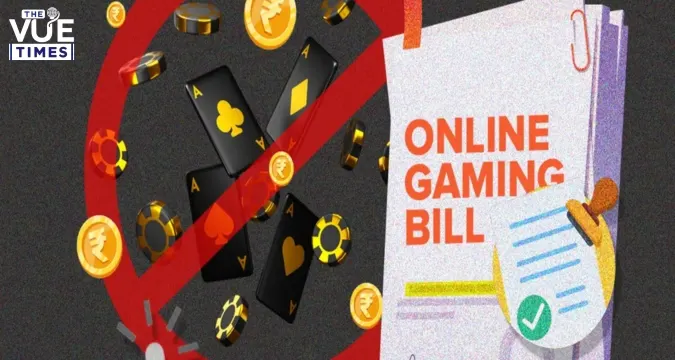
In October 2023, the government increased GST on real-money games to 28%, and industry observers say that was already reducing growth. The heavier punch came when earlier this week, the Union Cabinet gave the nod to the Promotion and Regulation of Online Gaming Bill, 2025.
The Bill suggests:
- The total prohibition of all real-money games websites.
- The possibility of criminal prosecution of operators and up to three years of jail time.
- Penalties of up to 10 lakh rupees to any person and businesses that facilitated the payments or promoted such sites.
- Bank and digital payment processor liability in the processing of gaming fund transactions.
- Restriction of celebrities who advertise gaming apps.
The Bill was circulated by the Ministry of Electronics and Information Technology (MeitY) and the Ministry of Home Affairs (MHA) on the grounds of money laundering, fraud, and mental health hazards.

A part of the Bill reads as follows:
“Individuals have fallen victim to financial losses… sometimes resulting in extreme outcomes. These platforms frequently employ predatory monetization tactics… and reward systems designed to exploit psychological triggers to increase spending.”
The Industry’s Pushback
The Federation of Indian Fantasy Sports (FIFS), the E-Gaming Federation (EGF) and the All India Gaming Federation (AIGF), which have the largest names in the field of gaming, replied vigorously. The industry bodies argued in their letter addressed to Amit Shah that:
- Outright prohibition would sound a death knell to a legitimate industry.
- This would create the loss of over 200,000 direct jobs and ripple effects on tech engineers, designers, content creators, and event managers.
- Almost 400 startups may be driven out.
- Even investor mood which has already been dulled by retrospective GST claims will further fail.
- Indian consumers would seek updates on the black foreign power, which would raise risk rather than decreasing them.
AIGF CEO, Roland Landers, reported:
“Thousands of startups, engineers and content creators rely on this ecosystem. The proposed ban would deter investment, destroy over 200,000 jobs, and wipe out ₹31,000 crore in annual revenues while ending tax contributions of over ₹20,000 crore.”
The Tax and Investment Angle
The tough stand of the government is also due at a time when the industry is already plagued with the retrospective demands of GST. In February, the Supreme Court started hearing appeals on 2 trillion claims cumulatively by GST on 6th financial years, FY17-FY22.

This led to an uncertainty and unbalanced balance sheets when it comes to startups. It was argued that they were paying taxes initiated with the currently known interpretations of the law and should not be punished retroactively.
The future of the sector is grim, should the new Bill pass:
- The foreign investments worth 25,000 crores may be written off.
- Continued expansion programmed into the tier-2 and tier-3 cities would fail.
- Annual tax revenues of 20,000 crore may disappear.
To an economy that aspires to be a digital global hub, critics argue that such a ban does not augur well with Digital India vision and the Startup India.
The Social Concerns
On one side of the argument, the concerns that are raised by the government cannot be easily dismissed.
The pandemic has both increased shared financial frauds, suicides and addictions related to the gaming industry, in India. Families have testified on loss of life savings to compulsive gaming. The police investigation has also found instances of money laundering having been exploited through gaming apps.

The argument by the government is that contrary to the casual game play, real-money games take vulnerable players along a harmful loop. Reward schemes, push notifications, and celebrity partnerships are used to tempt players into overspending.
Policymakers regard the dilemma between economic growth and public safety as a struggle between any two.
Expert Opinions
What a senior lawyer, who is also connected to the gaming industry, said to Mint is illustrative:
Unless the Bill is forwarded to a standing committee where it can be looked into in more detail there will be a ruthless and unjust termination of the industry. Not much input was sought and startups did not even have an opportunity to collaborate with regulators.”
Economists caution, however, of a two-fold effect:
- Immediate prohibition would kill thousands of jobs and lower tax collections.
- However, uncontrolled expansion of real-money gaming may cause a social crisis, particularly in low-financial-literacy rural and semi-urban India.
Other scholars propose a compromise regime-resolution, not a ban. Age-gating, spend controls, clear auditing, and licensing schemes are possible measures.
What Lies Ahead
The Bill will henceforth be presented to Parliament. Without changes, applications that give the Indian online real-money gaming industry billions of dollars in business would be closed in several months.
In response, industry bodies are lobbying to be taken to a select or standing committee where with greater consultation the Bill might change to a regulatory environment rather than a blanket ban. Yet the clock is striking.
Until then, it is a giant question mark to the 200,000 workers, 400 start-ups, and millions of users who make this industry the core.
Conclusion
The idea of online gaming ban in India is an expression of a deeper dilemma we all face as a nation state and that is the question of how do we weigh the two scales of economic opportunity and social responsibility? It is clear that the industry has provided employment and income plus international fame. Still, the dangers of both addiction and fraud and financial stress cannot be disregarded.
Comprehensive prohibition can protect in the short-term, but it can lead to driving users to illegal offshore platforms and eradicating innovation in the country. Regulated framework, instead, may protect users and retain employment and investments.
The stakes in an online gaming policy as Parliament considers the Promotion and Regulation of Online Gaming Bill, 2025, are high. Central to its considerations is one fundamental question: Will India go the prohibition route, or will the country develop a regulatory framework that favors both development and accountability?
The outcome will not only determine the future of a 2-trillion ₹ industry, but also the prospects of the Indian digital economy.