The gig economy in India is in a turnaround. Millions of Indians are employed as delivery partners, ride-hailing drivers, freelance professionals, and platform-based employees, so the recent judicial ruling on gig workers in India has created a new discussion on their legal status, rights, and protections. Not only is this a legal development, but this ruling can redefine work, employment and social security in the country.
Gig workers have supported the digital economy of India over the years with their operations being in a grey legal area. They were not fully acknowledged as staff or were not safeguarded as independent workers. The gig platform decision over India has now evoked a countrywide discussion of fairness, responsibility, and the future of platform-based workmanship.
This comprehensive explanation deconstructs the ruling, its history, what changes now and why it is significant to the economy and labor force of India.
Who Gig Workers Are in India
Platform-mediated workers Gig workers are people earning income by working on demand or in short-term or labor-intensive work. This will cover the use of apps in India to drive cab drivers, deliver food, and logisticians, content creators, freelancers, and home-service professionals.

Government estimates and policy debates show that the number of gig and platform workers in India is more than 7.7 million and this figure will mushroom with the advent of digital. These are the employees at the center of the urban service economy, and their status in terms of employment has always been undefined.
Gig workers, unlike regular employees, do not receive regular pay and benefits, paid leaves and social security paid by the employer. Simultaneously, they are not always in charge of algorithms, performance ratings, and platform policies, as their actions are usually subordinate to independent entrepreneurs.
This is the main contradiction of the issue of the gig workers legal status in India.

Why The Case of the Legal Status of Gig Workers Turned into a Court Case
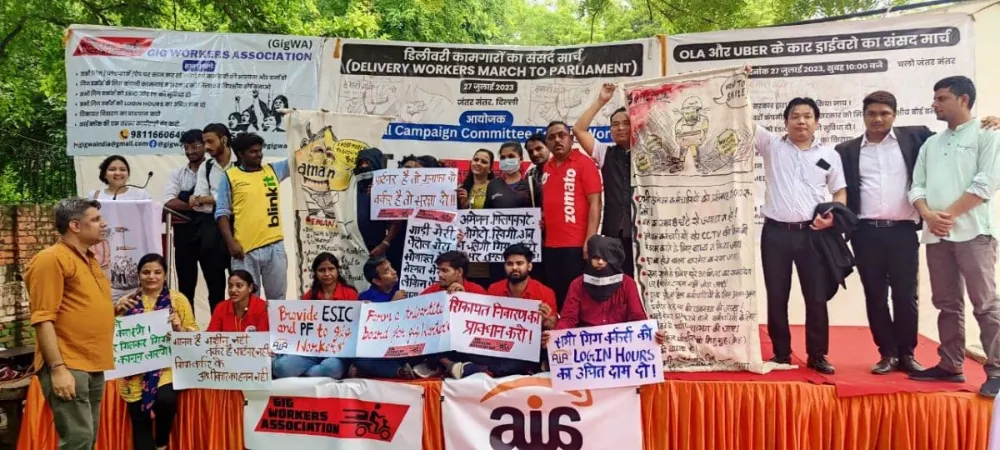
Among other issues, the gig workers in India have long lamented unfair deactivations, no minimum wages, no insurance, and unreliable incomes. Labour courts and high courts were approached by many claiming platforms rival control as an employer.

Issues that were put forward were:
- No certain minimum wage.
- None of the accidents and health insurance.
- Without any prior notification, accounts get suspended.
- Prolonged working hours with incentives.
- None of the collective bargaining rights.
With the number of these disputes growing, courts had to look into whether gig workers should still be considered as independent contractors or they should be accorded more protection.
This is what sometimes provoked a legal push which resulted in the current court decision regarding gig workers that currently defines the national discourse.

What the Recent Court Decision on Gig Employees States
The recent Indian court decision on gig workers does not automatically turn all gig workers into permanent workers. Nevertheless, it sends a striking message that simply being classified should not be used as a tool to deprive basic labour protections.
The court pointed out that contractual labels are less important compared to economic reality. When a platform sets prices, assigns work, incentivizes, and fines, it can never be entirely responsible to workers.
The major findings of the ruling are:
- Gig employees represent a special group that needs protection.
- Platforms enjoy the advantages of constant workforce, instead of on-demand services.
- In contemporary employment, social security is not an option.
- Constitutional values include worker dignity.
This ruling fortifies the claim that gig workers cannot be treated as a fungible commodity, but a fundamental success factor in the India growth story.
Supreme Court Gig Workers Decision and Its Greater Implication
Although several cases are still in its development, the Supreme Court gig workers decision observation has been vital in shaping individual lower courts and policymakers.
The Supreme Court recognized that:
- Conventional labour laws fail on digital platforms.
- The economic innovations require new laws.
- The welfare of the workers should be in line with technological change.
Although the court did not go as far as to grant blanket employee status, it made it clear that the gig economy in India cannot work in a regulatory vacuum.
This is a move towards inactive observation to active judicial participation.
The Implication of this Verdict in relation to Gig Worker Rights in India
Strengthening the rights of gig workers in India is one of the largest concerns of the verdict.
The ruling supports: Although policy and enforcement is to be ultimately implemented, it is upheld.
- Right to social security insurance.
- Insurance against unfair termination.
- Openness in compensation and rewarding schemes.
- Identification of employee complaints.
This is particularly relevant to delivery partners and drivers who rely fully on platform revenues to help their families.
This decision is a welcome change to many gig employees.
Life Impact: The Story of a Delivery Partner
Take the example of Ramesh who is a food delivery partner in a Tier-2 city. His income increased twofold when the demand burst during the pandemic. However, his earnings became unsustainable due to incentive reductions and increased fuel prices in the wake of the pandemic.
Since his deposit was at a critical stage and he was abruptly suspended because of the poor ratings, he did not have a formal complaint. The fact that gig workers are starting to become more the content of the stories such as his explains the reason why exploitation issues gain prominence in gig workers news India.
The observations made now by the court provide the workers such as Ramesh with a legal ground to demand justice.
Platforms and Company Impact
The decision regarding the gig economy India has a substantial concern upon the corporations that practice digital platforms.
Platoons can now be asked to:
- Donate to social security funds.
- Offer insurance coverage
- Transparency Transparency in algorithms will be enhanced.
- Create grievance redressal systems.
Companies contend that this may raise the cost base, but experts hold that it will also introduce stability, lower employee turnover as well as enhance service quality.
The judgment implies that there should not be development at the expense of the dignity of workers.
Response and Policy Direction by the Government
In addition to that, the government is already recognizing the necessity of changes via the Code on Social Security, which includes gig and platform workers as an additional category.
Based on talks in policy discussions, and estimates by NITI Aayog, the number of gig workers in India is projected to make close to 23 percent of the national workforce by 2030. Their well-being cannot be disregarded any longer.
The court decision reinforced the argument of introducing social security plans and regulatory transparency at a faster rate.
Gig Workers Employment Status India What Changes Now
The most repeated inquiry is whether or not gig workers have become employees.
The answer is nuanced.
The ruling does not pronounce the gig workers as full-time, but disapproves the notion that they are fully independent. Rather, it favors a middle employment position- one that is flexible and safe.
It is a global trend where nations are developing a hybrid type of workers in different countries.
History: The Way India got Here
The labour laws in India were structured towards the factories, offices and permanent jobs. These structures were broken by the emergence of apps-based work.
The first thing is that the gig work was glorified as empowering and flexible. With time though it has become evident that lack of security in flexibility results in vulnerability.
The discussion of the gig worker law India has changed into neglecting the existence of gig workers, to debating around the rights of the workers. The most recent judgment is the most notable step to this path up to date.
India Economic Effect on Gig Economy
The gig economy in India plays a major role in creating jobs, particularly to the youth and migrants.
Nevertheless, working conditions would become unstable and lower productivity and long-term sustainability. The decision promotes a more balanced environment in which employees feel safe and sites do not lose talent.
Economists claim that the protection of workers does not undermine growth, on the contrary, it enhances it.

The Comparison of this Verdict with that of the rest of the world
The right to recognition of the rights of gig workers has already been shifted towards, especially in countries such as the UK and the EU, globally.
The strategy of India seems to be conservative yet liberal. Courts are also advocating locally-specific solutions that are based on local realities in preference to importing foreign models.
This renders the court decision on gig workers especially significant to the developing economies.
A Guide to What Gig Workers Should Do Now
Gig workers should:
- Avoid being ignorant of their rights.
- Keep records and payment information of work.
- Interest in worker collectives or unions.
- Be a member of government registration programmes.
The key to empowerment is self-awareness.
Which Platforms Preparations should be made
Companies should:
- Review worker policies
- Investment in compliance systems.
- Enhance contact with employees.
- Get ready against regulatory audits.
Dynamic compliance will be superior to compliance.
Implementation Problems
Nevertheless, despite the judgment, there are still issues:
- Enforcement across states
- Resistance from platforms
- Lack of worker awareness
- Administrative capacity
Judicial bodies can put it in motion but it has to be implemented.
The Future of the Gig Economy in India
The most recent court decision on gig workers in India is not the applause but the start of change.
The future developments might involve:
- Clear national standards
- The accountability mechanisms of the platform.
- Full coverage of social security.
- Law on algorithmic management.
The gig economy of India is at the crossroad of unrestrained and accountable growth.
Workers, Companies and Policymakers: Some of the Lessons to Learn
For gig workers:
Be aware of your rights, be educated and organize.
For companies:
No longer a choice, but a necessity, fair treatment is a legal, ethical requirement.
For policymakers:
Any denial of time will enhance inequality. Action must follow intent.

Why This Ruling Is Important Outside of Courts
Gig worker decision is not just a matter of classification of the employment. It is concerning the ways of how India defends work, dignity, and justice in the digital era.
With the economy being transformed by platforms, legislation needs to be developed to safeguard those who drive it. This is a strong message that the court is trying to pass to India; the future of work in this country must be inclusive, just and humane.