Haryana Floods: A Crisis That Demands Attention
The 2025 monsoon has left its mark in severity and has impressed well in the north in India. Normally ranked as a state of fertile farming and high industrialization rates, Haryana is currently having to deal with one of the worst cases of flooding in decades. Over 3 lakh acres of agricultural land is flooded, rivers are overtopping danger levels and Faridabad, the industrial centre of Haryana, is gearing up to be hit with surplus water being discharged into the Yamuna by the Hathnikund barrage.
This is not a mere news bulletin circle but a bombshell local news story to tackle the larger questions of climate uncertainty, poor management of rivers, and not properly planning cities. To millions of the people residing in it is no longer just the amount of rain but a matter of life, how to adapt, how to make it so even the natural calamities are directly confronted by the government.
In this pictorial report to The Vue Times, we get further into the changing crisis, the causes, the reaction of the state to this crisis, the result of this crisis on agriculture and the economy, and the implications of this crisis on Haryana and future preparedness to this issue in India.
Haryana’s Wettest August in Two Decades
Meteorological Extremes
The India Meteorological department (IMD) announced that August 2025 will be the wettest in Haryana in the last 20 years. The amount of rainfall it has got is 32 percent excessive of the long-term average. The Faridabad district recorded 275 mm (approximately 31% higher than the normal level scaled as 275 mm). Excessive rain was seen at Gurugram, and at Ambala, and even in some districts of Karnal and Kaithal, the waters fell unabated and transformed arable land into water-lots.

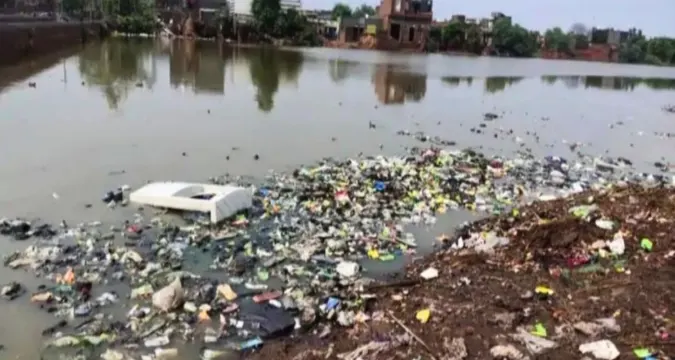
Such excessive precipitation has shattered several records, straining both the natural and artificial drainage systems. On average the earth is already totally saturated and therefore a single more rainfall will be immediately converted into surface runoff and overflowing of rivers.
Flood Warnings from Rivers
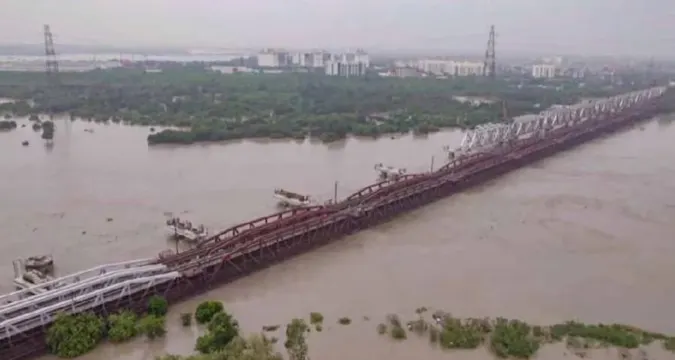
Major River Yamuna which runs along the Haryana-Delhi border broke its high-flood levels as well. The information flowing reached 3.29 lakh cusecs in Hathnikund barrage more than the danger of floods of 2.5 lakh cusecs at Yamunanagar. This caused a controlled downstream water release into the downstream regions such as Faridabad, Palwal, Sonipat and ultimately the Delhi NCR region.
The Ghaggar, Tangri, Markanda, and the Narwana canals are also in full spate and the towns of Ambala, Sirsa, and Kaithal are on high alert. The condition is volatile given that Himachal Pradesh and Uttarakhand–the upstream catchment areas–are expected to receive more rainfall than before.
Faridabad: The New Epicenter of Risk
Villages on High Alert
The city of Faridabad, an urban colony, with industries, agricultural lands and ranked as one of the fastest-growing districts in Haryana has turned out to be a hotspot of dangers. Officials marked 14 high-risk villages like Basantpur, Kidawali, Mahavatpur, Rajpur Kalan, Manjhawali, and Mohna as under a risk of flooding.

The administration has encouraged the residents to take refuge in safer places. Tents have been established in schools, community halls and panchayat bhawans. Food, clean drinking water, medicines, and backup electricity have also been stocked in each shelter.
Control Rooms and Helplines
The Faridabad district administration has activated dedicated helplines (0129-2227937, 0129-2226262) and real-time monitoring control rooms. Disaster responding teams, police and medical personnel are all on standby to respond to disasters like flash floods, highway collapses or blackouts.

Industrial and Urban Concerns
Compared to purely rural districts, this is a special problem of Faridabad: in this city are big industrial complexes and residential settlements that may actually be paralyzed by economic factors in case of increased flooding. Delhi-Agra highway (NH-19) and metro rail could also be disrupted in the case of even greater water flows.
Agricultural Devastation: The Farmer’s Nightmare
3 Lakh Acres Underwater
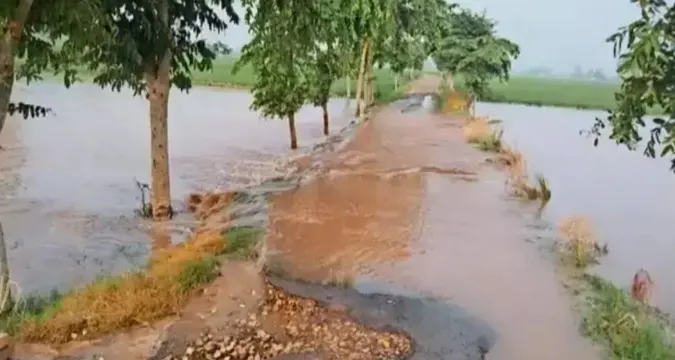
Flooding over 3 lakh acres of arable land is an enormous setback to the agricultural economy of Haryana. The state is also among the largest producers of wheat, rice, sugarcane, cotton, and vegetables in India. Pulses and paddy, which are standing crops at this age during the kharif, are mostly susceptible.
Sustained submergence of fields longer than 72 hours is sufficient to kill yields. Farmers in various villages of Kurukshetra, Karnal and Panipat complain that their harvest has been swept away by water and they have no fresh harvest to look forward to in this month.
Prices, Market and Food Security.
Haryana is a major producer of rice and vegetables in the food markets of the Delhi NCR. The supply disruption would achieve spikes in retail food prices and it would impact directly millions of urban consumers. This trickle-down effect of floods, field to kitchen, underscores why such general illumination news releases only begin on the farm, but take interest in every household.
Government Response: Emergency Mode
CM Monitoring and Cancellations
Nayab Singh Saini, Chief Minister, put off all official programs and was on the ground monitoring flood situations directly. There is continuous communication with the State Disaster Management Authority (SDMA) and district administrations on a daily basis.
The state government has:
- Suspended leaves of all field officers until the 5th of September.
- Instruction to chief district commissioners not to leave the ground.
- Deployed disaster relief troops, and NDRF teams to hot spots.
- Sequenced de-silting of flows and pumping activities in Gurugram and Faridabad.
Evacuation and Relief Packages
Preliminary response packages are being prepared in relation to crop gratification. However, farmers are concerned that the compensation may not be timely and may be inadequate to cover real losses. Delays in compensations of months in 2019 and 2023 floods in the south have been fertile sources of irritation.
Human Side of the Crisis
Stories of Displacement
To the people who live along the riverbank villages in Faridabad, it is not simply another rainy season. Families are scrambling to move livestock, food grains and household items to the highlands. Others have already lost cattle which is a very important economic asset in country households.
Children are skipping school and are farmers caught in the middle, with eroding waters taking away months of hard work. Waterlogging has entered the home, power cuts have become the order of the day and travelling is a nightmare to urban dwellers.
Health Concerns
The second crisis that floods usually cause is in the form of disease outbreaks. Stagnant water breeds mosquitoes which cause malaria and dengue. Contaminated water sources also expand the threat of diarrhea, cholera and skin illnesses. The district hospitals are making plans in case of a patient overload.
Historical Context: Haryana’s Tryst with Floods
Floods are not something new to Haryana, but the size of the incident of 2025 in this category is unparalleled. In 2010 and 2019, the Yamuna burst its banks and people of Faridabad and Sonipat suffered extensive losses. Nevertheless, flooding this year is aggravated by urban growth into floodplains coupled with climate change-driven rain variability.
Scholars claim that the vulnerability of the state has been aggravated by the uncontrolled real estate developments and floodplain zoning laws especially in lowlands.
Climate Change and Future Preparedness
Why Floods Are Becoming More Frequent
Scientists cite a direct relationship between climatic changes and rising occurrences of extreme precipitation. More moisture is trapped by warmer air which means heavy rain and unpredictable monsoons. The geographical location of Haryana is a natural catchment area due to the position between the rivers of Himalayas and urbanization of the NCR region.
What Needs to Change
- Floodplain Management: Strict regulations against anything being done on river banks.
- Resilient Crops: Encouragement of waterlogging resistant varieties.
- Early Warning Systems: Village warning systems.
- Improvements of Infrastructure: Embankments are sturdier, drainage is enhanced, and rainwater is collectable.
- Farmer Insurance: Rewarding losses by increasing crop insurance to cover the real losses.
Wider Implications: Why This Matters Beyond Haryana
Haryana floods are not a solitary case but an expansive nation-wide structural challenge on climate resilience. Haryana supplies water, food, and industry to Delhi NCR which has more than 3 crore people. This type of disruption can cause food prices, industrial production and everyday life in northern India to ripple.
Policy-wise, this flood crisis gives more weight to the argument of:
- Interstate Co-ordination of river water management with Himachal and Uttarakhand.
- Urban resilience planning of NCR.
- Investments by nations on the mitigation of floods using schemes such as the National Adaptation Fund on Climate Change.
Turning Crisis into a Lesson
Haryana is in a watershed time. The floods have wiped out farmlands and displaced the families and placed cities like Faridabad on the edge. However, they also provide an opportunity to India to re-examine its approach to dealing with natural disasters in a climate change world.
This is not only of the losses of the present day, it is also of the readiness of tomorrow. Floods do not have to be yearly tragedies with the right combination of technology, governance, and community interaction. Rather, they can be controlled incidents that do not bring about great losses to life, means of living, and development.
As The Vue Times keeps delivering the most recent news reports, trending news reports and breaking news features, the central idea is frequently stated: flood is natural, but disaster is man made. India is going to watch whether or not it will react in a manner that makes Haryana a protocol of what one can endure, or an unmarked story in the litany of climate coverage.