Introduction: Why Bail Is More Important Than Most People Realise
For most Indians, interaction with the criminal justice system happens unexpectedly, through a police call, an FIR involving a family member, or a news report that suddenly feels personal. In such moments, one word dominates conversations: bail.
Bail is not a technical loophole used by the powerful. It is a legal protection created to safeguard ordinary citizens from unnecessary imprisonment. Yet, confusion around bail rules in India is widespread. People often believe that arrest automatically means jail, or that bail is available only to the rich or well-connected. These assumptions are incorrect and harmful.
This article explains bail rules in India in simple language, without legal jargon. It answers real questions that arise in people’s minds, helps students understand core concepts, and empowers common citizens with clarity.

What Is Bail? A Simple Explanation for Everyone
In basic terms, bail means temporary freedom granted to a person who has been accused of a crime, on the condition that they will cooperate with the investigation and appear before the court when required.

Bail does not mean:
- The case is over
- The accused has been declared innocent
- The charges are false
Bail simply means the court believes that keeping the person in jail is not necessary at that stage.
The idea behind bail is simple:
Punishment should come only after conviction, not before.
Why Does the Law Allow Bail?
Indian law is built on the principle that every person is presumed innocent until proven guilty. Trials in India can take years. If bail did not exist, thousands of people, many of whom may later be found innocent, would spend years behind bars.

Bail exists to:
- Protect personal liberty
- Prevent overcrowding of prisons
- Ensure fairness in criminal proceedings
- Balance police power with judicial oversight
This is why Indian courts repeatedly state:
“Bail is the rule, jail is the exception.”
Constitutional Foundation of Bail in India
Although the word bail does not appear in the Constitution, it flows directly from Article 21, which guarantees the Right to Life and Personal Liberty.

The Supreme Court has clarified that:
- Arbitrary arrest violates Article 21
- Unnecessary detention violates dignity
- Denial of bail without reason is unconstitutional
Thus, bail is not charity, it is a constitutional safeguard.
Laws Governing Bail in India
Bail rules in India are mainly governed by:
- Code of Criminal Procedure, 1973 (CrPC)
- Indian Penal Code (IPC) / Bharatiya Nyaya Sanhita (BNS)
- Special criminal laws (NDPS Act, UAPA, PMLA, etc.)
- Judicial precedents laid down by higher courts
For common offences, CrPC plays the most important role.
Understanding Offences: Bailable vs Non-Bailable
Everything about bail depends on one basic question:
Is the offence bailable or non-bailable?
Bailable Offences Explained
Bailable offences are less serious offences where the law itself allows bail as a matter of right.
Examples include:
- Defamation
- Public nuisance
- Causing simple hurt
- Rash or negligent driving
- Criminal trespass (in many cases)
Key points for citizens:
- Bail is a legal right
- Police must grant bail
- Magistrate cannot refuse bail
- No discretion exists
If someone is arrested for a bailable offence and bail is denied, the denial itself is illegal.
Non-Bailable Offences Explained
Non-bailable offences are serious offences that may involve:
- Violence
- Grave social impact
- Severe punishment
Examples include:
- Murder
- Rape
- Dowry death
- Kidnapping
- Large-scale fraud
In such cases:
- Bail is not automatic
- Court examines facts carefully
- Police cannot grant bail (with rare exceptions)
However, non-bailable does not mean “no bail.” It only means bail depends on judicial discretion.
Who Has the Power to Grant Bail?
Different authorities have different powers:
- Police Officer – only in bailable offences
- Judicial Magistrate – most common bail authority
- Sessions Court – serious offences
- High Court – wide powers
- Supreme Court – final authority
Higher courts can grant bail even if lower courts refuse.

Types of Bail in India
1. Regular Bail
Regular bail is granted after arrest.
Applied when:
- Accused is already in custody
- FIR is registered
- Police investigation has started
Regular bail applications are most common in Indian courts.
2. Anticipatory Bail
Anticipatory bail is sought before arrest, when a person reasonably fears arrest in a non-bailable offence.
Why it matters:
- Prevents unnecessary humiliation
- Protects reputation
- Stops misuse of arrest power
Courts may impose conditions such as:
- Joining investigation
- Not leaving the country
- Not influencing witnesses
Anticipatory bail is a powerful shield for personal liberty.
3. Interim Bail
Interim bail is temporary bail granted for a short duration.
Used when:
- Bail hearing is pending
- Immediate relief is needed
- Medical or personal urgency exists
It bridges the gap until the final decision.
4. Default Bail (Statutory Bail)
Default bail is granted when police fail to complete an investigation within the prescribed time.
Time limits:
- 60 days for less serious offences
- 90 days for serious offences
This is not judicial generosity, it is a legal right of the accused.
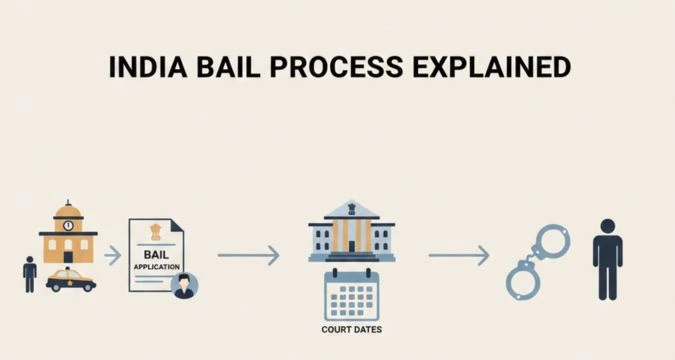
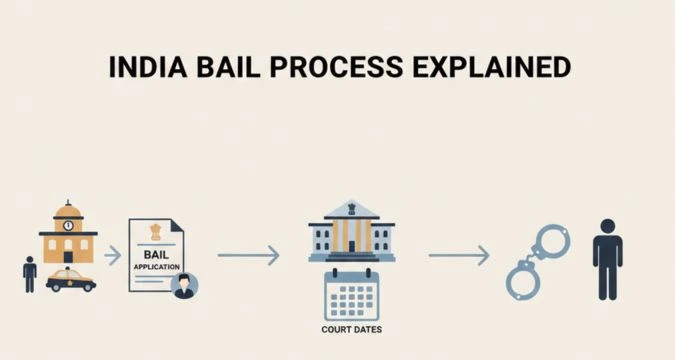
Step-by-Step Bail Procedure
Step 1: Arrest or Apprehension
- Person is arrested, or
- Person fears arrest
Step 2: Bail Application
- Prepared by lawyer
- Filed before appropriate court
- Mentions facts, grounds, and legal provisions
Step 3: Court Hearing
Court considers:
- Nature of offence
- Evidence on record
- Criminal history
- Possibility of absconding
- Impact on society
Step 4: Bail Order
If granted, court specifies:
- Bail amount
- Conditions
- Surety requirements
Bail Amount: How Courts Decide
There is no fixed bail amount under Indian law.
Courts consider:
- Financial condition of accused
- Gravity of offence
- Likelihood of fleeing
- Social roots
The Supreme Court has clearly stated that bail should not become punishment because of poverty.
Bail Conditions: What Citizens Should Know
Common conditions include:
- Personal bond execution
- One or more sureties
- Regular court appearance
- No contact with witnesses
- No travel without permission
Violation of conditions can lead to cancellation of bail.
Special Consideration in Bail Matters
Bail for Women
Courts follow a liberal approach for women, even in non-bailable offences, unless the crime is extremely grave.
Bail for Children
Children are dealt with under the Juvenile Justice Act, where bail is the rule.
Bail for Elderly and Sick Persons
Health conditions and age are strong grounds for bail.
Bail Under Special Laws: Why It Is Tougher
Certain laws restrict bail:
- NDPS Act
- UAPA
- PMLA
Courts require:
- Prima facie innocence
- Satisfaction of strict conditions
However, even under these laws, bail is not completely barred.
Can Bail Be Cancelled?
Yes. Bail can be cancelled if:
- Accused misuses liberty
- Threatens witnesses
- Commits another offence
- Violates conditions
Cancellation can be sought by:
- Police
- Prosecution
- Complainant
Bail vs Parole vs Furlough (Common Confusion)
| Feature | Bail | Parole | Furlough |
| Stage | During trial | After conviction | After conviction |
| Purpose | Temporary liberty | Emergency release | Periodic leave |
| Authority | Court | Prison authority | Prison authority |
Common Myths About Bail in India
Myth: Bail means the accused is innocent
Truth: Bail has nothing to do with guilt
Myth: Only rich people get bail
Truth: Courts increasingly protect poor accused
Myth: Police can refuse bail anytime
Truth: Not in bailable offences
Practical Advice for Common Citizens
- Always ask whether offence is bailable
- Demand grounds of arrest
- Apply for bail immediately
- Follow conditions strictly
- Seek legal help early
Knowledge of bail rules can prevent unnecessary suffering.
Importance of Bail in a Democratic Society
Without bail:
- Prisons would overflow
- Innocent people would suffer
- Police power would go unchecked
Bail preserves:
- Human dignity
- Rule of law
- Constitutional morality
Frequently Asked Questions (FAQs)
Is bail a fundamental right?
Bail itself is not a fundamental right, but it flows from Article 21.
Can police deny bail in bailable offences?
No. Denial is illegal.
Is anticipatory bail available in all cases?
No, but courts decide case-by-case.
Can bail be granted in serious offences?
Yes, depending on evidence and circumstances.
What happens if bail conditions are violated?
Bail can be cancelled and arrest ordered.
Can bail amount be reduced?
Yes, courts can modify bail conditions.

Conclusion: Bail Is Not a Favour, It Is a Right-Based Protection
Bail is one of the strongest protections against misuse of state power. It ensures that justice remains humane, balanced, and constitutional.
For common citizens, understanding bail rules in India is not just legal knowledge, it is self-defence against injustice. A society that understands bail is a society that values liberty.
Justice in India must begin with fairness, not confinement.