One of the most consistent reasons aspirants lose marks in descriptive papers is writing Generic Answers in Government Exams. These answers appear relevant but lack depth, specificity, and structured enrichment. They read like textbook summaries rather than exam-ready responses tailored to the question.
Examiners do not reward surface-level familiarity. They reward clarity, specificity, structured argument, and applied understanding. A generic answer may cover broad points, but it fails to demonstrate analytical control. This article provides a structured system to eliminate generic writing and replace it with targeted content enrichment techniques that improve scoring precision.
Problem Statement
The Core Mistake
Most aspirants:

- Write broad, safe statements.
- Avoid specific examples.
- Use repetitive phrases.
- Add textbook definitions without application.
- Fail to tailor answers to directive words.
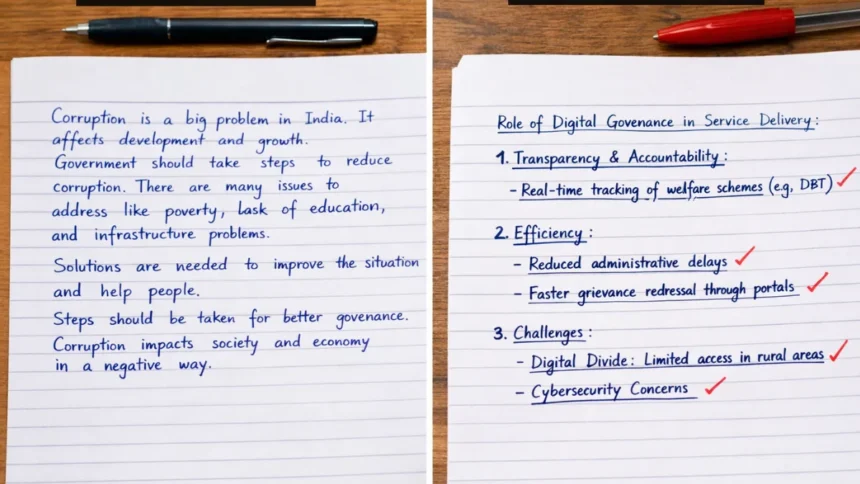
Example of generic writing:
“Corruption is a major issue in India and affects development.”
This statement is factually correct but exam-weak. It adds no dimension, no example, no structure.
Generic writing results from:
- Fear of being incorrect.
- Lack of structured practice.
- Insufficient value addition material.
- Poor understanding of examiner expectations.
In competitive exams conducted by bodies like the Union Public Service Commission, answer differentiation determines rank. When 80% of candidates write similar lines, only enriched answers move into higher scoring brackets.

Concept Clarity
What Are Generic Answers in Government Exams?
Generic answers:
- Stay at surface level.
- Avoid specifics.
- Use vague adjectives.
- Lack structured dimensions.
- Do not reflect current relevance.
Non-generic answers:
- Include examples.
- Mention institutions, data, reports.
- Show cause–effect clarity.
- Align strictly with directive word.
- Offer applied analysis.

The Difference in One Line

Generic writing states facts.
Enriched writing demonstrates understanding.
Understanding Content Enrichment
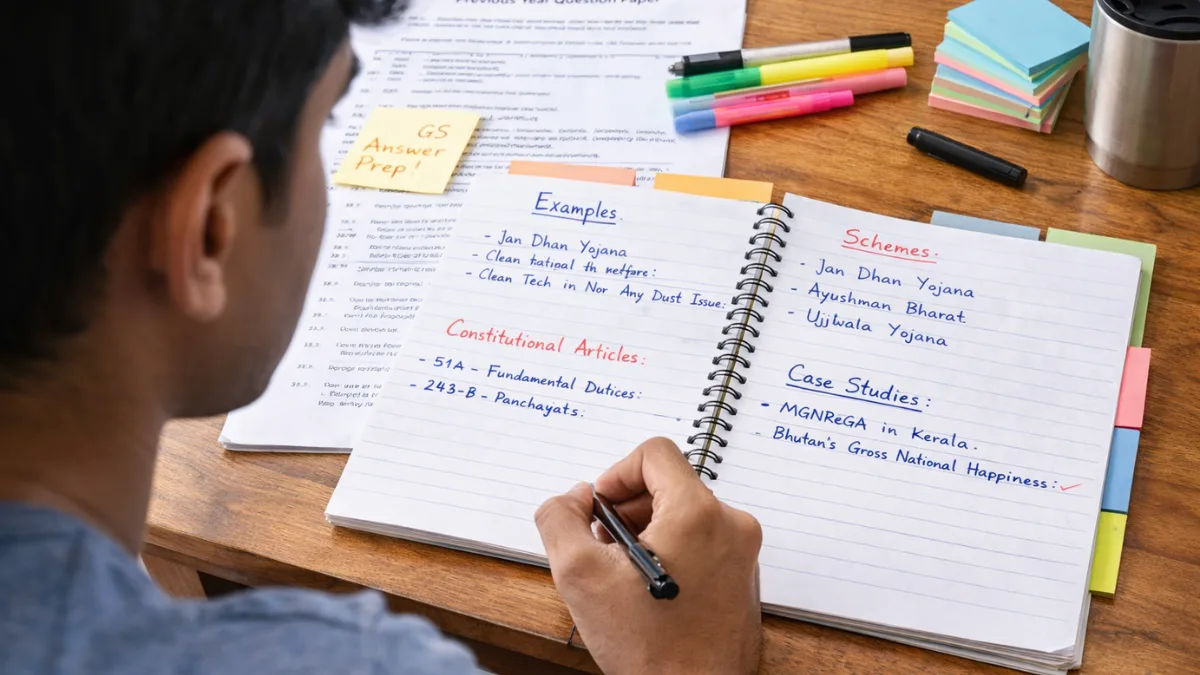
Content enrichment means adding:
- Specific examples
- Constitutional references
- Schemes and policies
- Data points (if remembered correctly)
- Case studies
- Comparative perspective
- Diagrammatic support (if time permits)
It is not about adding more words. It is about adding sharper relevance.
Practical Framework
H2: Eliminating Generic Answers in Government Exams
To systematically eliminate generic writing, follow this structured approach.
Decode the Directive Word
Before writing:
- Discuss → Provide multiple dimensions.
- Analyse → Show cause-effect.
- Critically examine → Present strengths + limitations.
- Evaluate → Provide final judgement.
Generic answers ignore directive alignment.
Add One Layer of Specificity Per Paragraph
Every body paragraph must include at least one enrichment element:
- Example
- Data
- Scheme
- Institutional reference
- Real case
Use the 4-Dimension Method
For any governance or society question, think across:
- Social dimension
- Economic dimension
- Political/Institutional dimension
- Technological/Administrative dimension
Generic answers stay in one dimension.
Structure Answer Clearly
Follow:
- Introduction
- Thematic body headings
- Short conclusion
Structured presentation reduces generic appearance.
Replace Vague Words
Instead of:
- “Very important”
- “Major problem”
- “Many challenges”
Use:
- “Institutional constraints”
- “Fiscal imbalance”
- “Administrative inefficiencies”
Precision reduces generic tone.
Model Answer Snippet (Short Format)
Question: Analyse the role of digital governance in improving service delivery.
Generic Version:
Digital governance improves transparency and efficiency. It reduces corruption and helps citizens.
Enriched Version:
Digital governance enhances service delivery by reducing administrative discretion, enabling real-time tracking of welfare schemes, and improving transparency through platforms like direct benefit transfer systems. However, digital exclusion and infrastructure gaps limit uniform implementation.
This enriched answer:
- Adds mechanism.
- Adds limitation.
- Demonstrates analytical depth.
- Avoids vague wording.
Mistake vs Correct Approach Comparison
| Generic Approach | Why It Fails | Correct Approach |
| “Education is important for development.” | Too broad | “Improved female literacy directly correlates with workforce participation and demographic dividend realization.” |
| No example | Lacks proof | Add one policy example |
| Only advantages | One-sided | Add limitation |
| Repeated keywords | Redundant | Add layered argument |
| Long paragraph | Hard to read | Use subheadings |
Common Errors
Overuse of Textbook Definitions
Starting every answer with dictionary-style definitions wastes space.
Instead:
Provide contextual introduction relevant to question.
Avoiding Examples Due to Fear
Many students avoid adding examples fearing factual error. Instead of statistics, use structural examples.
Writing Safe but Empty Lines
Example:
“The government must take necessary steps.”
This is policy-empty writing.
Ignoring Current Relevance
Even static topics benefit from current linkage.
Example:
While writing about federalism, briefly link to inter-state fiscal issues.
Writing Identical Introductions Across Questions
Repetitive format signals mechanical preparation.
Tactical Application: How It Improves Marks
Examiners assess:
- Depth
- Relevance
- Analytical quality
- Completeness
Non-generic answers:
- Move into higher evaluation band.
- Show maturity.
- Demonstrate preparation beyond surface level.
- Reduce competition overlap.
In descriptive papers conducted by institutions like the Staff Selection Commission, structured and enriched answers often outperform verbose but shallow copies.
Even a 1-mark improvement per answer across 20 questions significantly changes final outcome.
Content Enrichment Bank Creation
To avoid generic writing, build a small enrichment repository.
Create 5 Lists:
- Constitutional Articles (selective)
- Important committees
- Recent schemes
- Governance principles
- Key reports
Review weekly.
Daily Improvement Plan
30-Minute Daily Drill
- Take 2 previous year questions.
- Write only body paragraphs.
- Ensure each paragraph contains one enrichment element.
Weekly Exercise
- Rewrite one old generic answer.
- Compare both versions.
- Highlight improvements.
Self-Evaluation Checklist
After writing answer, ask:
- Did I include at least one example?
- Did I show cause-effect?
- Did I add limitation?
- Is language precise?
- Is structure visible?
If 3 answers are “No,” rewrite.
Integrating with Broader Strategy
To systematically reduce Generic Answers in Government Exams:
- Practice answer structuring.
- Improve directive alignment.
- Build enrichment notes.
- Focus on precision over length.
For related guidance, see:
[How to Structure 10 and 20 Mark Answers]
[Writing Effective Conclusions in Government Exams]
[Directive Words in Government Exams Explained]
Advanced Refinement
Once basics improve:
- Add mini diagrams.
- Use flowcharts.
- Add comparative perspective.
- Use short subheadings.
- Add conditional judgement in conclusion.
These small additions separate average from high-scoring scripts.

Conclusion
Avoiding Generic Answers in Government Exams requires deliberate structural discipline and systematic content enrichment. Generic responses arise from safe but shallow writing. Enriched answers demonstrate applied understanding, analytical depth, and directive alignment. By adding specific examples, institutional references, structured dimensions, and precise language, aspirants reduce overlap with competitors and improve scoring clarity.
Consistent practice, targeted enrichment banks, and strict self-evaluation eliminate Generic Answers in Government Exams and produce answers that are complete, differentiated, and examiner-ready.