


Serious government exam aspirants often collect dozens of books, coaching notes, and test series. Yet many fail to systematically study the most valuable preparation resource — Previous Year Questions Analysis.
Simply solving old papers is not enough. The real advantage comes from understanding patterns, recurring themes, conceptual focus, and exam trends through structured analysis. When used correctly, previous year questions (PYQs) reveal how an exam thinks.
This article explains a practical Previous Year Questions Analysis framework that aspirants can apply immediately to improve accuracy, speed, and scoring ability.
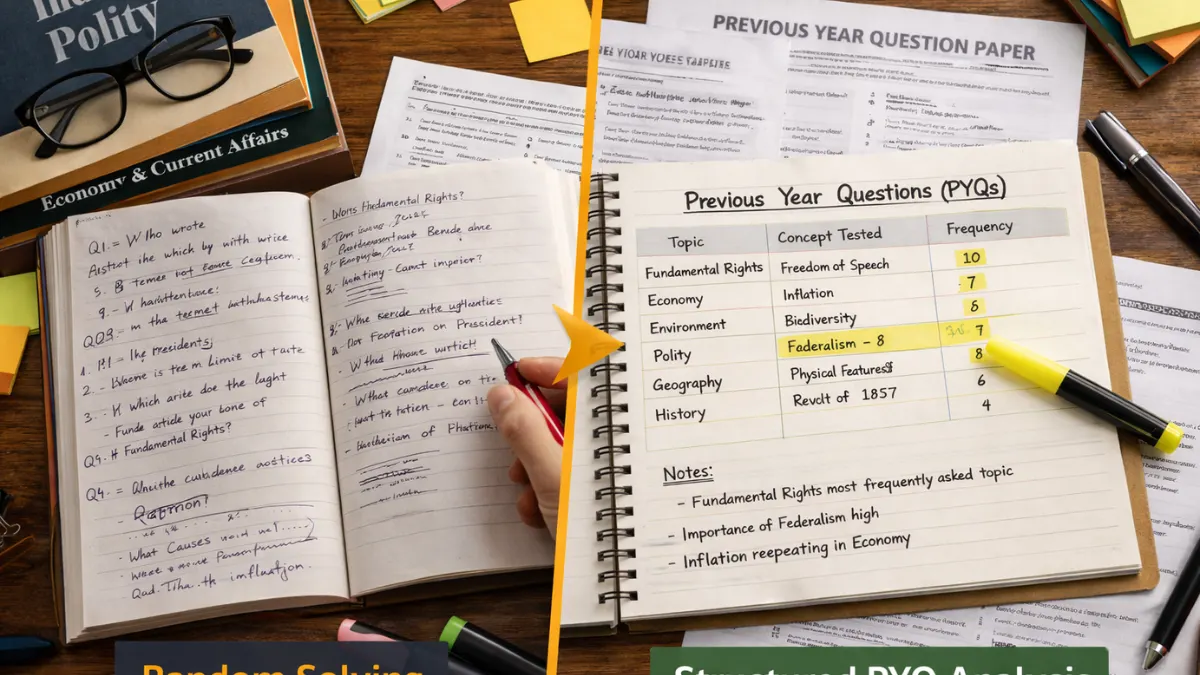
Problem Statement: Why Students Fail to Use PYQs Properly
Most aspirants attempt previous year questions casually. They solve a few questions after finishing a topic and then move on. This approach leads to three major preparation problems.
Random Solving Without Pattern Identification
Students treat PYQs like practice exercises rather than data about the exam pattern. As a result, they miss the opportunity to identify recurring question formats.
Topic Blindness
Many aspirants read entire textbooks equally, even though exams repeatedly focus on specific subtopics. Without PYQ analysis, it becomes difficult to identify what actually matters.
No Trend Tracking
Government exams evolve gradually. Question difficulty, conceptual depth, and subject weightage change over time. Students who don’t analyze PYQs fail to detect these shifts.
The solution is not just solving questions but performing structured Previous Year Questions Analysis.
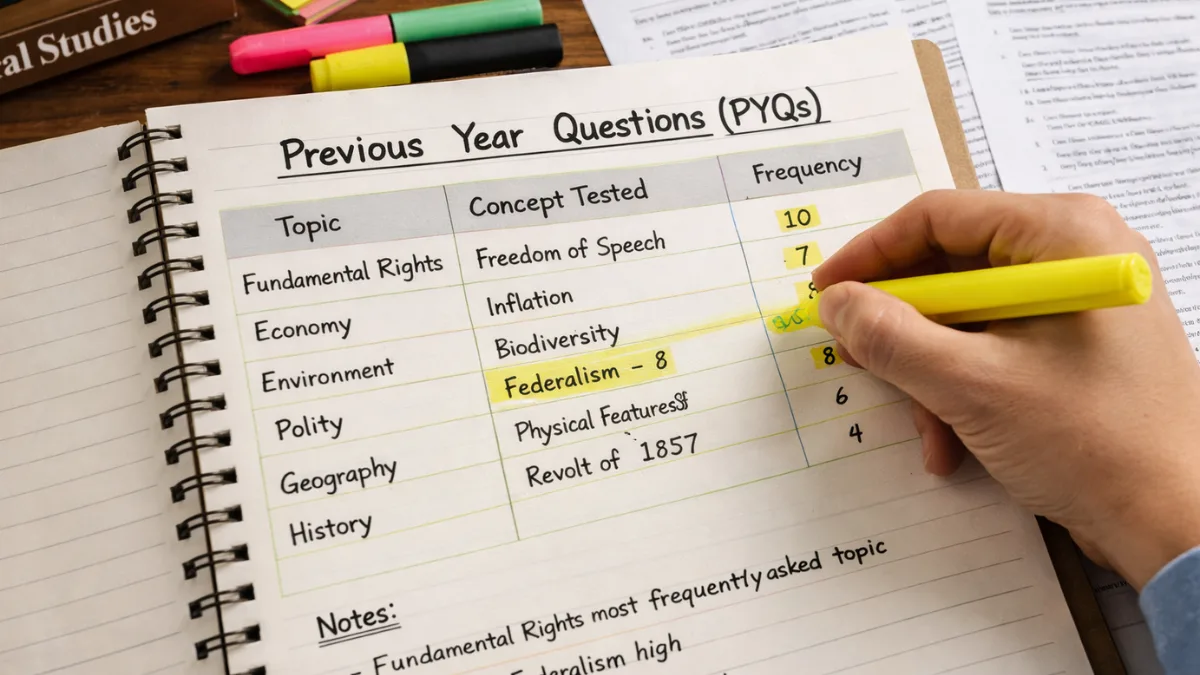
Concept Clarity: What Previous Year Questions Analysis Actually Means
Previous Year Questions Analysis is a methodical process of studying exam questions to decode the examiner’s mindset.
Instead of asking:
“Can I solve this question?”
You ask:
- Why was this question asked?
- Which concept does it test?
- How often does this topic appear?
- What pattern does the exam follow?
Three Layers of PYQ Strategy
A strong PYQ strategy works on three levels:
Level 1 — Topic Mapping
Identify which topics appear most frequently.
Example:
| Subject | Repeated Subtopics |
| Polity | Fundamental Rights, Federalism |
| Economy | Inflation, Monetary Policy |
| Environment | Biodiversity Conventions |
Level 2 — Question Type Identification
Exams usually repeat similar formats:
- Direct concept question
- Statement-based question
- Application-based question
- Current affairs linked question
Recognizing the type improves solving accuracy.
Level 3 — Difficulty Pattern
Some exams shift from factual questions to conceptual questions. PYQ analysis helps predict this shift.
Practical Framework: Step-by-Step Previous Year Questions Analysis
Aspirants should follow a structured system while analyzing previous year questions.
Collect 10–15 Years of Questions
Start by compiling questions topic-wise rather than year-wise.
For example:
Polity → Fundamental Rights → All Questions from 2010–2024
This reveals patterns clearly.
Step 2: Categorize Each Question
For every question, label it with three attributes:
- Topic
- Concept depth
- Question type
Example:
| Question | Topic | Type |
| Freedom of speech limits | Fundamental Rights | Conceptual |
| Article identification | Constitution Articles | Factual |
This categorization builds exam awareness.
Identify Repetition Frequency
Count how often a topic appears.
Example:
| Topic | Frequency |
| Federalism | 8 times |
| Directive Principles | 5 times |
| Emergency Provisions | 2 times |
This helps prioritize revision.
Extract the Core Concept
Every question tests a core concept.
Example Question:
Which of the following are features of Indian federalism?
Core Concept:
Division of powers between Union and States
Students should revise the concept, not just the answer.
Build Concept Notes From PYQs
Instead of making notes from textbooks, create notes based on questions asked in the exam.
Example structure:
Topic: Federalism
Include:
- Constitutional articles
- Centre-state powers
- Finance Commission
- Recent federal disputes
This aligns preparation with the exam pattern.
Example: Model Answer Snippet
Here is a short model structure used in descriptive exams.
Question:
Explain the significance of federalism in India.
Model Answer Snippet
Introduction:
Federalism refers to the constitutional division of power between central and regional governments.
Body:
- Promotes administrative efficiency
- Protects regional diversity
- Enables decentralized governance
Example:
- Finance Commission recommendations
- GST Council cooperative federalism
Conclusion:
Federalism strengthens democratic governance by balancing unity with regional autonomy.
This structure demonstrates how understanding PYQ patterns helps frame answers.
Mistake vs Correct Approach
| Mistake | Correct Approach |
| Solving PYQs randomly | Topic-wise analysis |
| Memorizing answers | Understanding concepts |
| Ignoring repeated themes | Prioritizing high-frequency topics |
| Solving once | Revising PYQs multiple times |
This shift dramatically improves exam readiness.
Common Errors in Previous Year Questions Analysis
Even students who practice PYQs often make analytical mistakes.
Error 1: Treating PYQs as Mock Tests
Many aspirants attempt previous year papers under exam conditions but never study them deeply afterward.
The real value comes from post-analysis.
Error 2: Ignoring Incorrect Questions
Students often skip questions they get wrong instead of studying the concept behind them.
Every wrong answer reveals a conceptual gap.
Error 3: No Pattern Recording
Aspirants rarely maintain a record of recurring topics. Without documentation, patterns remain unnoticed.
Error 4: Overlooking Statement-Based Questions
Many government exams increasingly use statement-based questions. These require conceptual clarity rather than factual memory.
Without analyzing PYQs, students struggle with this format.
Error 5: Focusing Only on Recent Years
While recent papers are important, older questions still reveal long-term patterns.
Ignoring them reduces analytical depth.
Tactical Application: How PYQ Strategy Improves Marks
A well-executed PYQ strategy directly improves exam performance in multiple ways.
Targeted Preparation
Instead of reading entire textbooks repeatedly, students focus on high-probability topics.
Faster Question Recognition
When aspirants have analyzed hundreds of PYQs, many questions appear familiar in structure.
This speeds up decision-making in objective exams.
Better Elimination Technique
Understanding question patterns improves option elimination.
Example:
If a question includes an extreme statement, it is often incorrect.
PYQ analysis helps identify such patterns.
Improved Answer Writing
For descriptive exams, analyzing PYQs teaches:
- Answer structure
- Expected depth
- Use of examples
This increases scoring potential.
Smart Revision
Instead of revising entire subjects, aspirants revise PYQ-linked concepts, making revision faster and more focused.
Improvement Plan: Weekly Execution Strategy
To fully benefit from Previous Year Questions Analysis, aspirants must integrate it into their weekly study schedule.
Daily Method (30–40 Minutes)
- Solve 10–15 PYQs from one topic.
- Mark incorrect questions.
- Revise the underlying concept.
- Update notes.
Weekly Method
| Day | Task |
| Monday | Solve Polity PYQs |
| Tuesday | Economy PYQs |
| Wednesday | Environment PYQs |
| Thursday | History PYQs |
| Friday | Geography PYQs |
| Saturday | Analyze mistakes |
| Sunday | Revise PYQ notes |
This routine gradually builds exam intelligence.
Monthly Pattern Review
At the end of each month:
- Identify frequently asked topics
- Update priority list
- Adjust study focus
This ensures preparation remains aligned with the exam pattern.
Use PYQs Before Studying a Topic
An effective trick used by toppers is:
- First read PYQs related to a topic.
- Then study the textbook.
This immediately highlights what information matters.
Internal Resources for Further Preparation
Aspirants should integrate PYQ analysis with broader preparation strategies.
Internal reading suggestions:
- [Daily Answer Writing Strategy Guide]
- [Static and Current Affairs Integration Method]
- [Improving Writing Speed in Government Exams]
These complementary strategies strengthen overall preparation.
More Read

Conclusion
For serious aspirants, solving previous year papers is not enough. What truly improves performance is systematic Previous Year Questions Analysis.
By studying patterns, identifying frequently tested concepts, and categorizing question types, students gain a deep understanding of how exams are designed.
A structured PYQ strategy transforms preparation from random reading into focused learning. It allows aspirants to prioritize important topics, recognize question patterns quickly, and frame stronger answers.
When practiced consistently, Previous Year Questions Analysis becomes one of the most powerful tools for improving accuracy, reducing preparation time, and maximizing scores in government examinations.