
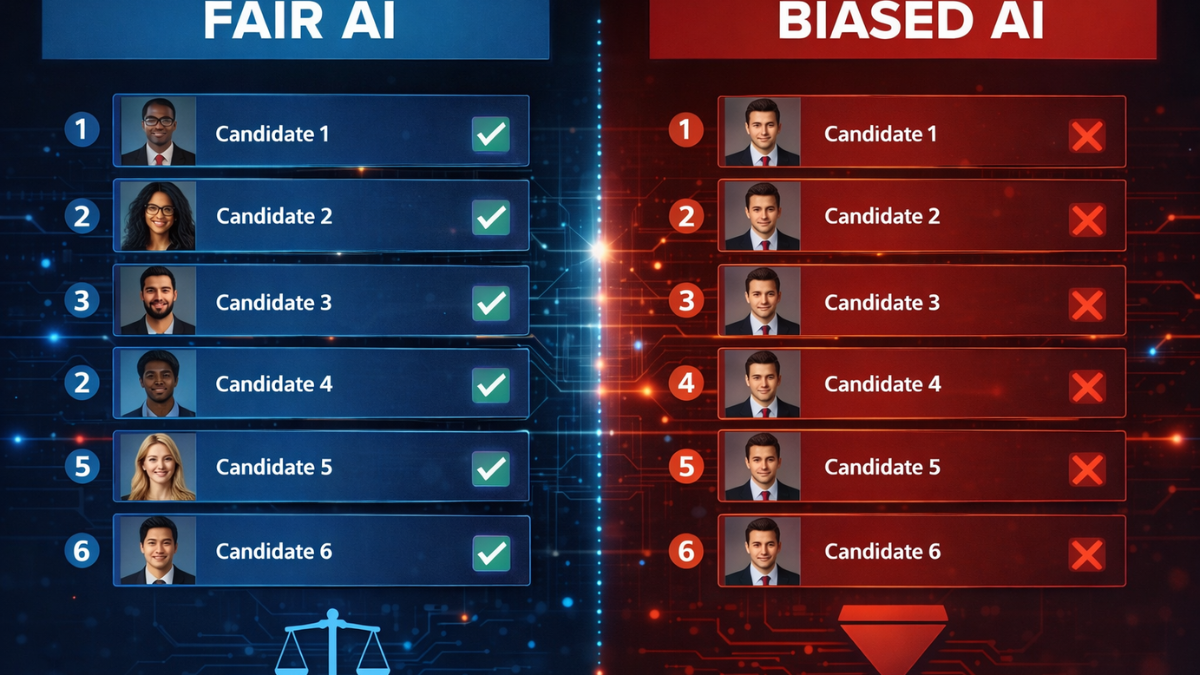
A hiring manager scrolls through a list of candidates. The system has already ranked them. Efficient, fast, seemingly neutral. But something feels off. Every top candidate shares similar backgrounds, similar education, similar demographics. No one asked the system to discriminate—yet somehow, it did.
This is where the conversation begins—not with code, but with consequences.
What Is AI Ethics? It’s the uncomfortable, necessary question that emerges when algorithms stop being tools and start becoming decision-makers. And increasingly, those decisions aren’t small. They influence who gets hired, who gets a loan, what news people see, and even how governments monitor citizens.
The technology may be complex. The moral dilemma isn’t.

What Is AI Ethics? Understanding the Core Idea
But simplicity ends there.
Unlike traditional machines, AI systems don’t just follow instructions—they learn patterns. And those patterns often come from real-world data, which carries all the imperfections of society itself. Bias, inequality, and historical prejudice don’t stay outside the system; they quietly enter through datasets.
Ethics, then, isn’t an optional layer. It becomes the only way to question outcomes that “look correct” but feel wrong.
From Theory to Reality: How AI Ethics Became Urgent
For years, AI was treated as a technical field—something engineers handled behind closed doors. That changed when the results became visible.

A facial recognition system misidentifies individuals from certain ethnic groups more frequently. A credit scoring algorithm quietly disadvantages applicants from specific neighborhoods. A recommendation engine pushes extreme content because it keeps users engaged longer.
None of these systems were designed with malicious intent. Yet their outcomes created real-world harm.
That’s when policymakers, businesses, and researchers began asking: If machines can learn from us, who is responsible when they replicate our worst patterns?

The rise of generative AI only intensified this concern. Suddenly, AI wasn’t just analyzing the world—it was producing content, influencing perception, and shaping public discourse at scale.
Ethics moved from academic debate to public necessity.
Why “What Is AI Ethics?” Matters More Than Ever
The urgency isn’t theoretical. It’s structural.
AI now sits at the center of decision-making across industries. Healthcare systems use it to suggest diagnoses. Financial institutions rely on it to assess risk. Governments experiment with it for surveillance and policy design.
In each case, the stakes are human.
What makes AI different from previous technologies is its invisibility. Decisions appear automated, objective, even neutral. But behind every output is a chain of human choices—what data was used, how the model was trained, what metrics define “success.”
Ethics forces us to look at those hidden layers.
Without it, efficiency becomes a dangerous excuse. Faster decisions aren’t better if they amplify injustice.
Bias: The Invisible Problem at the Heart of AI
One of the most discussed aspects of What Is AI Ethics? is bias—and for good reason.
AI systems don’t invent bias; they inherit it.
If historical hiring data reflects a preference for certain groups, the algorithm learns that pattern. If policing data is skewed toward specific communities, predictive systems reinforce that imbalance. The machine doesn’t question the data—it optimizes it.
And that’s the problem.
Bias in AI isn’t always obvious. It hides behind accuracy metrics and statistical models. It operates quietly, consistently, and at scale.
Correcting it requires more than technical fixes. It demands awareness, accountability, and, often, uncomfortable questions about the society that produced the data in the first place.
Transparency vs. Complexity: The Black Box Dilemma
Another layer of AI ethics lies in understanding how decisions are made.
Many advanced AI systems operate as “black boxes.” They produce results, but even their creators can’t fully explain how those results were derived.
This creates a paradox.
We rely on systems we don’t fully understand to make decisions that affect lives. When something goes wrong, accountability becomes blurred.
Who is responsible? The developer? The company? The algorithm itself?
Transparency isn’t just about technical clarity—it’s about trust. Without it, users are expected to accept decisions without explanation, which fundamentally challenges the idea of fairness.
The Business Angle: Ethics as Strategy, Not Compliance
For companies, AI ethics is often framed as a compliance issue—something to address to avoid legal trouble.
That’s short-sighted.
Ethics is rapidly becoming a competitive advantage.
Consumers are more aware. Regulators are more active. And reputational damage travels faster than ever. A single biased system can undermine years of brand building.
More importantly, ethical AI leads to better outcomes. Systems designed with fairness and inclusivity in mind tend to perform more reliably across diverse populations.
In that sense, ethics isn’t a constraint. It’s a design principle.
The companies that understand this aren’t just avoiding risk—they’re building trust.
Human Psychology and the Illusion of Objectivity
There’s a deeper reason why What Is AI Ethics? resonates beyond technology—it challenges how humans perceive authority.
People tend to trust machines. A decision made by an algorithm often feels more objective than one made by a person, even when that’s not true.
This creates a dangerous illusion.
When humans make biased decisions, they can be questioned. When machines do, the bias is often hidden behind perceived neutrality.
Ethics disrupts that illusion. It reminds us that AI systems are extensions of human choices, not replacements for them.
Regulation and the Global Push for Responsible AI
Governments are beginning to respond.
From the European Union’s AI regulations to evolving policies in the United States and India, there’s a growing recognition that AI cannot operate without oversight.
But regulation alone isn’t enough.
Technology evolves faster than law. By the time a policy is implemented, the system it was designed for may already be outdated.
That’s why ethical responsibility cannot rest solely on regulators. It must be embedded within organizations, development teams, and decision-making processes from the start.
Ethics works best when it’s proactive, not reactive.
Where It’s Headed: The Future of AI Ethics
The conversation is shifting.
Earlier debates focused on whether AI should be regulated. Now, the focus is on how.
Future AI systems will likely be evaluated not just on performance, but on fairness, explainability, and societal impact. Ethical audits could become as standard as financial ones. Transparency reports may evolve into industry norms.
At the same time, the line between human and machine decision-making will blur further.
That raises a more profound question: As AI becomes more capable, how much control are we willing to delegate?
The answer won’t come from technology alone. It will come from values.
More Read

Conclusion: Ethics Is the Real Intelligence Test
The real test of artificial intelligence isn’t how smart the system becomes.
It’s how responsibly we choose to use it.
What Is AI Ethics? isn’t just a technical question—it’s a reflection of priorities. It asks whether innovation will be guided by convenience or conscience, speed or fairness, profit or responsibility.
Because in the end, AI doesn’t define the future.
The choices behind it do.
Final Insight
As AI systems quietly shape decisions across hiring, healthcare, finance, and governance, the absence of ethical thinking becomes more dangerous than flawed code. The real conversation is no longer about what AI can do—but what it should do.
VUE TIMES Insight:
The future won’t be decided by smarter machines—but by wiser humans who design them.-THE VUE TIMES
Frequently Asked Questions
What is AI ethics?
AI ethics refers to the principles that guide the development and use of artificial intelligence to ensure fairness, transparency, accountability, and respect for human rights.
Why is AI ethics important?
It prevents harmful outcomes like bias, discrimination, and misuse of AI systems, ensuring technology benefits society rather than causing unintended damage.
What are examples of AI ethics issues?
Common issues include biased hiring algorithms, facial recognition inaccuracies, data privacy concerns, and lack of transparency in decision-making systems.
Who is responsible for AI ethics?
Responsibility is shared among developers, companies, policymakers, and regulators who design, deploy, and oversee AI systems.
How can AI bias be reduced?
By using diverse datasets, regularly auditing algorithms, and involving interdisciplinary teams to evaluate fairness and impact.