
The discussion on Startup Valuation in India has grown exponentially in the last one decade as the venture capital activity, startup accelerators and early-stage funding networks have increased throughout the nation. Numbers of valuation often feature in headlines, usually in the form of startup success or maturity of the ecosystem. Nevertheless, calculation of valuation has rather misunderstood mechanics, both among founders and to the rest of the wider startup ecosystem.
In most instances, there is no sufficient analysis by the valuation figures as an indicator of the business strength though there is inadequate analysis of the structural elements that generate the numbers. This gives a mismatch between the perceived success of startups and actual economic conditions in start-up businesses.
The startup ecosystem in India has rapidly developed there as a result of better capital access, the rise of digital infrastructure, and the involvement of more local and foreign investors. But valuation models applied to arrive at valuation are often simplified in popular opinion. Such a simplification contributes to a number of myths that persist in regards to startup valuation in India.
These myths can only be understood by looking at how funding structures work, how the models of valuation calculations work in practice, and ways the regulatory and policy structures affect investment conduct. Instead of discussing the one-on-one startup successes, it is more effective to examine how the system contributes to the valuation results.

This article discusses the organizational facts underpinning Indian startup valuations, misconceptions to be aware of, and how the founders and the investors perceive valuation signals in the overall economic environment.
Startup Context
India emerged as one of the biggest startup ecosystems in the world. As per several industry estimates, tens of thousands of startups are currently present in the country, operating in different industries, which include fintech, e-commerce, SaaS, health technology, and logistics.
Nevertheless, the development of the startup activity has been associated with the presence of a major misconception: valuation has been perceived as a direct indicator of the company performance.
Practically, valuation of a startup in its early stage can hardly be associated with current financial principles. Rather, it is an agreed-upon forecast regarding the possible market performance in future.
A variety of ecosystem dynamics are the causes of this gap in perception:

- Focus on the media on funding announcements instead of operational metrics.
- Poor awareness by the population in valuation calculation systems.
- Competitive investment conditions whereby during capital inflows, the valuations increase.
- Young businesses that have low revenues but high growth stories.
- Such dynamics make valuation to be symbolic and not analytical.
As an example, the number of a financing round often appears as the headline when announced by a startup at a high valuation. However the background information (revenue estimates, customer acquisition economics and dilution structure) is given much less coverage.
This breakage results in the creation of myths of valuation.
The most widespread misunderstandings are:

| Myth | Reality |
| High valuation equals strong business | Valuation often reflects investor expectations |
| Funding rounds prove product-market fit | Funding may precede sustainable revenue |
| Valuation increases indicate growth | Valuation may rise due to capital competition |
| Unicorn status signals profitability | Many unicorns remain loss-making for years |
Such myths affect the performance of founders, investor negotiation, and perception of startup performance by the population.
To find out the reasons why these fallacies exist, the structural mechanics of startup financing have to be looked into.
Structural Breakdown
The form of start-up funds has a direct influence on valuation. Start up funds in India may be funded in several phases, each with varying valuation processes.
Funding Structure
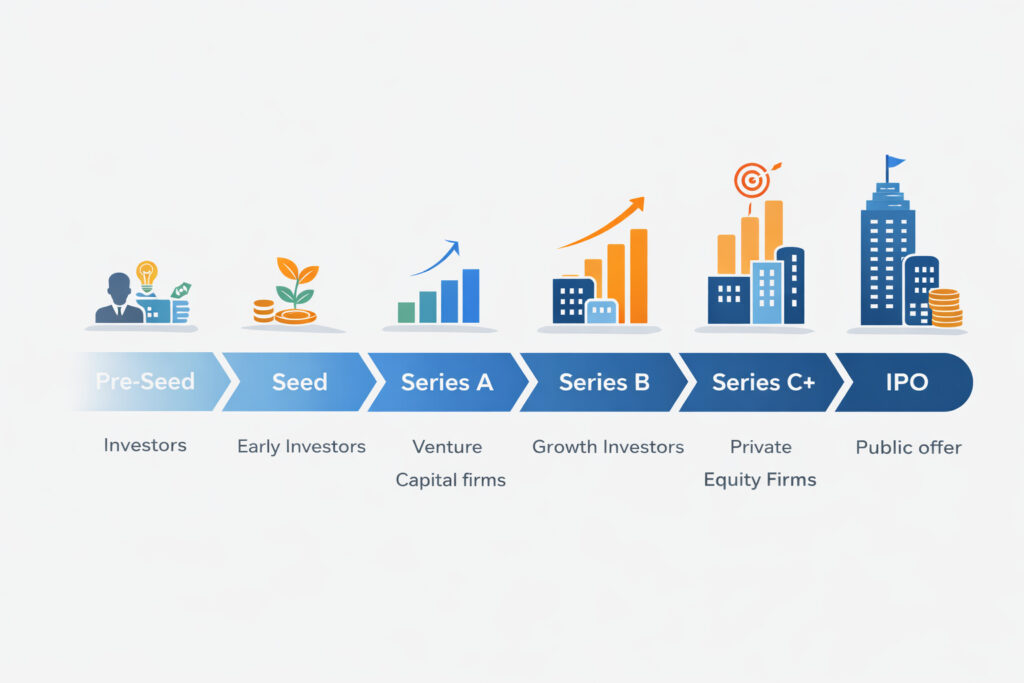
The majority of Indian startups have a sequential financing scheme:
| Stage | Typical Funding Source | Valuation Basis |
| Pre-seed | Angel investors | Idea + founder capability |
| Seed | Early-stage VC | Market opportunity |
| Series A | Institutional VC | Growth metrics |
| Series B+ | Large venture funds | Scale potential |
| Late-stage | Private equity | Market dominance potential |
Within every stage, new investors come in and set valuation depending on future returns.
The most important issue in this respect is that the valuation is not performance-based but forward-looking.
At beginning levels, the calculation of valuation can be based on such factors as:
- Market size assumptions
- Founder execution functionality.
- Competitive positioning
- Investor risk appetite
During the initial stages, revenue and profitability measures can only be of limited use.
Business Model Logic
Various startup industries generate various structures of valuation.
For example:
| Sector | Valuation Driver |
|---|---|
| SaaS | Recurring revenue multiples |
| Fintech | User base and transaction volume |
| E-commerce | Gross merchandise value |
| Consumer platforms | Network effects |
Due to the fact that every model pays more attention to different metrics, comparing valuations across industries may be misleading.
A SaaS business with a consistent subscription business might be worth valuing based on the predictable cash flows, whereas a consumer platform may be worth valuing based on the rapid growth in users.
Observers can not understand these sector-specific models and can therefore interpret valuation numbers as homogenous measures of success.
Regulatory Environment
The regulatory environment in India is another issue that affects the valuation behavior.
Factors include:
- Foreign investment laws.
- Startup recognition plans.
- Investment treatment taxation.
- Privacy laws of the individual companies.
The regulatory frameworks determine the entry mode of capital to the startup ecosystem and investment structure patterns.
Indicatively, they could be any policy that promotes inflows of venture capital, which impacts valuations indirectly during investment booms by increasing funds availability.
Economic Logic
In order to discover why the myths of valuation exist, one should investigate the economic reasoning of venture investments.
Venture capital performs on a portfolio basis. Only a small percentage of startups, as expected by investors, will bring a substantial payoff.
There are a number of structural characteristics because of this:
- Excessive valuations can be based on anticipated future magnitude as opposed to present-day income.
- Profitability is normally not the main concern in the starting stages when investors focus on the growth potential.
- The negotiation of valuation indicates that there is risk sharing between the investors and founders.
In venture economics, one successful investment can pay off in a large way that can compensate for numerous failed investments.
Consequently, the probability-weighted expectations have often been used in the valuation calculation instead of the context of traditional financial analysis.
This is very different in contrast to valuation models in mature companies where the financial fundamentals to rule the day are earnings, cash flow and balance sheet strength.
The metrics that the investors are interested in in the startup setting include:
- Total addressable market
- Acquisition efficiency of the customers.
- Technology differentiation
- Market entry barriers
These measures aid in future growth stories as opposed to current financial performance.
This organizational rationality describes why at the early stages of startups valuations seem to be not related to existing revenues.
Nonetheless, on occasions of a shift in the capital supply like during periods of slowdown in global funds, valuation corrections are likely to be realized.
These corrections bring out the distinction between valuation growth that is capital-based and valuation growth that is operation-based.
Operational Challenges
Although valuation arguments are frequently based on the amount of the investments, the reality of the operations is much more influential in the outcome of the long-term.
Indian startups also face a number of operational challenges irrespective of the level of valuation.
Compliance Complexity
In India, the startups are forced to operate under several regulations including:
- Corporate governance conditions.
- Tax compliance
- company-specific licensing laws.
- investor reports requirements.
When companies grow, the compliance demands grow and demand more resources to operate.
Capital Efficiency
Availability of capital does not bring in sustainable management of capital.
Startups must balance:
- customer acquisition expenditure.
- costs in technology development.
- team expansion
- marketing investment
In case of the inefficient use of capital, the high valuation can result in unrealistic growth assumptions.
Market Fragmentation
The market diversity in India has opportunities and threats.
Startups normally experience differences in:
What is the consumer buying behavior?
- digital adoption levels
- regional regulations
- infrastructure quality
Operational flexibility is needed in order to scale across these various market environments.
Scalability Constraints
Most of the startup models presuppose the fast growth of user bases. Nonetheless, the difficulty of scaling can arise because of:
- Infrastructure constraints in logistics.
- limitation in availability of talent.
- competitive market dynamics.
Whether the valuation expectations can be met is often due to operational issues.

Policy Interaction
The Indian policy of startup investments is greatly influenced by the government policy.
Plans intended to promote entrepreneurship tend to have an effect on availability of funds and investor trust.
Key policy areas include:
- startup recognition schemes
- funding innovation activities.
- Investor tax incentives.
- regulatory reforms in favour of venture capital.
Indicatively, any program that is interested in supporting early-stage entrepreneurship can result in higher startups entering funding pipelines.
Nonetheless, it is also possible that more startup supply can also affect the valuation behavior, in terms of increasing the supply of companies seeking investment.
The policy systems thus indirectly impact on the valuation outcomes since they influence the patterns of capital movement and formation of startups.
Moreover, regulatory transparency in foreign investment has traditionally been a crucial factor in the amount of foreign capital flowing into the Indian startup sector.
As the share of foreign capital participation rises, investor competition can also help to increase the startup valuation.
The uncertainty in policy, on the other hand, may lower the inflows of investments and increase more conservative valuation amounts.
Founder Implications
Failure to understand the right startup valuation in India may result in founders making strategic decisions that focus on increasing the valuation in the short term as opposed to increasing the sustainability of operations in the long term.
There are multiple implications of the valuation misconceptions.
Equity Dilution Decisions
Founders have to take into account substantial care in negotiating valuation issues in light of the ownership dilution.
Greater valuation can help decrease dilution in the short term, but it can also allow pressure on high growth in later funding rounds.
Growth Strategy
When valuation expects are higher than operations can handle, startups can use aggressive growth strategies that are resource-constraining.
This can lead to:
- unwarranted spending on marketing.
- hasty recruiting without matching productivity.
- premature market expansion
Investor Alignment
The various investors may have varied returns expectations and time horizons.
Valuation agreements should be realistic according to the business path that founders need to follow.
Performance Benchmarks
In cases where valuation grows at a significant rate in consecutive funding rounds, there is a possibility of the increase in performance expectations.
It can influence decisions associated with:
- revenue targets
- customer acquisition indicators.
- expansion timelines
Knowledge of the economic principles of calculating valuation can assist founders to make better decisions in terms of these strategies.
Future Outlook
The future of startup valuation in India will be probably based on a number of macroeconomic and ecosystem trends.
Raising Sophistication of Investors.
With the maturity of the ecosystem, investors are laying more stress on:
- revenue sustainability
- capital efficiency
- clear business models
Such a change can decrease the difference between storytelling on valuation and performance.
Valuation Models based on Data.
Upgraded analytics of data and comparison of sectors are enhancing valuation systems.
The investors can now have access to larger datasets which can make more accurate comparisons between startups in the same sector.
Sector Specialization
In some industries like SaaS, fintech, and deep technology, they are coming up with more standardized models of valuation.
This can contribute to the decrease in valuation ambiguity in the ecosystem.

Market Correction Cycles
The periodicity of funding cycles in startup ecosystems exists all over the world.
Valuations can increase at a very high rate during the period of capital expansion. Investors can become more serious in financial assessment procedures during contraction periods.
Such cycles are likely to persist in the ecosystem of India with an increase and decrease in the global venture capital flows.
Conclusion
It is time to stop looking at numbers on the headlines to get an understanding of Startup Valuation in India and to delve into the mechanics of venture financing, market expectations, regulatory frameworks, etc.
The valuation numbers usually reflect negotiated estimates on what may happen in the future and not the current operating performance. That difference clarifies why most popular assumptions related to the valuation of startups such as the idea that greater valuations are necessarily indicative of better businesses may be deceptive.
More Read

Better perception of valuation calculation would be to examine the structure of funding, incentive of investors, and unique growth models of the sector. All these matters influence the bargaining of the valuations and their development by the financing round.
To founders, it is imperative to identify these dynamics in order to make sound strategic choices in terms of equity dilution, capital utilization and expansion strategies.
With the Indian startup ecosystem still in maturity, the valuation debate will tend to be more analytical and the operational fundamentals and sustainable economic models will have to be taken into consideration.