Rationale of this Visit: Strategic, Economic and Geopolitical Background
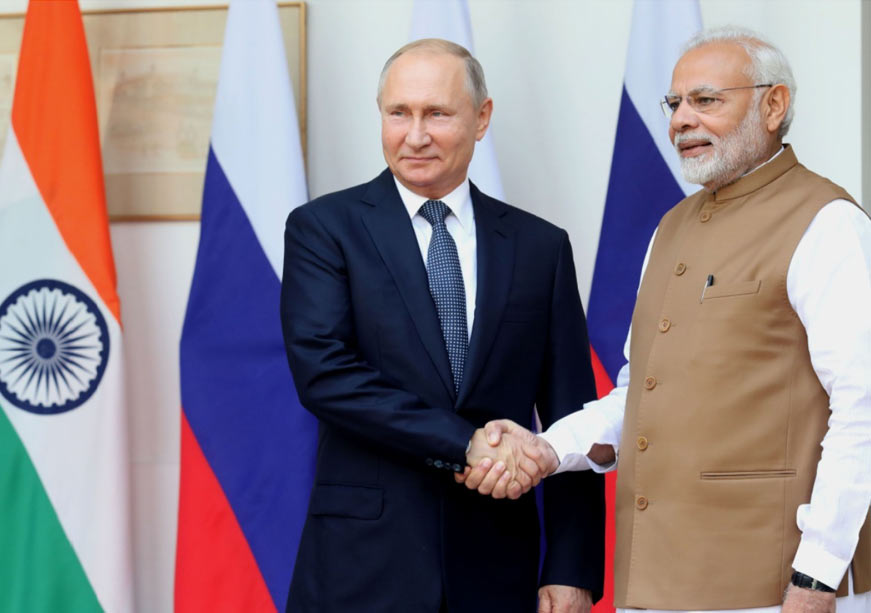
The Russian President Vladimir Putin’s visit to India in 2025 will be conducted in an era of worldwide anxiety – changing alliances, energy insecurity, and new security challenges. In the case of India, which is an increasingly economic and geopolitical power, the time and importance of this visit cannot be overestimated. It is not merely diplomatic formality. It is a well timed step that can transform the energy security of India, defence preparedness, trade relations and foreign-policy leverage on the global arena.
In the past, there have been decades of relations between India and Russia (then the Soviet Union) in the areas of defence, energy, trade and diplomacy. Since the historic 1971 Treaty of Friendship and Cooperation up until the arms deals of the Cold War, and the nuclear-energy cooperation that was to characterize the relations between the two nations after the collapse of the Soviet Union, the relations have changed but nonetheless were strategic to the core. Over the last several decades, with the turning of the global balance of power, India has followed the multipolar foreign policy – maintaining a balance between relations with the US, EU, Middle East, and Russia.

This visit is a re-calibration point in 2025, when geopolitical tension worldwide is expected to rise, energy markets will remain unpredictable, and defence requirements will increase. To Russia as well, the benefits of a closer relationship with India are economic and diplomatic.
Therefore, the visit is guided by three key strategic pillars energy and resource security, defence and defence-industrial cooperation, and global diplomatic alignment.
What is on the Table: Intention and Possible Results
Energy & Resource Deals – Long-term Fuel Supply
Among the most important goals of the visit is to conclude energy transactions – in crude oil, liquefied natural gas (LNG) and perhaps long-term supply contracts. The energy demand in India has increased tremendously over the years as a result of household, industry, agriculture and transport. Dependence on unstable foreign markets (Middle East, global oil price volatility) has continuously put pressure on the import bill and inflation rates of India.
Working with Russia, India is interested in:
- Reliable, predictable supply at reasonable prices – decreasing exposure to international price pressure.
- Energy diversification – reducing reliance on imports in the Middle East.
- Industry/ household supply security – a buffer against international energy insecurity.
A long-term bilateral energy contract would be an enormous victory considering that Russia has a lot of reserves and India has a rising energy demand. This will be able to stabilize the fuel, fertilizer and power prices in India- both rural and urban.

Defence Cooperation and Technology Transfer-Enhancement of Indian Military Advantage.
One of the major pillars of relations between India and Russia is defence relations. Over decades, Russia has provided India with high-tech military equipment – aircraft, naval ship, missile, and other equipment. However, in 2025, the agenda is not only about sales: it also focuses on joint development, co-production, and technology transfer.
Expected outcomes:
- Modernisation of procurement of state-of-the-art weapons.
- Joint production (an addition to the Indian “Make in India” initiative in the defence industry).
- Technology transfer and maintenability – decreasing foreign support and making military equipment critical self-reliant.
In a world where security challenges are becoming more and more intricate, such as border tensions and maritime security, such cooperation can greatly improve defence preparedness in India.
Trade, Industry and Technology Alliances–Beyond Energy and Arms
In addition to energy and defence, the visit will expand economic collaboration: trade of goods, joint ventures in such areas as aerospace, electronics, renewable energy and manufacturing of high technology products. India must increase industrial capacity, generate employment, and eliminate reliance on imports.
Potential benefits:
- New investments and joint ventures – generating jobs and developing strong industrial capacity.
- Technology alliances – especially aerospace, electronics, renewable energy and infrastructure.
- Indian SMEs in the export business to Russia – exploiting a huge market in goods and services.
Such increased economic involvement can facilitate the Indian manufacturing plans and realization of the G20-era vision of inclusive growth in India.

Diplomatic Alignment & Global Strategy Multipolar Balance
The independent foreign policy of India, with its balancing between the US, EU, Middle East, and Russia is even more appropriate in a world where alliances are shifting. In the case of Russia, there are economic and diplomatic benefits of enhancing relations with India, particularly during times of sanctions on the country and geopolitical confrontations.
This visit could result in:
- Enhanced collaboration in the multilateral fora, including UN, BRICS, SCO, where India is a Global South leader.
- Combined diplomatic efforts regarding world issues energy security, climate change, global peace and trade systems.
- Reassertion of non-alignment and strategic independence by India, demonstration of its capacity to ensure balanced relations with the key world powers.

Historical Background: The History of the Indian-Russian Relations
To grasp the importance of the visit of 2025, it is worth returning to the important milestones in the bilateral relationship:
- 1971 Treaty of Friendship and Cooperation: The historical agreement between India and USSR that formed decades of military alliance and foreign policy alignment.
- Arms and Defence Countermeasures Cold War Era Arms and Defence Deals: Big Aircraft, tank, artillery-construction of the main defence equipments of India.
- The Post-Cold War Cooperation: Russia was an essential ally even after the dissolution of USSR, in nuclear energy, space cooperation, and in defence.
- 2000s and further On: Civil nuclear agreements, LNG and oil imports, increased trade, mutual scientific ventures.
- 2010s-2020s: The emphasis extends to joint production, civil cooperation, energy security, and diverse trade.
In these decades, even as the world was going through changes, superpower alliances, sanctions, economic crises, the India-Russia relationship changed, endured, and sometimes even flourished.
The 2025 visit is not thus an empty place of a clean sheet of paper – but a renewal at a crucial crossroad of turmoil and possibilities across the world.

What India Should Be Careful of – Obstacles and Dangers
There is no big international transaction that is risk-free. In the case of India, there are a number of challenges that will have to be addressed:
International Sanctions on Russia: Owing to the geopolitical position of Russia, there is a high number of sanctions by Western nations. India should make sure that a trade or energy agreement should not be subject to secondary sanctions. It should be properly organized, transparent and observant of international laws.
Tradeoff Other Diplomatic Relations: As it lifts its relationship with Russia, India ought to strike balance with the Western nations, the Gulf nations, and East Asia. Diplomatic diplomacy has to be subtle not to elicit alienation.
Domestic Transparency and Public Accountability: Large transactions- particularly those in the defence and energy sector should be transparent. Transparency, disclosure and competitive tendering are critical to avoid corruption or distrust in the hands of people.
Infrastructure Preparation: Energy import transactions or co-production demand well-developed infrastructure – ports, pipelines, storage, logistical infrastructure. Failure to do so will result in delays, bottlenecks or inefficiencies in India.
Market Volatility and Economic risk: World energy market, currency, demand and supply variations- all can have a ramification on the profitability and utility of long-term transactions. Over-dependence has to be guarded in India.
How This Visit Could Change Life of Ordinary Indians – Real World Impact
So what follows with the big deals and diplomacy of your strategies is what does it hold to the common citizen, to the farmers, to the workers, to the small business man, to the youth seeking employment?
Energy + Fuel Stability- Reduced Inflation, Costs Stasis
Assuming India has obtained long term energy supply on a stable rate with Russia:
- Fuel prices can become predictable.
- Fertilizer, transport and manufacturing overheads can stabilize.
- Essential items might experience less volatility among consumers.
This represents gain to millions of people- to rural farmers who will be dependent on fertilizers and diesel to the urban commuters and small industries.
Creation of jobs in the manufacturing and technological sectors
Employment on the manufacturing, maintenance, R & D side would result through joint ventures, technology arrangements, and defence industrial cooperation.
The young graduates, engineers, technicians, can get opportunities in high skills jobs.
SMEs can become bound up as vendors, supplier, service providers.
Empowered Defence and Security- National Stability
A strong system of defence- cutting-edge equipment and homegrown maintenance makes the country secure. Growth, investments, infrastructure (which benefit the society at large) must be based on stability and security.
Exporting and Global Branding of SMEs
Better trade relationship can imply that Indian firms (particularly SMEs) will have an opportunity to enter the Russian market as well as other markets. Export revenues, diversification, and international relationships can become less difficult.
Long-Term Vision: What Can India Be in 5-10 Years
A wise implementation of the agreements of this visit might see India seeking:
- Defence self reliance– locally manufacture complex weaponry, lessen reliance on imports.
- Energy diversification and security Strong energy importation and storage infrastructure, substitute fuel.
- Growth in manufacturing and technology – joint venture, innovation facilities, export industries.
- Nonpartisan International Policy – powerful relations along geopolitical boundaries, retaining strategic independence.
- Economic strength – stabilized imports, falling inflation pressure, cropping export growth.
This kind of path may dramatically improve the chances of India to achieve more national objectives; the development of the economy, creation of new jobs, global leadership and sustainable development.

What Stakeholders Need to Do, Recommendation and Action
Government and Policy Makers
- Make deals transparent and competitive, and disclosed.
- Establish bi-lateral energy, defence, trade accords committees.
- Enforce infrastructure preparedness – ports, pipelines, logistics to absorb fresh import/exports.
- Invest in skill training- in manufacturing, defence production, maintenance, R&D.
To business people and entrepreneurs
- Consider joint-venture with Russian companies – particularly in manufacturing, defence supplier chain, energy, technology.
- Status as SME vendors/suppliers- once large contracts are available for sale, small companies may take advantage of being vendors or service providers.
- Ready to sell to Russia and other allied markets – globalize your business.
In the case of Citizens, Youth and Workforce
- Keep an eye on the new projects- manufacturing units, maintenance, logistics, tech support.
- Personal development International trade compliance, renewable energy, logistics, allied defense manufacturing.
- Be vigilant, keep policymakers on the way and push them towards transparency in all transactions.
Final Observations as to the Significance of this Visit
The India visit by Putin in 2025 is not just another diplomacy visit. It is burdened with decades of bilateral history and the hope of any kind of deal that will be a transformer. As the world becomes more characterized by uncertainty, energy shocks, geopolitical volatile zones, and economic hurly burly, the India-Russia relationship provides India with a road of stability, long-term strategy and development.
With prudent management, open governance, robust institutions and balanced economic allocation, the results of this visit are capable of transforming the energy security, defense readiness, Indian industrial potential and the economic position of the country internationally.
This is not mere diplomacy to India. It is a turning point towards stability, development and tactical independence at a complicated international system.