Maintenance has long occupied a sensitive space within Indian matrimonial law. It is at once a legal entitlement, a social safeguard, and an emotional flashpoint. Designed to protect a financially vulnerable spouse from destitution after marital breakdown, maintenance has traditionally been understood as a means of survival. Yet, as Indian society evolves, courts are increasingly compelled to ask a deeper question. Is survival alone enough, or should maintenance also enable dignity, agency, and eventual self-reliance?
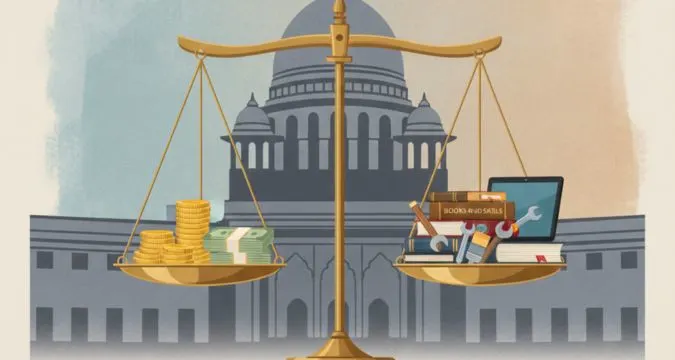
A recent observation by the Punjab and Haryana High Court has brought this question into sharp focus. While refusing to enhance the maintenance amount granted to a wife, the Court directed that ten percent of the maintenance she receives should be used for skill development to help her become financially independent. The Court reasoned that the object of maintenance is not confined to bare subsistence but extends to long-term dignity and self-sufficiency.
This Punjab and Haryana High Court maintenance judgment may appear modest in form, but its implications are significant. It reflects a gradual yet meaningful shift in how Indian courts perceive the purpose of spousal support in a changing socio-economic landscape.

Understanding the Punjab and Haryana High Court Maintenance Ruling
The case before the High Court involved a wife seeking enhancement of maintenance. While the Court declined to increase the amount, it did not end its reasoning there. Instead, it took the opportunity to articulate a broader principle. Justice Alok Jain observed that maintenance should not become a static entitlement that perpetuates dependency. Rather, it should act as a support mechanism that enables the recipient to rebuild capacity and independence.

The direction to use 10% of the maintenance amount for skill development was neither punitive nor conditional. The Court did not reduce maintenance, nor did it impose a deadline for employment. It simply acknowledged a fundamental truth: economic stagnation undermines dignity just as surely as financial deprivation does.
This approach reframes maintenance as a rehabilitative tool rather than a permanent substitute for livelihood.
What Is the Legal Object of Maintenance Under Indian Law?
Maintenance as Protection Against Destitution
Indian maintenance laws, whether under the Hindu Marriage Act, Hindu Adoptions and Maintenance Act, Code of Criminal Procedure, or personal laws of other communities, are rooted in the principle that no spouse should be left without means of survival after separation.
Courts have consistently held that maintenance must allow the claimant to live with reasonable comfort and dignity, approximating the standard of living enjoyed during the marriage. Maintenance is not alms. It is a legal right arising from the marital relationship and the economic imbalance it may create.
How Courts Traditionally Calculate Maintenance
Traditionally, courts consider factors such as income, standard of living, duration of marriage, age, health, and responsibilities. The focus has been largely compensatory, aimed at correcting immediate financial imbalance.

What has often been missing from this framework is a forward-looking assessment of capacity building. The Punjab and Haryana High Court maintenance judgment begins to address this gap.
Why the Court Linked Maintenance to Skill Development
Judicial Reasoning Behind the 10% Direction
The Court’s reasoning rests on a crucial distinction. Maintenance is meant to support dignity, not dependency. Justice Alok Jain emphasized that the objective of maintenance extends beyond survival to enabling self-reliance.
By encouraging investment in skill development, the Court sought to prevent long-term stagnation. The ten percent figure is symbolic yet practical. It acknowledges financial constraints while reinforcing the importance of self-improvement.


Skill Development as a Tool for Financial Independence
Skill development is not merely about employment. It restores confidence, enhances bargaining power, and reintroduces agency into an individual’s life. For many women involved in prolonged matrimonial litigation, skills erode over time due to career interruptions, caregiving responsibilities, and emotional strain.
Encouraging vocational improvement within the framework of maintenance is a pragmatic response to this reality.
Also Read: Skill Vs Degree Who Wins
Maintenance, Dignity, and Article 21 of the Constitution
The right to live with dignity under Article 21 of the Constitution has repeatedly informed judicial interpretation across domains. Maintenance, when viewed through this constitutional lens, cannot be reduced to a subsistence allowance.
Dignity implies autonomy. It implies participation in social and economic life. Long-term financial dependency, even when legally sanctioned, can compromise these values.
The Punjab and Haryana High Court maintenance judgment aligns matrimonial jurisprudence with constitutional morality by recognizing that dignity is incomplete without the possibility of independence.
Also Read: Women In Indian Politics
Changing Social Realities and the Limits of Long-Term Dependency
Education, Workforce Gaps, and Career Interruptions
Indian society today presents a complex reality. While many women continue to face structural barriers to employment, there is also a growing population of educated women whose careers are interrupted by marriage, childbirth, or litigation.
In such cases, maintenance often becomes a substitute for lost opportunity rather than a bridge to renewal. Over time, dependence hardens, and reintegration into the workforce becomes increasingly difficult.
Courts are now confronting the unintended consequences of prolonged dependency and seeking balanced solutions.
Does This Judgment Dilute the Right to Maintenance?
Why the Ruling Is Encouraging, Not Punitive
A common concern is whether such directions undermine the right to maintenance. The answer lies in the nature of the Court’s approach.
The judgment does not mandate employment. It does not penalize non-compliance. It does not assume uniform capacity across individuals. It merely encourages skill development where feasible.
Judicial discretion remains central. Age, health, education, caregiving responsibilities, and local employment conditions must still guide each case. The right to maintenance remains intact.
Implications of This Maintenance Judgment for Family Courts
How Future Maintenance Cases May Be Decided
This ruling may influence how family courts conceptualize maintenance. Lawyers may increasingly present rehabilitation plans alongside financial claims. Courts may explore phased independence models rather than indefinite support.
Such an approach could reduce prolonged litigation, promote faster settlements, and restore agency to litigants.
However, safeguards must be robust. Encouragement must never turn into coercion, and compassion must remain central to adjudication.
Gender Justice, Equality, and the Future of Maintenance Law in India
Maintenance laws were historically framed to protect women in a deeply unequal social order. While that protection remains essential, gender justice today demands more than protection alone.
True equality lies in opportunity, agency, and economic participation. Encouraging financial independence strengthens women’s rights rather than weakening them.
The Punjab and Haryana High Court maintenance judgment reflects this evolving understanding. It acknowledges vulnerability while affirming potential.
Frequently Asked Questions
What did the Punjab and Haryana High Court say about maintenance?
The Court held that maintenance is not limited to subsistence and should also promote dignity, self-reliance, and long-term financial independence.
Did the Court reduce the wife’s maintenance?
No. The Court refused enhancement but did not reduce the existing maintenance amount.
Why did the Court emphasize skill development?
The Court observed that investing in vocational skills helps prevent long-term dependency and supports dignity and autonomy.
Is skill development mandatory in maintenance cases?
No. Such directions are discretionary and depend on the facts of each case.
Will this judgment impact future maintenance rulings?
It is likely to influence judicial thinking by promoting rehabilitative approaches alongside financial support.
Conclusion: Maintenance as a Bridge, Not a Destination
The Punjab and Haryana High Court maintenance judgment represents a thoughtful recalibration of matrimonial justice. It does not weaken the right to maintenance. It strengthens its purpose.
By linking maintenance to skill development, the Court has affirmed that dignity is not sustained by dependency alone. True justice lies in enabling individuals to rebuild, re-enter, and reclaim agency over their lives.
In a legal system often criticized for rigidity, this judgment reflects adaptive thinking. It recognizes that support should stabilize, but empowerment should sustain.
Maintenance, as the Court reminds us, is not the end of the road. It is the bridge that leads to independence.