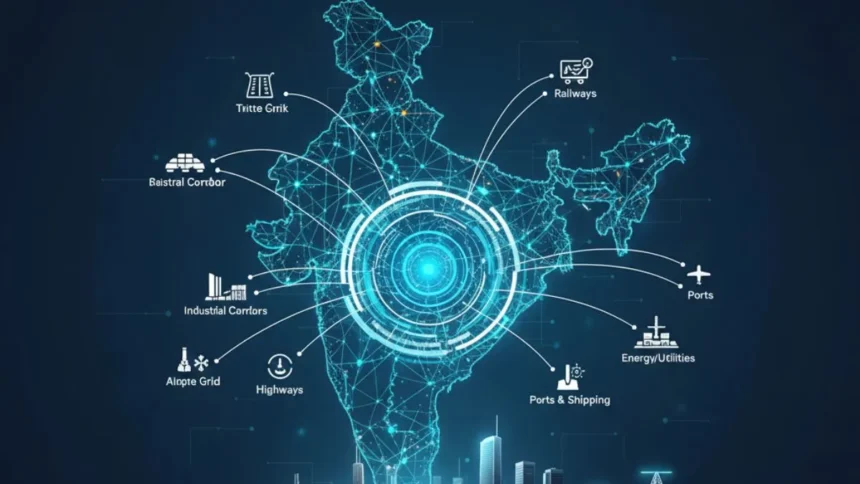
The story of India’s infrastructure development strategy over the years is marked by a history of fragmented planning, siloed implementation and lack of inter-ministerial coordination. The PM Gati Shakti initiative has emerged as the structural response to such constraints in this regard. Instead of a traditional capital expenditure plan, it targets changing the design of infrastructure governance by integrated planning, digital mapping and multi-level coordination. As a reform tool in the larger context of infrastructure policy India, it is a move from project based execution to network based infrastructure management, institutionally.
Launched in October 2021, PM Gati Shakti is placing the infrastructure not just as a function of public works but as a multiplier of productivity between the logistics efficiency and industrial competitiveness to spatial planning. Its importance is not so much in terms of fiscal allocation, but rather as a redemption of governance.

This article discusses PM Gati Shakti in terms of policy – structural – institution and the majority and assesses the institutional architecture, operational mechanisms, macro economic implications, constraints in implementation and the medium-term trajectory of this policy.
Policy Context
Historical Infrastructure Planning: The Issue of Fragmentation
India’s infrastructural governance evolved in the past by sectoral ministries with minimal interoperability. Roads were planned by the Ministry of Road Transport and Highways, River lines by the Ministry of Railways, more specifically for ports – the Ministry of Ports, Shipping and Waterways and Industrial corridors by separate authorities.

This created:
- Duplication of corridors
- Cost overruns for post facto clearances
- Delays due to land acquisition conflict
- Logistics inefficiencies
India has a cost of logistics that has been estimated at around 13-14% of GDP as against 8-9% for advanced manufacturing economies. This difference has a direct effect on export competitiveness.
Previous reform attempts such as:
- National Infrastructure Pipeline (or NIP for short)
- Dedicated Freight Corridors 7.
- Bharatmala program and Sagarmala program
The focus was therefore on investment mobilization, rather than institutional integration.
Why PM Gati Shakti Emerged
Three structural pressures came together:

- Supply Chain Reconfiguration After 2020
Global firms started diversifying manufacturing bases, which needed a reliable logistics network. - Capital Expenditure Push by Union Budgets (2021-2024)
Central capital expenditure increased to a great extent, over ₹10 lakh crore in recent Budgets. - Need for GIS Based Integrated Planning
Lack of a platform with common infrastructure for digital infrastructure led to overlapping utilities and poor sequencing.
PM Gati Shakti, thus, is a governance reform that is part of infrastructure policy India as opposed to being a stand-alone spending scheme.
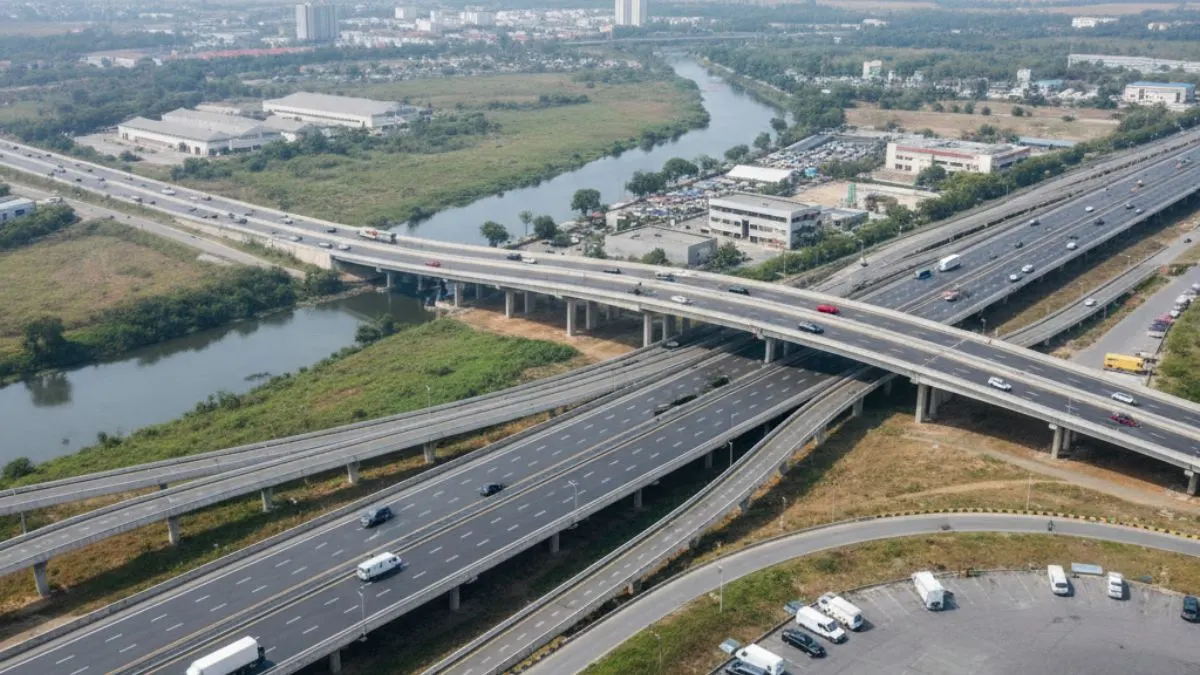
Institutional Architecture
State of governance and how the E-waste industry is governed
PM Gati Shakti is anchored in the Ministry of Commerce and Industry, specifically, in the Department for Promotion of Industry and Internal Trade (DPIIT). This is a strategic institutional positioning. Infrastructure coordination is put into an economic planning ministry instead of a sectoral infrastructure ministry.
Core Institutional Layers
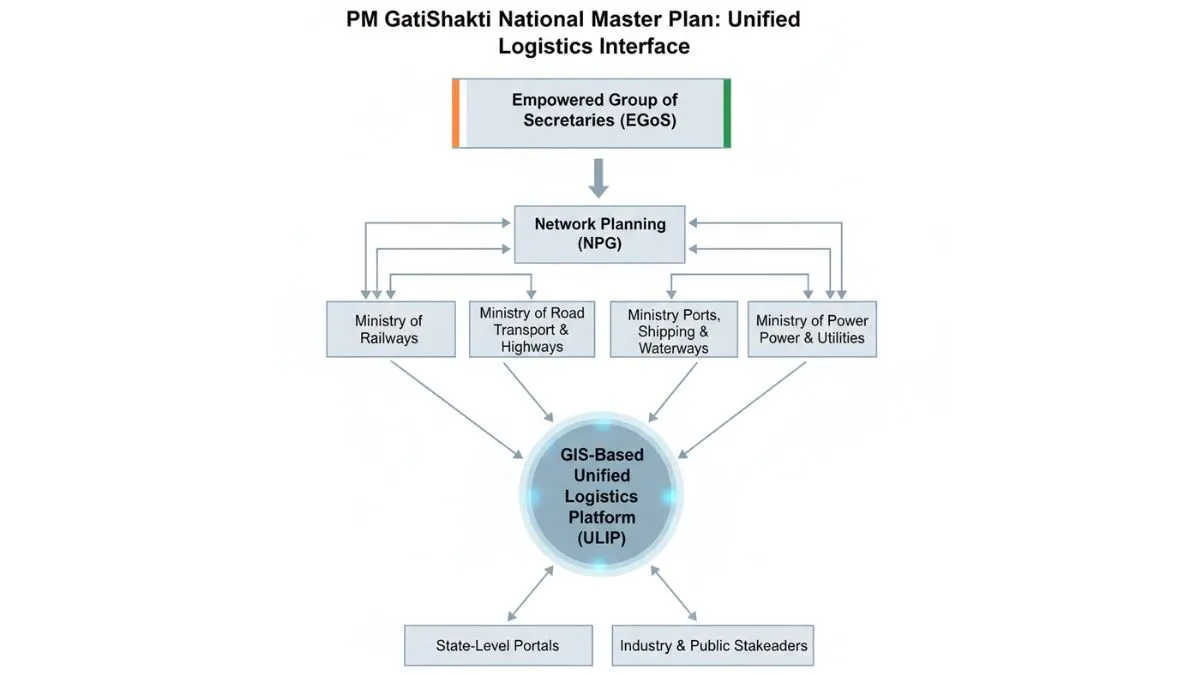
- Empowered Group of Secretaries (EGoS)
- Network Planning Group (NPG)
- Technical Support Unit
- Digital Platform Architecture
The EGoS offers high-level inter-ministerial coordination. The NPG explores the projects for multimodal integration before approving it.

Parliamentary Process
PM Gati Shakti was not a statute that was passed by itself. It is an executive coordinate framework. Funding still continues to pour through the existing budgetary processes that were approved in Parliament. This indicates:
- Administrative reform without legislative reform
- Ongoing Parliamentary control through budgetary scrutiny& Dean, A. P., (1999). “Reading the Oak”. Reading , Justinian, Human Rent & Enclosure, ed. R. Wilstood, John Martin Fulleby., Reading University :: (Aveo Publishers).
Budget allocations for participating ministries still are subject to debate by Parliament.
Federal Implications
The federal nature of the Indian state assigns a lot of infrastructure responsibilities to states. The PM Gati Shakt assignment has state-level digital integration and coordination mechanisms. States are encouraged to have their own Gati Shakti portals as per the plan of the national master.
Federal dimensions include:
- Shared GIS datasets
- Integration of State Infrastructure Plans
- Harmonization of Industrial Corridor – Mapping
Lack of revising of the constitutional amendments guarantees the balance of Federal but the coordination relies strongly upon the administrative capacity of the states.
RBI Relevance
The Reserve Bank of India is not directly operationally involved in it. However, there are macroeconomic implications of infrastructure capex influence:
- Liquidity conditions
- Public debt management
- Long-term development of the bond market
Infrastructure financing stability is still linked indirectly to the monetary policy situation.
Mechanism & Operational Framework
PM Gati Shakti as a Digital Platform of Coordination
The most innovative feature of PM Gati Shakti is the GIS-based digital platform bringing together more than 200 layers of data from various ministries.
How It Works
The mechanism may be explained in five stages:
Data Integration
Ministries upload layers of infrastructure which include;
- Rail lines
- Highways
- Transmission of electric power networks
- Industrial clusters
- Forest boundaries
- Utility pipelines
Project Proposal Submittal
Ministries put forward new infrastructure proposals to the Network Planning Group.
Multimodal Evaluation
The NPG evaluates:
- Connectivity synergies
- Redundancy risks
- Environmental constraints
- Cost rationalization
Inter-Ministerial Coordination
Required clearances and schedule must be discussedArtist’s Duration for Median clearance/Sequence before final approval of scheme.
Monitoring & Dashboard Tracking
Progress tracking is digitalized to give less opacity to administration.
Structural Diagram
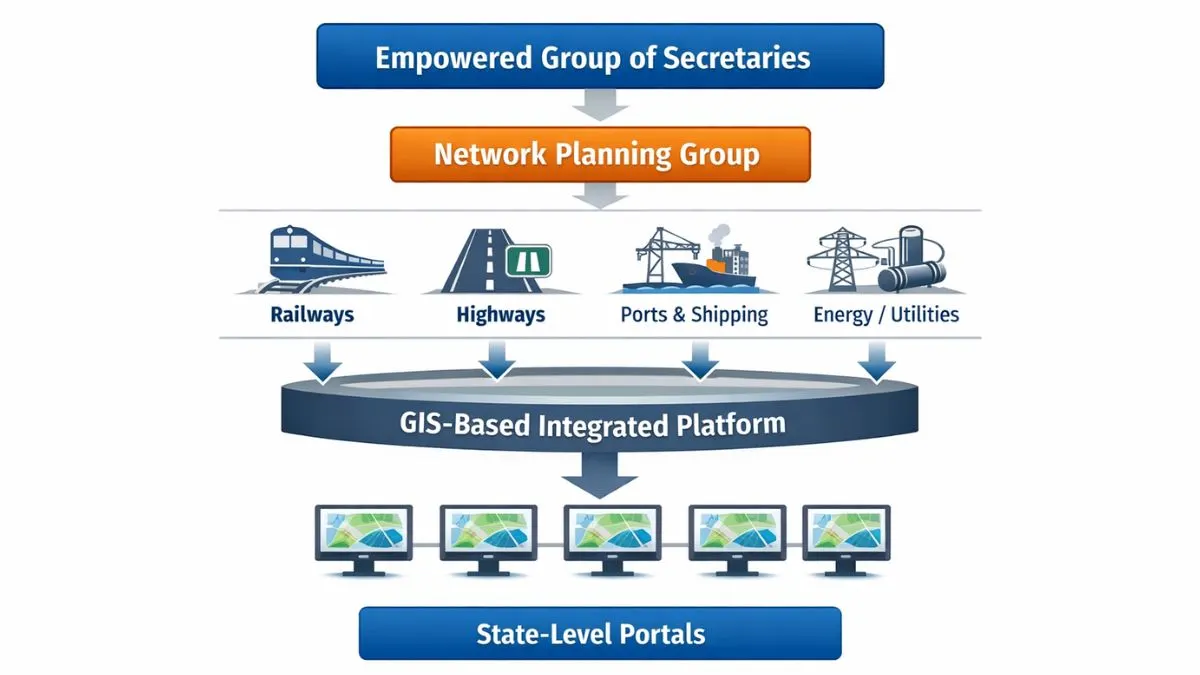
This structure involves the movement of infrastructure governance from linear (ministry-wise approval) to networked evaluation.
Operational Objective
The goal stated is to minimize project delays by ensuring:
- Pre-construction alignment
- Concurrent clearances
- Integrated corridor development
Unlike the past planning models, PM Gati Shakti is an attempt at spatially coherent planning as opposed to administrative segmentation.
Economic and Governance Implications
Fiscal Health
India’s capital expenditure has been increasing to a large extent in recent fiscal years. Investment in infrastructure tends to have the following features:
- High multiplier effects
- Front-loaded fiscal burden
- Long gestation periods
If the integration reduces duplication and delays, fiscal efficiency improves. Cost overruns in the past added 20-30% to the project budget. Contingent liabilities are reduced using rationalized planning.
However, the framework does not do away with:
- Land acquisition risk
- Judicial delay – “Judicial intervention delays” refers to delays in the delivery of justice.
- Revenue uncertainty of PPP projects
Therefore fiscal outcomes are dependent on execution integrity.
Federalism
PM Gati Shakti is of a cooperative federal design. However, states differ in:
- Digital capacity
- GIS infrastructure
- Inter-departmental coordination
States with good frameworks for planning (e.g. industrial corridor states) reap greater benefits more quickly. Others may have lag because of capacity restrictions.
The plan does not lead to centralization of infrastructure authority: it does have standardization in the coordination protocols.
Administrative Capacity
Some of the administrative implications are:
- Change from reactive planning to anticipatory planning
- Institutionalization of Evaluative Data
- Reduction in bureaucratic silos behavior
The success of this measure depends on:
- Data quality
- Updating frequency
- Accountability mechanisms
Without constant updating, GIS platforms run the risk of being a repository rather than a plan.
Private Sector Impact
For private investors PM Gati Shakti offers:
- Increased Visibility Into Infrastructure Pipelines
- Lessened uncertainty into corridor development
- Potential reduction of the cost of logistics
India is aiming towards lowering the logistics cost from about 14% to near 8-10% over a period of time. Better multimodal connectivity creates a more competitive manufacturing sector.
However, private participation still remains dependent on:
- Regulatory clarity
- Contract enforcement
- Viability gap fund stability
PM Gati Shakti is an enabling layer and not a financing substitute
Implementation Gaps
Data Interoperability
Integrating incidental heterogenous datasets across ministries is challenging even from the technical point of view. Differences in standards and quality of the map data and metadata as well as differences in real-time updates may make the different platforms less reliable.
Capacity Inequalities Across States
Some states have weak spatial planning institutions. Without investment into technical capacity, Federal integration may remain lopsided.
Institutional Incentives
Ministries by tradition are autonomous. The keys of effective coordination is:
- Incentive realignment
- Performance measures associated with integrating
- Clear escalation protocols
Without the institutional buy-in, coordination platforms run the risk of procedural compliance without substantive alignment.
Land and Environmental Clearances
Even integrated planning cannot totally eliminate disputes arising from:
- Fragmentation of land ownership
- Environmental litigation
- Community opposition
Monitoring Transparency
While dashboards can exist they come in various levels of public disclosure. Transparency standards must change to assure accountability.
Criticism & Arguments against it
Criticism 1: Design Being Exec-Centric
Since PM Gati Shakti was not legislated, the critics consider that long-term continuity may depend on executive priorities.
Counter-Argument:
Infrastructure governance reform frequently needs administrative flexibility. Plugging the framework into an already existing budgetary oversight guarantees parliamentary oversight by proxy.
Criticism 2: Issues of Centralization
Some say the initiative could skew the planning authority in favor of the Union government.
Counter-Argument:
States remain in control of executions and budgets. The platform is one way of standardizing the coordination rather than of reallocating the constitutional powers.
Criticism 3: Reliance on Digital Platforms too much
Digital integration does not ensure implementation discipline.
Counter-Argument:
While true, digital platforms help reduce information asymmetry, which is a founding step in reform of governance.
Criticism 4 Limited Impact on Direct Employment
Unlike rural employment schemes, PM Gati Shakti is neither directly targeting employment generation.
Counter-Argument:
The policy works on a structural level of productivity enhancement, not being a labour market instrument.
Balanced evaluation implies that PM Gati Shakti is not the panacea and symbolic, it is an institutional modernization attempt.
Future Outlook (5-10 Years)
Over the next decade, there are a number of possible trajectories:
- Integration in the area of Industrial Strategy
Linkage with Production-Linked Incentive clusters as well as with the export zones could help to coordinate spatial planning with industrial policy. - Expansion into Interface of Urban Infrastructure
Currently being implemented on a national-scale infrastructure level, if integrated with municipal planning, it could lead to the reduction of urban congestion. - Bond Market Deepening
Long term infrastructure pipelines can be used to underpin the development of infrastructure investment trusts (InvITs) and municipal bonds. - Institutionalization by Statutory Support
A parliamentary framework can be derived in the future where the need for coordination mandates can be formalized, thereby improving continuity. - Logistics Competitiveness Benefits
If the issue of implementation integrity is resolved, the cost of logistics in India has the potential to go down materially and strengthen competitiveness in exports.
Ambitious scale requires constantly caring administrative discipline and constantly updating the technology.

Conclusion
The PM Gati Shakti Master Plan is the structural intervention in India’s infrastructure governance structure and not a conventional capital expenditure program. It is an attempt to put together a fragmented sectoral planning with integrated and GIS-driven coordination, under the more extensive umbrella of infrastructure policy India.
Its success will not be measured in terms of the amount of money spent and therefore by head-hairs added to physical forms but by duplication elimination, improved multimodal connectivity, federal fiscal efficiency, and federal coordination. The institutional anchoring of the initiative in the Ministry of Commerce and Industry is a deliberate breakaway from a structuralist understanding of infrastructure governance in favor of a productivity-orientated understanding.
Implementation risks also remain huge, especially related to data integrity, administrative incentives and state capacities disparities. However, if implemented with discipline, PM Gati Shakti can act as a blueprint for the overhaul of infrastructure on systemic basis in the next decade.
In analytical terms, PM Gati Shakti can best be thought of as an analytical governance architecture reform, an attempt to rethink how infrastructure decisions are being taken, sequenced and monitored in India’s complex Federal system. Its long-term impact will not depend on cycles of announcements, but on institutional consolidation and stifling policy coherence.
For more understanding from the institutional aspects, reference to official documentation from DPIIT and discussions on the budget in the Parliament would give more technical certitude.
The success of the trajectory of PM Gati Shakti would finally prove the efficacy of integrating related planning in converting capital expenditure into long-term gains in productivity according to the evolving infrastructure policy India framework.