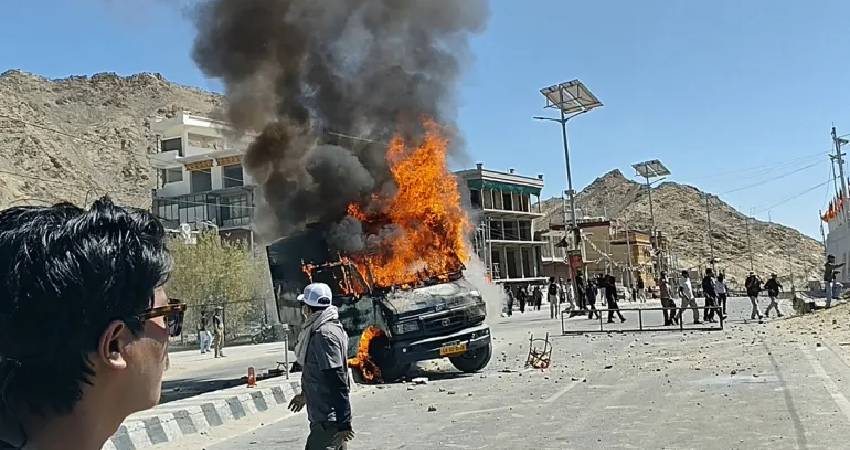
In September 2025, the tranquil landscapes of Ladakh made headlines for a tragic reason: protests turned violent, with four protesters killed, dozens injured, and widespread unrest across Leh and nearby areas.
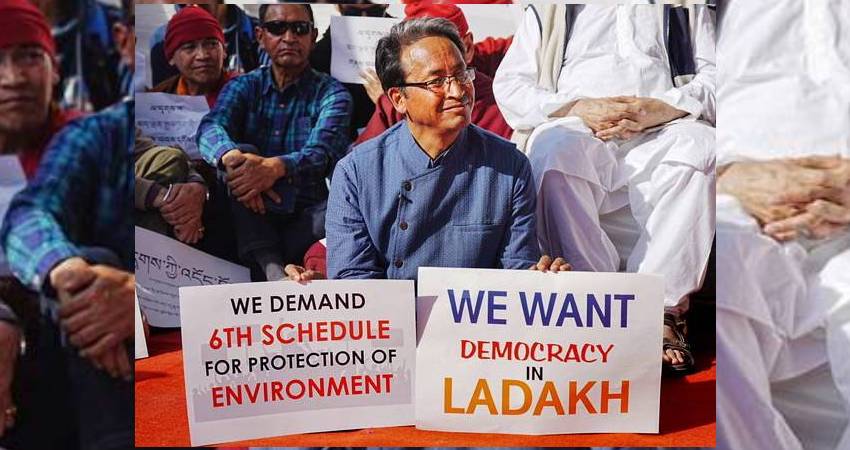
At the heart of this upheaval are deep-rooted political and constitutional demands — including full statehood and the inclusion of Ladakh under the Sixth Schedule of the Indian Constitution.
Historical Context & Ladakh’s Political Journey
Early Identity, Geographic & Demographic Profile
Ladakh is a vast, high-altitude region in northern India, bordering Tibet (China) and adjacent to Pakistan-administered territories. It features two main regions: Leh and Kargil, with distinct religious and cultural identities.
Over decades, Ladakhis have voiced that despite accounting for around 65 % of J&K’s area, they received only ≈ 2% of the state budget (due to low population).
Ladakh’s identity is deeply influenced by its Buddhist, tribal, and mountain culture. Demographically, over 90–97% of the population is classified as Scheduled Tribes in various contexts.

Demand for UT Status (Before 2019)
The idea of granting Ladakh Union Territory status has a long history. As early as the 1950s, leaders like Kushok Bakula Rinpoche raised concerns that Ladakh was underrepresented, with local demands for autonomy or separate administrative status.
Over time, persistent grievances included:
- Neglect in state budgeting
- Poor connectivity and infrastructure
- Marginalization in political representation
- Fears of cultural dilution and influx of outsiders under liberal land/domicile rules
Thus, when the BJP government pushed its Kashmir reorganisation agenda in 2019, many in Ladakh supported separation — on condition that meaningful safeguards and representation be ensured.
The 2019 Reorganisation: From Part of J&K to UT
On 5 August 2019, the Indian Parliament revoked Article 370 (special status of Jammu & Kashmir) and passed the Jammu & Kashmir Reorganisation Act. As per that act:
- The erstwhile state of J&K was bifurcated into two Union Territories: Jammu & Kashmir (with legislature) and Ladakh (without legislature).
- Ladakh would lack its own legislative assembly; its administration would be directly overseen by the Lieutenant Governor and central authorities.
- Two Autonomous Hill Development Councils (LAHDCs) — one each in Leh and Kargil — would continue with limited powers. However, these councils already existed prior and had constrained powers.
For many Ladakhis, the removal of J&K’s legislature meant the loss of direct representation in a democratic assembly, and a shift toward bureaucratic control from Delhi.

The Aftermath: Growing Discontent
Soon after UT status, protest groups flagged a number of unaddressed issues:
- Limited authority of LAHDC councils: Mostly confined to taxation, land allotment, and local infrastructure — but no legislative powers over major domains like forests, mineral regulation, water, etc.
- Land & domicile anxiety: New domicile rules in J&K (post-2019) alarmed locals in Ladakh about outsider encroachment.
- Under-employment and job scarcity: Youth, especially graduates, faced low prospects.
- Environmental strain: Touristic influx, infrastructure projects, and climate stress endangered Ladakh’s fragile ecology.
- Voice deficit: Local voices felt ignored, especially in policy decisions regarding energy, land, and tourism.
By 2023–2024, multiple rounds of dialogue, protest marches, fasts, and peaceful agitations by bodies like Leh Apex Body (LAB) and Kargil Democratic Alliance (KDA) had occurred — yet none resulted in a breakthrough.
Hence, when 2025 arrived, tensions had been simmering for years, setting the stage for a major flashpoint.

What Is the Sixth Schedule & Why It Matters for Ladakh
For many observers, the demand for Sixth Schedule status is the most technical yet pivotal constitutional ask in the current protests. Let’s unpack what it is—and whether it can truly deliver.
Origins & Constitutional Basis
- The Sixth Schedule is part of the Indian Constitution (Articles 244(2) and 275(1)) and provides special administrative arrangements for tribal areas in some northeastern states.
- Under the Sixth Schedule, Autonomous District Councils (ADCs) or Autonomous Regional Councils (ARCs) are constituted. These bodies are empowered to legislate on certain subjects within their territorial boundaries, often for tribal populations.
- There are currently several Sixth Schedule regions in Assam, Meghalaya, Mizoram, and Tripura.
Powers & Functions Under the Sixth Schedule
An ADC under the Sixth Schedule can have powers over:
- Legislation & regulation in areas like land, forest management, water, village administration, inheritance, marriage, social customs, etc.
- Judicial powers, especially over tribal disputes and customary law, by establishing courts for cases involving Scheduled Tribes (subject to limitations).
- Executive functions: local infrastructure, health, sanitation, resource management.
- Financial autonomy: Can impose taxes, tolls, receive grants, and manage budgets for local development.
- Autonomy in appointment, internal governance, and oversight within certain limits.
Thus, an area under the Sixth Schedule gains local self-governance with constitutional protection — acting as a buffer between central power and local decision-making.
Why Ladakh Wants the Sixth Schedule
- Constitutional safeguard for tribal identity
Ladakh’s population is predominantly tribal. Locals worry about cultural dilution, land alienation, and outsider dominance. Sixth Schedule status would legally protect control over local customs, land, and identity. - Enhanced local governance & legislative authority
Granting inclusion would empower local bodies to make laws tailored to Ladakh’s ecology and culture — something currently lacking under UT status. - Control over land, resources & environment
Given Ladakh’s fragile ecosystem and tourism pressures, local control over land and natural resource decisions is pivotal. Sixth Schedule can provide constitutional backing to do so. - Reduced dependence on central bureaucracy
Many feel decisions are made in Delhi or through bureaucrats with limited local inputs. Sixth Schedule helps decentralize power. - Symbolic and political legitimacy
It signals recognition by the central government that Ladakh is distinct and its rights deserve protection under constitutional law.
Challenges, Constraints & Counterarguments
- Constitutional intent & precedent
The Sixth Schedule was explicitly designed for northeastern areas; applying it to Ladakh (outside the Northeast) is untested territory. Some legal scholars argue that introducing Sixth Schedule in non-Northeast regions may require a constitutional amendment. - Security and strategic concerns
Ladakh is a sensitive border region with China and Pakistan. Local autonomy must be balanced with central oversight of defense, foreign affairs, and strategic infrastructure. - Financial and resource limitations
Autonomous councils often rely heavily on state/central grants. Without financial autonomy, local bodies may struggle to function. - Administrative capacity
Local bodies will have to manage many new responsibilities—requiring trained staff, robust institutions, and governance systems. - Potential fragmentation or conflict with central policy
The central government may find it harder to implement national infrastructure or defense projects if too many local vetoes exist.
Thus, while the Sixth Schedule presents a promising path, it must be designed carefully with safeguards and hybrid models.
Core Demands Behind the 2025 Protests
Now that we understand the background and possible constitutional tools, let’s get into what protesters are demanding and why.
Full Statehood for Ladakh
- Protesters argue that only full statehood (with legislative assembly, representation in national Parliament, autonomy in decision-making) can address Ladakh’s systemic deficits.
- Statehood would allow Ladakh to pass its own laws, manage development, and have direct political accountability.
- Currently, as a UT without a legislature, Ladakh has no voice in national policy debates (beyond its few MP/MPs) or in its own governance.
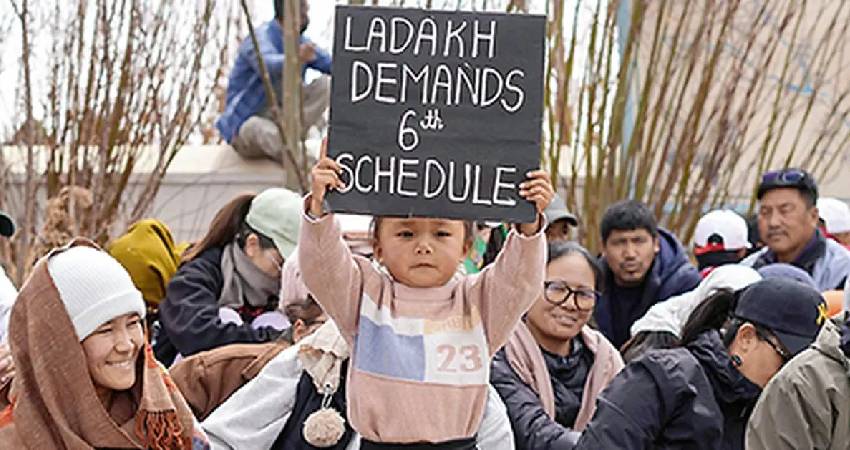
Inclusion Under the Sixth Schedule
- As covered earlier, inclusion under Sixth Schedule would give constitutional backing to local governance, land rights, and tribal protections.
- Protesters see Sixth Schedule as a way to legally insulate Ladakh from central overreach or policy decisions that ignore local views.
Local Jobs, Quotas & Representation
- A major demand is reservation or priority in government jobs for locals. Many youth feel left out of state or central recruitment.
- Protesters also want local quotas in infrastructure and project contracts so local businesses benefit.
- More representation in local bodies — expanded roles for LAHDC, new municipal bodies, and reserved seats for youth and women.
Environmental, Land & Identity Protections
- Touristic expansion, infrastructure projects, solar parks, mining, and climate stress all threaten Ladakh’s ecosystem.
- Protesters demand local oversight on land use, water rights, mining permissions, and environmental impact assessments.
- They also demand legal protection of their cultural and linguistic heritage from outside influence.
The 2025 Protest Wave: Timeline & Escalation
This is where the long-simmering discontent erupted into a major confrontation.
Lead-up: Hunger Strikes, Shutdowns & Warnings
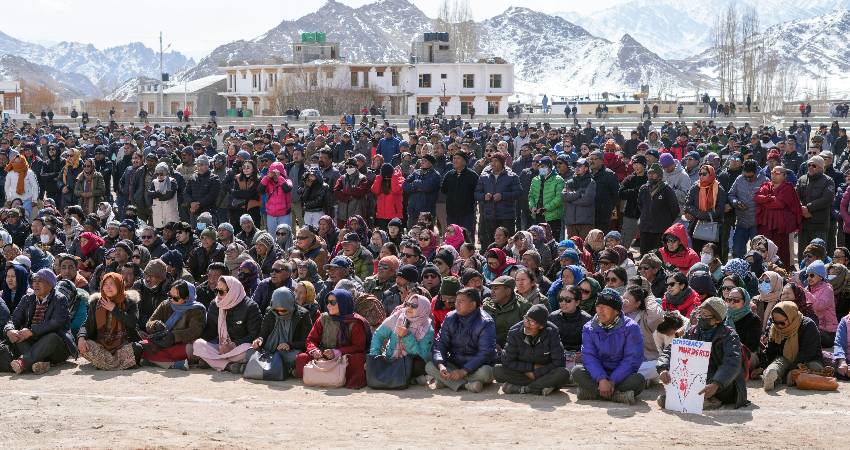
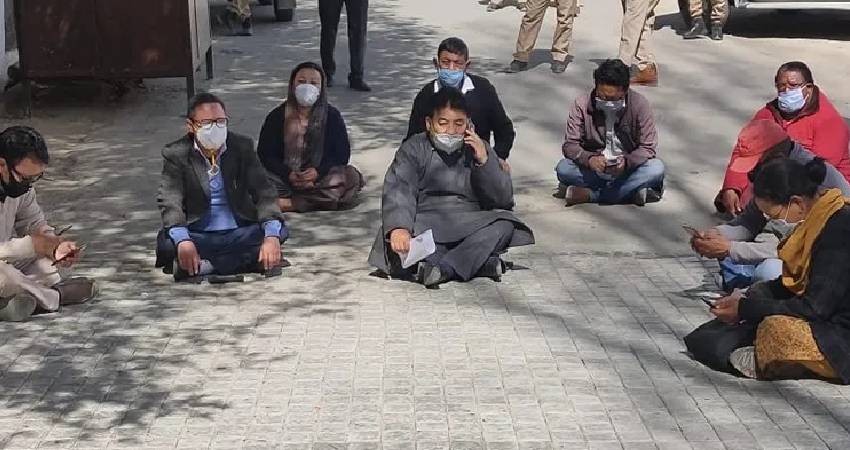
- In early to mid 2025, local bodies and activists escalated their protests. 35-day hunger strikes were initiated by groups led by Sonam Wangchuk.
- In Kargil, regional bodies held a three-day hunger strike in August 2025 to press statehood and Sixth Schedule demands.
- Over months, shutdowns, marches, and dialogue attempts between Leh Apex Body (LAB), Kargil Democratic Alliance (KDA), and central agencies happened — but often without decisive results.
- Protesters increasingly expressed frustration at delays and perceived broken promises. Youth voices began to lose patience.
The Flashpoint: September 24, 2025
On September 24, tensions boiled over:
- Hunger strike extremis
Two elderly hunger strikers (aged ~62 and 71) were critically hospitalized just before the protest. Organisers called for a shutdown to press Delhi for urgency. - Youth-led radical shift
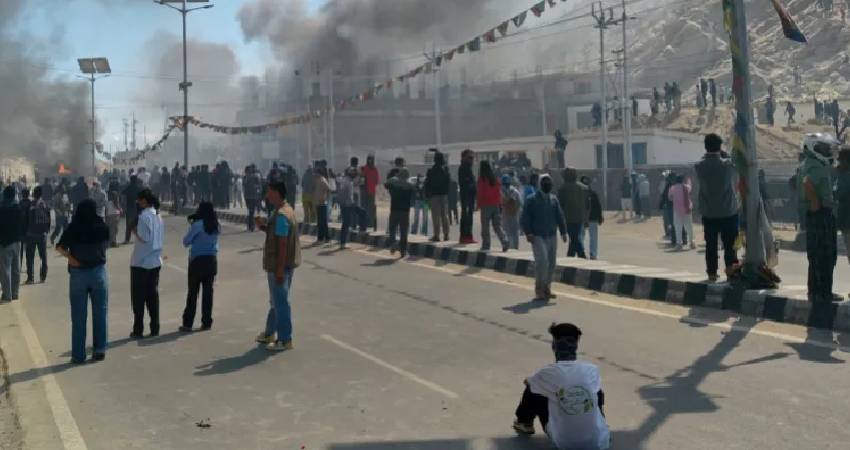
The protest, originally peaceful, was taken over by youth activists who moved toward official buildings and the BJP office in Leh. Clash erupted. - Violence, arson & police response
Protesters set fire to vehicles, torched the BJP office, and threw stones. The security forces responded with tear gas, baton charge, and eventually live fire. Four protesters died, dozens wounded.
Police asserted self-defense; many locals and activists called it a disproportionate use of force. - Curfews, mobile internet shutdowns & heightened security
Authorities imposed curfews, restricted mobility under Section 163 of BNSS, and shut down mobile internet in Leh.
The central government also revoked FCRA license of SECMOL (NGO run by Wangchuk) citing violations.
Arrest of Sonam Wangchuk under the National Security Act (NSA) followed. - Public outrage & reaction
Local cultural groups, NGOs, and civil society expressed shock and condemnation. Calls for inquiries, restoration of peace, and urgent dialogue went viral.
Key Individuals & Stories
- Sonam Wangchuk — well-known educator/activist, long associated with sustainable development and Ladakh’s demands, led the hunger strike and became a symbolic figure.
- Tsewang Tharchin — an ex-serviceman from Zanskar, later involved in protests. He was one of those reportedly killed during the clashes.
- Local youth activists — many “Gen Z” leaders took over ground operations, citing impatience with slow dialogue.
Their stories bring human faces to the political narratives.
What Went Wrong — Critical Analysis
While the protests had strong moral foundations, several structural, tactical, and systemic issues caused the escalation. Here’s a breakdown.
Delay & Failure of Engagement
- The government reportedly set talks only by October 6, months after initial demands surfaced. Many locals said that schedule was too distant, given deteriorating health of hunger strikers.
- Some protest leaders felt the talks were non-binding or too symbolic, lacking immediate actionable outcomes.
- In multiple earlier rounds, promises were made but implementation lagged. Over time, trust eroded.
Lesson: A dialogue framework without urgency is often weaker than a well-planned confrontation.
Breakdown of Peaceful Norms
- While earlier protests were largely nonviolent, the shift to arson and targeted attacks provided a justification (in the eyes of authorities) for forceful response.
- Youth leadership, impatient with delays, may have underestimated escalation risks.
- Once violence erupts, the narrative often tilts toward state control and security arguments.
Overreaction & State Response
- Use of live fire, especially in a region with few violent precedents, shocked many and raised serious questions about proportionality.
- Curfews, mobile shutdowns, and arrests (especially of Wangchuk) inflamed public sentiment further.
- Revoking NGO funding (FCRA license) is seen by critics as targeting civil society rather than addressing root causes.
When state uses extreme tools, optics and public backlash often spiral, especially in a politically volatile region.
Mixed Messaging & Media Narrative
- Central government and security agencies accused the protest of being incited by “provocative statements” referencing Arab Spring or Nepal protests.
- Protest leaders accused authorities of defamation and media bias.
- The blame game—“outsiders,” “foreign influence,” etc.—added complexity and ambiguity, affecting public perception.
Structural & Constitutional Constraints
- The fact that Ladakh was made a UT without legislature means there’s no built-in democratic channel to absorb dissent.
- The Sixth Schedule, while powerful, is constitutionally delicate—adapting it outside the Northeast requires high political will and possibly a constitutional amendment.
- The absence of earlier institutional reforms (e.g., strengthening LAHDC, local planning powers) meant protests were the only recourse left to locals.
In sum, structural deficits, unresolved demands, political inertia, and security instincts combined in a combustible mix.
Repercussions, Reactions & Public Sentiment
Local Sentiment in Ladakh
- Many residents mourn the loss of young lives and demand accountability.
- Youth see their frustrations validated; elders worry about escalation.
- Civil society groups emphasize the need for restoring peace, reestablishing dialogue, and honoring demands.
- Some calls for statehood by any means are now more forceful and less patient.
Political Reactions & National Discourse
- Opposition parties (particularly Congress) have backed the demands, called out violence, and demanded a Sixth Schedule. Rahul Gandhi demanded that “Ladakh folks be given Sixth Schedule and a voice.”
- Sanyukt Kisan Morcha (SKM) has urged release of Wangchuk, revocation of NSA, and full implementation of demands.
- The center government has defended security actions, initiated inquiries, and set new rounds of talks.
Human Rights, Civil Liberties & NGOs
- NGOs and rights groups have raised alarms over excessive force, internet shutdowns, rights to protest, and revocation of NGO funding (FCRA cancellations).
- The use of NSA against activists is contested in courts and public debate.
- calls for independent probe and judicial oversight are mounting.
Media & Narrative Framing
- National media has extensively covered the protests, with stark images of torched buildings, curfews, and grief.
- Some outlets frame it as law-and-order crisis; others emphasize structural injustice.
- In regional and Leh/Kargil media, there’s deeper coverage of demands, local voices, and on-ground implications.
The narrative is evolving rapidly—how media frames it will shape long-term perceptions.
Path Forward & Possible Scenarios
The crisis also offers paths ahead. What choices exist, and what trade-offs do they carry?
Policy Options: Graded Autonomy, Statehood, Hybrid Models
Option A: Grant full statehood
Pros: Full democratic representation, greater powers, symbolic legitimacy
Cons: Political risk, central vs state overlap, constitutional complexity
Option B: Modified autonomy (legislative UT or semi-state status)
A compromise between UT and full statehood; more local powers but central oversight retained.
Option C: Strong Sixth Schedule + security coordination
This is perhaps the protesters’ preferred model: local control over environment, land, culture + central control over defense, foreign policy, infrastructure.
Option D: Strengthen LAHDC with expanded powers immediately
As an interim measure, bolster existing local institutions (e.g., grant more legislative/executive control to LAHDC) to buy time and build trust.
Constitutional Amendment Prospects
Inserting a region like Ladakh into the Sixth Schedule would likely require Parliamentary approval and possibly a constitutional amendment, since historically Sixth Schedule has been limited to the Northeast.
Political will, opposition resistance, and security considerations will influence feasibility.
Balancing Security & Autonomy
Given Ladakh’s border sensitivity, any autonomy must:
- Retain central oversight over defense, external affairs, intelligence
- Create mechanisms for fast-track coordination between local councils and central agencies
- Protect national security corridors, infrastructure, and army supply lines
A hybrid model can allow local autonomy without jeopardizing national security.
Role of Youth, Civil Society, Media
- Youth activism is both asset and risk—ensuring it stays nonviolent is vital.
- NGOs and civil society must act as bridges between state and people—offering platforms for constructive dialogue, monitoring implementation, and legal aid.
- Media must responsibly report, fact-check, and avoid polarization.
Lessons for Other Regions & National Development
- Other tribal or border regions might look to Ladakh as a template.
- The balance between centralization and local autonomy is a critical question in Indian national development.
- Ensuring that reorganisation or developmental policies are accompanied by constitutional safeguards is a lesson for policymakers.
Actionable Takeaways & What You Can Do
Here’s what different stakeholders and readers can do:
For Policy Watchers, Students & Readers
- Monitor official government releases (PIB, MHA, Ministry of Home Affairs) for updates
- Follow local bodies like LAB, KDA for authentic voices
- Compare Ladakh with other Sixth Schedule regions to learn models
For Media & Civil Society
- Push for independent inquiry into the September 24 events
- Hold authorities accountable for transparency, compensation, and justice
- Facilitate public forums in Ladakh to rebuild trust
For Citizens / Ladakh Residents
- Demand clarity and timelines from authorities
- Engage constructively in local bodies (LAHDC) or municipal forums
- Use legal recourse and public interest litigation if rights violated
For National & Regional Planners
- Any policy for Ladakh should embed constitutional safeguards from the start
- Infrastructure and developmental plans must comply with environmental, social, and cultural checks
The 2025 Ladakh protests are not just a regional flashpoint—they reflect deep tensions in India’s federalism, identity politics, and governance model.
On one side, locals demand justice, identity, and autonomy. On the other, the central state prioritizes security, uniformity, and control. The ideal path likely lies in carefully negotiated compromises—granting meaningful local powers while ensuring national integrity.