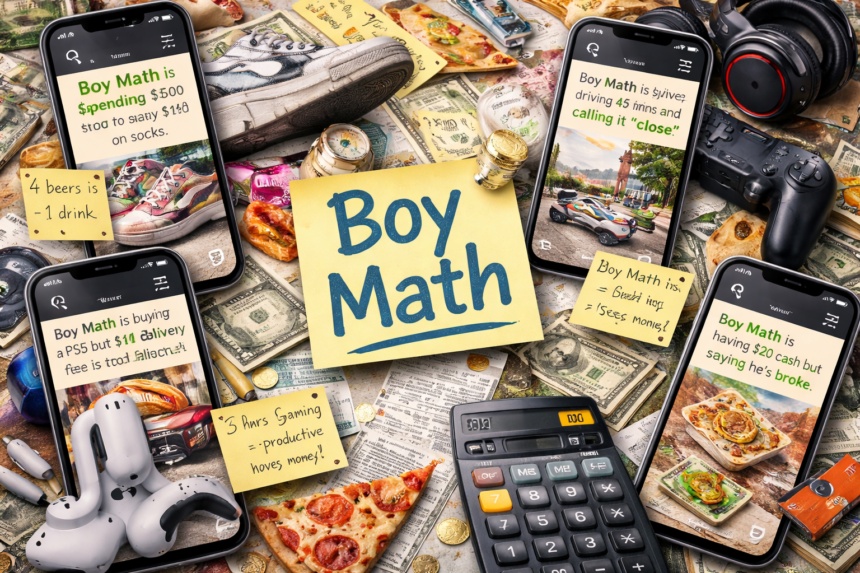
There is a certain kind of sentence that arrives on the internet looking like a joke and stays because it turns out to be a decent piece of social analysis. Boy Math is one of those phrases.
It spread the way many modern expressions do: fast, ironic, deceptively lightweight. At first glance, it reads like a throwaway meme, the sort of thing people post between screenshots and half-serious complaints. A man says spending more upfront “saves money” even when he never uses what he bought. A person insists a two-hour drive is “basically around the corner.” Someone rounds his height up, his losses down, and his football betting logic into something that sounds mathematically impossible. That, the internet decided, is Boy Math.
The phrase works because most people understand it instantly. Not literally, of course. No one is accusing boys or men of inventing a new branch of arithmetic. The joke is about selective reasoning: the tiny personal calculations people use to justify habits, preferences, ego, convenience, or contradiction. Boy Math turns those calculations into a social shorthand. And like the best pieces of online language, it says more than the joke itself.
What Boy Math Actually Means
Boy Math is a meme format people use to poke fun at the sometimes strange, inconsistent, or self-serving logic often linked to how guys behave—either in a playful way or a critical one. It usually comes across as a list of funny contradictions.

A classic example might be someone splurging on a cool gadget they barely use, only to turn around and say something like, ‘Are you serious? That basic necessity is too expensive!’ Another common angle targets things like dating logic, sports logic, money logic, gym logic, or that impressive, always-flexible math of male confidence.
It’s not meant to be a real academic theory, but it does tap into something real: basically, people often create stories in their head to make their choices seem logical, even when they’re clearly not.
That’s probably why the phrase caught on so quickly. It’s specific enough to be funny, but broad enough that you can keep using it over and over for different situations.
The internet had already been playing around with something similar called ‘Girl Math,’ which made jokes about how women might justify purchases or look at spending. ‘Boy Math’ came along partly as a response to that, partly as a spin-off, and partly just to spread the joke around a bit more. According to Know Your Meme, both ‘Girl Math’ and ‘Boy Math’ became popular slang formats that really took off on TikTok and X in 2023, with ‘Boy Math’ popping up as people started riffing on those kinds of male-coded contradictions and exaggerations.”

The Rise of Boy Math on Social Media
What really propelled “Boy Math” into the spotlight wasn’t just its humor—it was how instantly recognizable it felt.

This phrase found its footing in a social media world already hooked on quick, punchy insights—short, shareable formats that let folks show off their clever takes. A meme that starts with “Boy Math is…” followed by a snappy one-liner barely asks anything of the reader. No background needed, no build-up required. The reader just jumps in, filling the gaps with their own experiences.
This makes “Boy Math” unusually effective content. It fits perfectly as a tweet, a TikTok caption, a line in an Instagram carousel, or even a cheeky joke from a brand’s social media team if they’re feeling bold. Plus, it thrives because it invites everyone to join in. Once people get the hang of the format, they can whip up their own examples endlessly. Meme culture absolutely loves templates, and “Boy Math” is a fantastic one.
According to Know Your Meme, the phrase really took off after “Girl Math” was already popular, and one of the first examples that got wide attention made fun of the idea that buying things in bulk always equals saving money. That detail is important because it shows how these trends develop and change. A meme rarely sticks to just one meaning; it becomes a lens through which users start rethinking everyday actions.

And that’s when “Boy Math” transformed into more than just a joke about questionable spending habits. It morphed into a sharp, quick take on masculinity, how people present themselves, and the contradictions of modern life.
Why Boy Math Feels So Familiar
The most impactful memes aren’t just random stuff. They really play on things people already recognize and notice, often by exaggerating them.
“Boy Math” feels relatable because it zeroes in on a certain kind of social thinking: being completely sure about something even when the reasons behind it aren’t very solid. It’s not always meant to be mean, and often it’s not even something people are doing on purpose. It’s just that common human tendency to defend our sense of self with arguments that don’t really hold up when you look closely.
This isn’t something men do alone, by any means. Everyone has their own version of this kind of “math” to justify their choices. But the meme really lands because it takes this everyday habit and connects it to a familiar male stereotype: that whole thing about being confident in numbers, systems, and their own personal way of seeing the world. That’s where the humor comes from—the person sounds logical, but it’s obvious they’re being totally illogical.
There’s also a subtle generational element at play here. Online humor these days increasingly favors a more indirect kind of critique. Instead of giving a long lecture on how gender roles are performed, people just share a quick joke, like how a guy might call a 45-minute walk “close” but think emotional honesty is “too much.” It gets the point across faster, sharper, and is more likely to be shared. The meme basically squeezes a whole lesson in sociology into one line and a knowing eyebrow raise

Boy Math and the Psychology of Everyday Justification
Beneath the surface of the joke, there’s a deeper truth: humans are incredibly skilled at justifying things to themselves.
For a long time, behavioral psychology has demonstrated that people often make choices based on feelings or habits, then later construct logical explanations as if they’d thought everything through deliberately. “Boy Math” is amusing because it vividly illustrates this disconnect. It highlights the stories people invent to protect their self-image: “I’m practical,” “I’m efficient,” “I’m strategic,” or “I’m definitely not just making this up as I go.”
This gap is actually more significant than the meme might imply.
When people chuckle at Boy Math, they’re also acknowledging how identity is defended through small, selective uses of logic. The guy who splurges on his own hobby but laughs at someone else’s spending isn’t just being contradictory; he’s legitimizing the things that align with his personal sense of value. The person who dismisses emotional effort while expecting endless empathy isn’t doing math, of course, but they’re definitely calculating what makes them feel comfortable.
A lot of online humor thrives because it lets us offer criticism without getting bogged down in heavy analysis. Boy Math provides exactly this. It’s easy to understand socially, carries a gentle sarcasm, and is just believable enough to hit home.
Boy Math as Cultural Commentary
This is where the phrase gets more interesting.
At surface level, Boy Math is a meme about male-coded nonsense. At a deeper level, it reflects how internet culture now talks about gender: through micro-observations, irony, and shorthand that can be both affectionate and accusatory at the same time.
Older media often treated gender commentary in broad stereotypes. Contemporary online language tends to work in smaller, more precise fragments. It notices behavioral details. The overconfidence. The selective thrift. The emotional double standards. The casual inflation of statistics—height, scores, savings, effort. Boy Math packages all of that into a two-word label.
That compactness is powerful, but it is also limiting. As with most meme language, the phrase can flatten people into types. Used well, it is observational comedy. Used lazily, it becomes a bucket for cheap clichés. That tension follows almost every viral term now: it begins as insight, then risks becoming lazy shorthand once everyone starts using it.
Still, the popularity of Boy Math says something valuable about digital culture. People want language for patterns that are easy to feel and hard to summarize. A meme gives them that language.
The Business of Boy Math: Why Brands and Media Love These Trends
There is also a commercial angle here, and it is not subtle.
Phrases like Boy Math are highly attractive to publishers, creators, and brands because they combine searchability, relatability, and shareability. They can anchor explainers, reaction posts, listicles, video scripts, and branded social content. A good meme phrase becomes content infrastructure.
That helps explain why internet slang now travels beyond the platforms that created it. Once a phrase begins on social media, digital media outlets package it as a trend piece, creators turn it into skits, and marketers test whether they can borrow the language without sounding painfully late. Some succeed. Many do not.
For media brands, though, the appeal is obvious. A term like Boy Math offers an entry point into larger conversations: gender scripts, consumer behavior, online language, digital irony, even parasocial identity performance. It is catchy enough for traffic and flexible enough for analysis.
That is the real economic value of meme culture. It gives media a constant stream of cultural hooks that feel timely without requiring a breaking-news event.
Where Boy Math Goes From Here
Most internet slang burns bright and disappears. Boy Math may not remain dominant forever, but the pattern behind it absolutely will.
The future of online language looks increasingly modular: short phrases that act like social diagnostics. They identify a behavior, assign it a witty label, and turn recognition into participation. That format is not going away because it suits the speed of digital attention.
What may change is the level of sophistication. Audiences are getting faster at spotting when a trend has been overused, commercialized, or stripped of its bite. For a phrase like Boy Math to retain value, it has to keep doing more than recycling lazy stereotypes. The best examples reveal something fresh about how people justify themselves, perform competence, or negotiate identity in public.
That is why the phrase has outlasted its first burst of novelty. It still gives people a compact way to describe contradictions they encounter every day.
More Read

Conclusion
Boy Math may have started as a meme, but its staying power comes from something deeper than internet humor. It captures the strange, familiar ways people dress up contradiction as logic and call it common sense. That is what makes the phrase funny, but also culturally useful.
More than a passing trend, Boy Math reflects how digital culture now explains behavior through irony, shorthand, and instantly recognizable patterns. The joke lands because it is not really about numbers at all. It is about confidence, self-justification, and the stories people tell to make their choices sound reasonable. In that sense, Boy Math is less a meme about men and more a mirror held up to modern social behavior—sharp, exaggerated, and uncomfortably accurate.
Final Insight for The Vue Times
At The Vue Times, trends like Boy Math are worth taking seriously not because they are profound on their own, but because they reveal how modern culture thinks in public—through jokes, shorthand, and social patterns that travel faster than formal commentary ever could.
The internet rarely invents human behavior. It simply gives old contradictions a new name.
A phrase like Boy Math sounds disposable until you notice how accurately it maps the logic people use to protect ego, justify spending, and turn inconsistency into confidence. That is the quiet brilliance of the meme. It makes irrationality look neat, then invites everyone else to point and laugh.
And maybe that is why it sticks. Not because it is about boys, exactly. Because it is about the stories people tell when they want their contradictions to sound like facts.
Frequently Asked Questions
What is Boy Math?
Boy Math is a viral internet phrase used to joke about irrational or self-serving logic often associated with male behavior. It usually highlights contradictions involving money, dating, confidence, or everyday decision-making.
Where did the Boy Math trend come from?
The trend grew out of social media conversations around Girl Math in 2023. It gained traction on platforms like TikTok and X, where users began posting examples of exaggerated “male logic” in meme format.
Why is Boy Math trending online?
It is trending because the format is instantly recognizable, easy to remix, and funny in a very specific way. People see familiar behavior in it, which makes the joke easy to share and adapt across platforms.
Is Boy Math meant to be offensive?
Usually, no. It is mostly used as playful social commentary. That said, like many meme trends, it can slip into stereotype territory when people use it lazily or turn it into a broad attack rather than a pointed joke.
What is an example of Boy Math?
A common example would be someone spending heavily on a hobby he uses twice a year while calling everyday necessities “a waste of money.” The humor comes from the mismatch between confidence and logic.
Is Boy Math the same as Girl Math?
They are related, but not identical. Both are meme formats built around humorous irrationality, yet they focus on different gender-coded behaviors and social expectations. Boy Math often leans toward confidence, exaggeration, and selective reasoning.