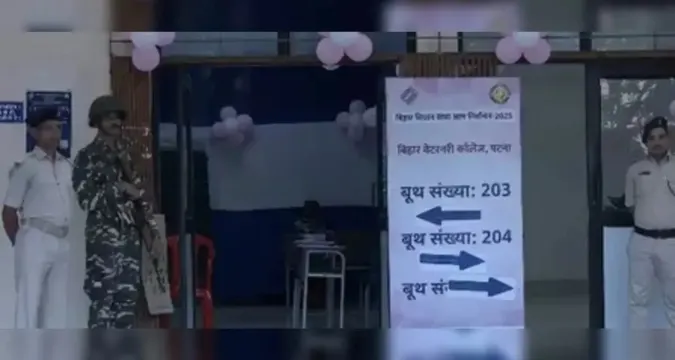
It was 6 November 2025 and the sun was rising over the plains and flood-plains of Bihar and, literally, a high stakes democratic exercise had started. The initial stage of the Bihar Legislative Assembly election has just been inaugurated in 121 counties in 18 districts of the state of Bihar, a moment politically, socially and developmentally charged with the destiny of India. Here is a detailed exploration of the history of polling, the dynamics behind it, and how this affects the governance process and policy makers, and what this could tell us about the changing voice of the state at the national level.
The Basics: What is on-the-line
This is the year of elections of all 243 seats in Bihar Assembly and Phase 1 has 121 seats to contend. The second day will be on 11 November and counting will be done on 14 November.
Why does this matter so much? Bihar is one of the most populous states in India with sizable electorate, both rural and city constituencies, substantial representation of Scheduled Castes, Scheduled Tribes and Other Backward Classes and endures years of issues in governance, infrastructure and migration as well as social change. Here voters are not only deciding on a state government but sending their messages on how politics, economy and society in India is changing.
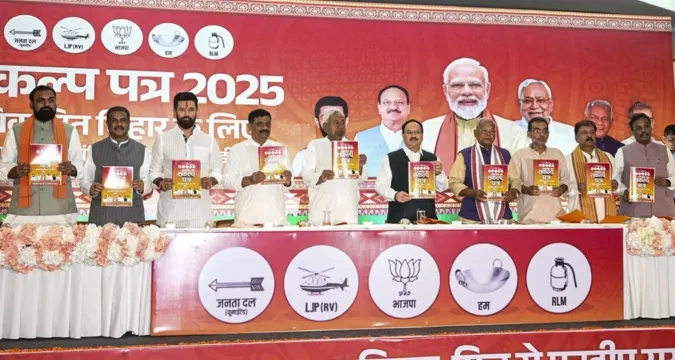
During the last election in 2020, an alliance (incumbent) mainly headed by the Bharatiya Janata Party (BJP) and the Janata Dal (United) (JD(U)) became the winners of that election (NDA). The question is now whether or not the opposition led by the bloc of the Rashtriya Janata Dal (RJD) can change the terrain.

Notably, the electoral rolls received massive revision in precedence to this election and through a Special Intensive Revision (SIR) at which massive removals and additions were made into the electoral roll, which since became itself a politically charged procedure.
Phase 1: Key facts and figures
Phase 1 scale and tempo is eye opening:
There are more than 3.75 crore voters who can cast their ballots in the 121 constituencies in this phase.
The official commencement of polling will be at 7 a.m. and will persist until 6 p.m (some constituencies will close earlier due to security/logistical reasons) on 6 November.
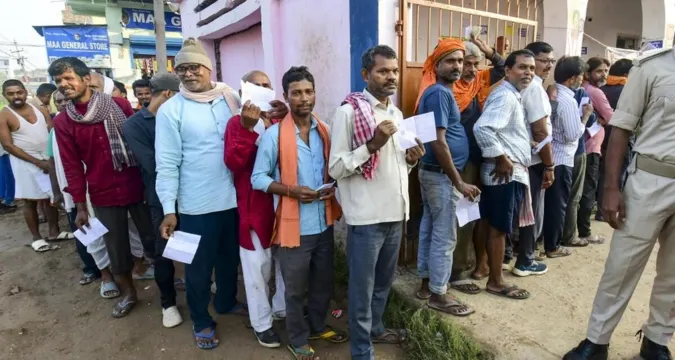
Voter turnout was at 13.13 per cent at around 9 a.m.- early signs of how the electorate is reacting this time.
Some of the key constituencies to consider include the major battlegrounds of Raghopur, Alinagar, Chhapra, Saharsa, Madhepura, Tarapur, Mokama and Siwan.

These figures are not mere bureaucratic–they are indications. Indeed, a 13 per cent turnout rate during the first two hours will indicate a decent mobilisation, but of real concern will be the performance of women, youth, first-time votes and historic low turnout numbers.
Read More: Election News
The political battle-lines: Who fights, what?
At this point, the competition consists of well-known faces and developing plots.
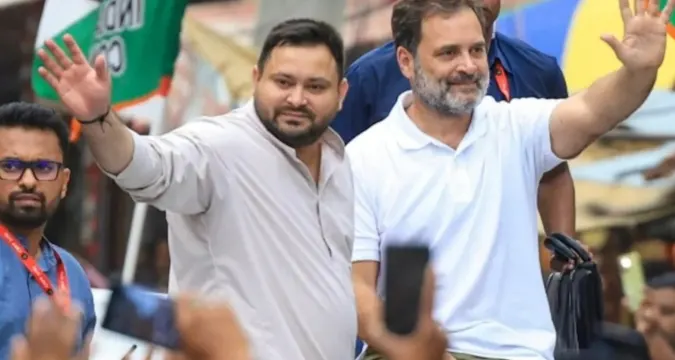
BJP and JD(U) are still prime players in the NDA side. The example is those leaders like Samrat Choudhary (Deputy CM and BJP), who are running in Tarapur (Phase 1) and have symbolic value.

To the opposition, it was a strong strategic push as the Mahagathbandhan experimented with its chief ministerial face of Tejashwi Yadav (RJD) who was to run in the Raghopur constituency.
To top it all the landscape is also complicated by the fact that there is a newer political party, the Jan Suraaj Party (JSP) under the leadership of strategist-cum- politician Prashant Kishor. Their presence is addressed to the Bihar politics of fragmentation and re-alignment even as their ground-reality of being a subject is pervasive.
Story-lines that bear pointing out:
Governance and “double engine” performance – The NDA boasts of development, law and order, infrastructure in Bihar, commonly purporting to be a “double engine government” (i.e. state plus central synergy). In its turn, the opposition promises jobs, rural development and improvement of the standard of living.
Jungle law and order, the spectre of jungle raj – The discussion is often made to refer to the question: has Bihar emerged out of bad times or does it open up to a retrogression? An example is the mention of jungle raj in the mass media.
Youth, migration, first time voter – A large number of migrant workers in Bihar come work in Bihar; the question of how many are going to vote, how many will not vote and what their expectations are always accompanies the election.
Electoral roll controversy There has been controversy over the SIR ( Special Intensive Revision), which purged about 65 lakh names, and has added new names, as to whether it is in the best interest of one or the other side. Although the Election Commission of India (ECI) insists that the process was absolutely normal, the opposition has raised an outcry.
What the initial step insinuates about the Bihar future
Farewell, identity, hello, performance?
Bihar politics has been, historically, an affair of caste identity, community alliances and strong person-politics. These are still very pertinent but indicators that are pointing to performance concerns such as generating employment, education, migration welfare, and infrastructure are becoming eminent. The presence of a young folk singer-candidate of the BJP, Maithili Thakur of the BJP, who is fighting this phase (from Darbhanga) indicates parties are trying to bring young symbolism to the idea of the campaign.
This is not to say that identity is no longer important–not at all–but only to observe how parties bring the traditional interpersonal arithmetic to bear the newer demands.
The issue of voter turnout and its importance
A 13% turnup by 9 a.m., and a strong per cent turn up in such historically highly engaged seats as Minapur (Muzaffarpur), suggests that this election will potentially result in surprises in the participation realms. With high turnout in women areas, youth areas, the first time area and area of migrants, then this may work against the challenger (opposition) since the status-quo factor would be favourable to the incumbent when turn-out was large. One such metric will be tracking the change in turnout within the different socio-economic groups.
Fragmegration and its influence on politics
To add to this, due to the entry of Jan Suraaj and the fact that even the Aam Aadmi Party (AAP) has now announced plans to seek all 243 seats (but not alliance partnering) in Bihar, the election front is more scattered than typically. This can result in a three-cornered fight, vote-splitting and even the unexpected seat result in fragmentation. The strength of NDA could be based on the effectiveness of the system in turning the share of votes into seats in a divided race.
The accountability in governance is escalating
The campaigns signal change: now the campaigns are not merely promising new handouts or even new symbolic changes, there is an impression that more will be expected to be removed. The ruling coalition cannot afford to capitalize solely on legacy appeals, because jobs, migration, women empowerment, and corruption within the system are the new core of the oppositional narrative. Such constituencies as Mokama (where the RJD candidate Veena Devi is running) are not only in the circle of interests of personality politics but law-and-order, migration workers issues, and local government.
The next step to watch: Key indicators and turning points
- a) Women voting and young people appeal – There is in no doubt that parties are actively making an appeal to the 2 level groups. The number of booths installed in riverine areas and those assigned to different-abled voters (as revealed in some of the earliest polling reports) is an indication that logistical inclusion is being made differently-enabled.
- b) Constituency-based tendencies – The narratives at the state level are very important, but the final result will be determined by localized personalities, micro-issues and alliances. As an illustration, Raghopur (seat contested by Tejashwi) and Tarapur (seat contested by Samrat Choudhary) will show the outcome of the front-runners. It will be educational to follow any large surprises in such marquee seats.
- c) Historically low-engagement areas – In case districts traditionally registering low turnout (e.g. remote areas, areas that have a high migrant population) report an increase in turnout, it may tip the balance. The engaged voter revolution referred to by some of the outlets might be actual.
- d) Post-poll tie mathematics and the outcomes of governance– Despite the potential fragmentation and entrants even after the count, a complex process may ensue of consensus-building. The trick is not only about who is going to succeed but how can the post-poll government be stable.
Indian and Vue Times readership strategic implications
To get a bigger picture in the eyes of readers of The Vue Times: Bihar is not an ordinary state election. It may be a mini-cosm of the changing democracy in India. It can have a number of national trends reflected in a number of trajectories beginning in Bihar:
Vindication or consolidation of traditional political identities to issue-based politics (jobs, migration, infrastructure).
How difficult it is to those in power when a voter wants promises, but fulfillment.
Voter roll revision, migration and urbanisation and their impact on election results.
The interests of governments with contrast to symbolic politics in large, diversified states.
Concisely, the voting patterns of Bihar in the coming phase will provide information about the voting patterns of India, both the state assemblies, and the national parties.
More Read

Conclusion
The Phase 1 polling of the 2025 Bihar Assembly elections is a turning point in the life of the state and consequently the history of democratic progress of India. The indicators that will arise due to the turnout, party ratings, the turnout of youths, and women, as 3.75 crore voters start casting their ballots in 121 constituencies will contribute to the narrative.
In the case of the NDA incumbent alliance, the question is simple: how to rebrand institutional memory and development claims into a new mandate. To the Mahagathbandhan and other parties, the avenue is to turn momentum into reality in terms of electoral rewards. The only thing which is yet to be observed is whether this election would be turning around on local matters or would lift up to trace a greater country line of reform.
We shall keep on monitoring not just the vote counts but also the changes behind the vote counts in terms of voter attitudes, expectation of governance and the political set up. The counting on 14 November will provide the verdict, but the narrative commences in the present–with all the votes that attaches, all the voting offices that are opened, and all our communities who have to go into the voting booth anticipating something less about politics and more.
Sources:
The Times of India, NDTV, The Economic Times, The Indian Express, LiveMint, India Today, ISAS Singapore, The Indian Times, Wikipedia.