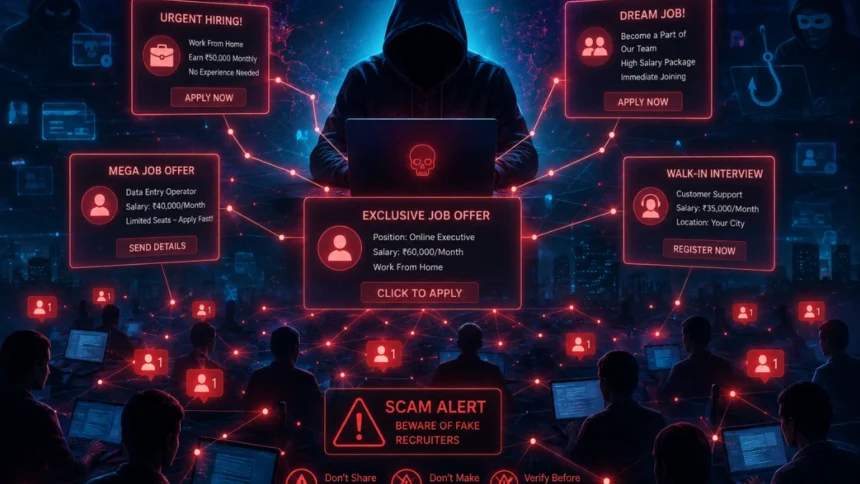
There’s a certain kind of desperation that scammers understand very well.
A student waiting for campus placements that never arrive. A laid-off professional scrolling through LinkedIn at 2 AM. A fresher applying to fifty jobs a week with no replies. A parent hoping for a stable work-from-home opportunity after years away from employment.
Online job scams in India thrive in these emotional gaps. And over the last few years, the scale has exploded.
What once looked like poorly written emails from suspicious addresses has evolved into something far more convincing. Fake HR executives now conduct polished Zoom interviews. Fraudsters copy real company logos, clone websites, create LinkedIn profiles, and even issue forged offer letters with joining dates and employee IDs. Some scams go as far as building fake onboarding portals.

The scary part is not that these scams exist. The scary part is how normal they’ve started to look.
In the broader conversation around Jobs & Education, this issue has quietly become one of the biggest digital risks facing young Indians entering the workforce.
Why Online Job Scams Are Increasing in India
The fundamental truth is that AI literacy is rapidly evolving into career literacy.
Over the next five years, students entering the job market will probably need to:
Collaborate with AI systems.
Validate content produced by AI.
Formulate more effective questions.
Handle information effectively.
Apply critical thinking even with increased automation.

Educational institutions that solely emphasize memorization might end up preparing students for a diminishing job market.
Conversely, students who acquire the skills to work with intelligent systems could adapt more quickly across various sectors.
This doesn’t diminish the importance of traditional knowledge.

Instead, it highlights that readily available information is no longer the scarce resource.
What’s valuable now is the ability to interpret it.
To exercise judgment.
To be creative.
And to think critically.
Ironically, the widespread adoption of AI might actually increase the value of uniquely human capabilities.
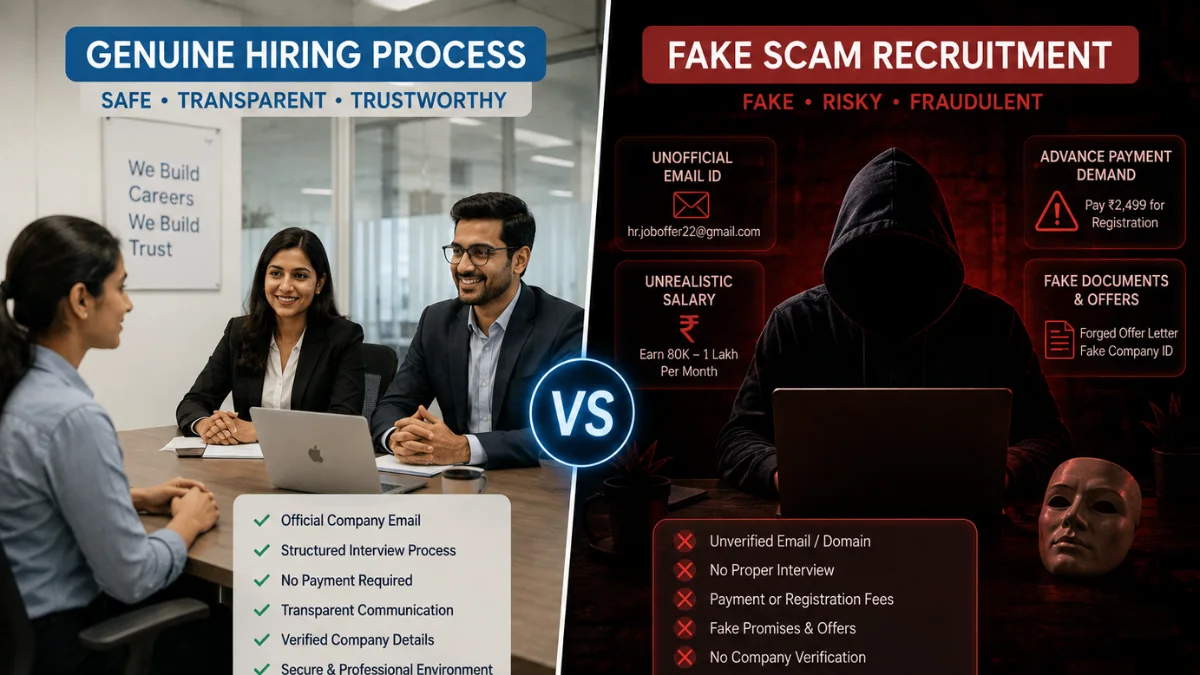
The Biggest Red Flag: Paying Money for a Job
A legitimate employer will never ask you to pay for any part of the recruitment process.
This includes things like:
Interviews
Training materials
Verifying your documents
Security deposits”
Laptop fees
Registration fees
Despite this, countless individuals still end up sending money each month because these scams are often presented very professionally.
Sometimes the requested amount is quite small, like ₹499 or ₹1,999, making it seem more trustworthy. Other times, the demands gradually increase through various “processing stages.” Unfortunately, victims often don’t realize they’ve been scammed until they’ve already invested significant time and emotional energy into the situation.
Scammers are adept at leveraging a key aspect of human psychology: once someone has committed to a course of action, they tend to stick with it, even if doubts begin to surface.
This is precisely why many fraudulent recruiters will keep candidates engaged for several days before eventually asking for payment.
Fake Work-From-Home Jobs Are Becoming More Sophisticated
The old stereotype that scam jobs are “too obvious” just doesn’t hold up anymore.
Scams today look polished, up-to-date, and professionally branded.
A common scam in India involves fake data-entry or review jobs. Candidates are promised quick money for simple, repetitive tasks like rating apps, reviewing hotels, boosting products, or doing typing assignments.
At first, they might even get small payments to build trust.
Then, suddenly, the platform demands “unlock payments,” “premium tasks,” or deposits before they can keep earning. By the time people realize they’ve been tricked, they’ve already sent over a substantial amount of money.
The increase in remote work made online hiring seem normal, but unfortunately, it also made fake online workplaces seem normal too.
How Fraudsters Use Real Company Names
One of the most dangerous trends is impersonation.
Scammers now pretend to recruit for real companies — sometimes large multinational firms. They copy branding from official websites, use fake HR names, and create email addresses that look almost authentic.
A single extra letter in the domain name is often enough to fool people.
For example:
- company-careers.com instead of company.com
- hr@amaz0njobs.com instead of an official corporate email
- recruitment-india.net styled like a real portal
Some even conduct fake interviews using scripted technical questions to appear legitimate.
This creates confusion because victims often think: “Why would someone go to this much effort just to scam me?”
The answer is simple. Because it works.
The Psychology Behind Job Scams
Most people assume scams succeed because victims are careless. That explanation is too simplistic.
Job scams succeed because they exploit hope.
When someone has been unemployed for months, logic weakens under emotional pressure. The desire for certainty becomes stronger than suspicion. That’s especially true in a highly competitive market where many applicants already feel invisible.
Scammers intentionally create emotional momentum:
- quick responses
- instant shortlisting
- exaggerated praise
- unusually high salaries
- promises of easy hiring
Real hiring processes are often slow, imperfect, and bureaucratic. Fake ones are smooth because they’re designed to manipulate.
Ironically, many scam jobs look “better organized” than genuine recruitment.
How to Verify Whether a Job Offer Is Real
A few simple habits can eliminate most risks.
Check the Email Domain Carefully
Legitimate companies usually recruit through official domains. Random Gmail or Outlook addresses should immediately raise suspicion, especially for large companies.
Even when domains appear professional, read them carefully letter by letter.
Search the Recruiter on LinkedIn
Does the recruiter have a credible profile?
Do they have genuine connections and activity?
Are they connected with actual employees from the company?
Fake profiles often look recently created or strangely inactive.
Visit the Official Careers Page
Never trust only the message you receive. Cross-check the job opening on the company’s official website.
If the job doesn’t exist there, be cautious.
Never Share Sensitive Documents Too Early
Many frauds are also identity theft operations.
Avoid sending:
- Aadhaar copies unnecessarily
- PAN details without verification
- bank information
- OTPs
- selfies for “KYC approval”
Some scammers use stolen candidate data for financial fraud later.
Be Suspicious of Unrealistic Salaries
A fresher role offering an unusually high salary with almost no screening process is not a lucky break. It’s usually bait.

Telegram and WhatsApp Recruitment Scams
Messaging apps have become major recruitment scam hubs.
The structure is predictable:
- Random recruiter message
- Attractive salary
- Minimal qualification requirement
- Urgent response demand
- External payment or registration request
These scams spread quickly because forwards create social proof. If many people are already in the group, it appears trustworthy.
But volume is not credibility.
In many cases, entire fake recruitment ecosystems operate through Telegram channels with thousands of members — all designed to manufacture legitimacy.
The Business of Digital Employment Fraud
Online job scams are no longer isolated crimes. They’re organized business models.
Some operations run call centers. Others buy leaked databases of job seekers from shady platforms. Many target users who recently uploaded resumes publicly.
This is where the conversation becomes bigger than individual awareness.
India’s employment ecosystem increasingly depends on digital trust:
- recruitment portals
- online interviews
- freelance marketplaces
- remote onboarding
- AI screening systems
If trust collapses, the entire hiring environment becomes more fragile.
The long-term danger isn’t just financial loss. It’s psychological damage. Victims become suspicious of genuine opportunities too.
That creates hesitation in an already uncertain job market.
Why Young Job Seekers Are Most Vulnerable
Freshers often face the highest pressure with the least experience.
Many don’t yet know how professional hiring actually works. So they rely heavily on emotional cues:
- friendliness
- fast replies
- impressive branding
- urgency
- verbal assurance
Scammers weaponize all of this.
Students from smaller towns moving into digital-first hiring spaces are particularly targeted because they may not have strong professional networks to verify opportunities.
This is why colleges and universities increasingly need digital fraud awareness as part of career preparation.
Employability now includes scam literacy.
What Safe Job Searching Looks Like in 2026
The safest candidates are not paranoid. They’re methodical.
They verify before trusting.
They slow down urgent conversations.
They question unrealistic promises.
They research companies independently.
They avoid emotional decision-making.
That approach matters more than ever because AI-generated scams are becoming harder to detect. Deepfake interviews, cloned voices, and AI-written HR communication may soon blur the line between fake and real even further.
The future of recruitment will likely involve stronger identity verification systems, official hiring authentication, and platform-level fraud detection. But until then, awareness remains the first defense.
And awareness is no longer optional.

Final Insight
A healthy job market depends on trust. The moment desperation becomes a business model for fraudsters, the damage goes far beyond stolen money.
Online job scams in India reveal something uncomfortable about the modern internet: professional ambition itself has become exploitable data.
The challenge now isn’t just finding opportunities. It’s learning how to separate opportunity from manipulation.
In the coming years, digital literacy in the world of Jobs & Education will matter just as much as technical skills or degrees. Because the ability to recognize deception may become one of the most important survival skills of the online economy. Stay Updated Stay Informed- The Vue times
Frequently Asked Questions
What are online job scams in India?
Online job scams are fake recruitment schemes where fraudsters pretend to offer employment opportunities to steal money, personal data, or financial information from job seekers.
How can I identify a fake job offer?
Common signs include requests for payment, unrealistic salaries, urgent joining pressure, unofficial email addresses, and poor verification details about the company or recruiter.
Do real companies ask for registration or interview fees?
No. Legitimate employers do not charge candidates for interviews, onboarding, training, or job confirmation processes.
Are WhatsApp and Telegram job offers safe?
Not always. Many scammers use messaging apps because they allow fast communication and mass targeting. Always verify opportunities through official company websites.
What should I do if I get scammed by a fake recruiter?
Immediately stop communication, report the fraud to the cybercrime portal, inform your bank if money was transferred, and preserve screenshots and transaction records.