India’s Russian Crude Pause: How Washington’s October Sanctions Are Re-Shaping New Delhi’s Oil Import Strategy
The Week Oil Flows Faltered
A harrowing slump in Indian crude oil importation of Russia was experienced in the week end October 27, 2025 of 1.19 million barrels per day (bpd) as compared to 1.95 million bpd in the previous two weeks.

This rapid decline, accentuated by ship-tracking information of global commodity analytics provider Kpler, occurs immediately following fresh sanctions levied on Russian oil conglomerate Rosneft and Lukoil on October 22 by Washington.
The sanctions, which will be enforced on November 21, are already making waves in the world of logistics in the oil sector, payments, and insurances. On the one hand, Indian refiners, who had long followed discounted barrels of Russia since 2022, are now taking a cautious step, reevaluating agreements and other supply paths.
To India where over 85% of its crude needs are imported, these disruptions are not simply a trade glitch. They hit at the heart of its energy security, improving economics and the diplomatic juggling game between Moscow and Washington.

Data Snapshot: India’s Weekly Russian Oil Imports – October 2025
| Week (2025) | Average Russian Crude Imports (million bpd) | Change | Remarks |
| Oct 6 – Oct 13 | 1.92 | — | Stable high imports |
| Oct 14 – Oct 20 | 1.95 | +0.03 | Pre-sanction surge |
| Oct 21 – Oct 27 | 1.19 | -0.76 | Immediate drop post U.S. sanctions |
| Oct 28 – Nov 3* | Est. 1.25 | Marginal rebound | Awaiting confirmation |
(Data based on provisional tanker tracking; subject to revision.)
Dependence: India, Between Opportunistic Buyer and Strategic Partner
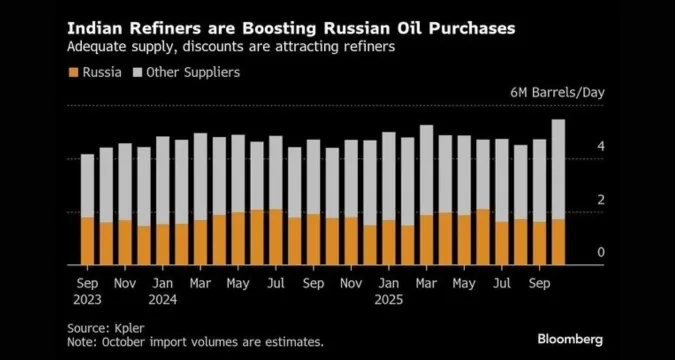
Upon the start of the reduction of Russian crude purchases by Western countries in early 2022, India intervened. By mid-2023 Russia surpassed both Iraq and Saudi Arabia to become the largest supplier of crude to India, frequently offering discounts up to $10 -15 per barrel over the Brent levels.
Imports reached almost 2.08 million bpd by June 2025 and this is the highest point in 11 months. Indian refiners like Indian oil corporation (IOC), Bharat petroleum (BPCL) and Nayara energy specifically configured their refining slates to endeavor Russian grades such as Urals, Sokol and ESPO with high efficiency.
This was not simply a commercial change, this was a strategic change. Russia provided crude on a non-geopolitical basis whereas India could get cheap energy to support its industrial and transportation systems during inflation in the international market.
Yet, this mutually beneficial equation has been put to test by the October sanctions

The Sanctions Shock: What Happened After October 22
On October 22, the U.S Treasury Department announced specific sanctions on Rosneft and Lukoil due to its breach of the G7 price cap system and alleged circumvention by using shadow fleets.

- Limitations make financial operations, freight insurance, and shipping by vessels loaded with oil of Russian origin more complex.
- This also led traders in refineries in India and other countries to start reducing orders beforehand as a matter of precaution or risk of exposure or secondary sanction.
The export of Rosneft to India decreased to 0.81 million bpd (it was 1.41 million bpd the last week).
The shipments of Lukoil went to zero during the same period
Although the sanctions do not explicitly target Indian buyers, they leave a gray zone of compliance that refineries are highly likely to act with utmost caution.

Analysts in the industry say that before trade patterns can stabilize, or the average time of long-haul delivery of crude at the Russian ports to the Indian refineries, four to six weeks may go by.
Recalibration of Supply: Indian Search to Find New Sources
As the Russian barrels supply flow was interrupted, Indian refiners have resorted to Latin America, Middle East and West Africa to fill the gap in the supply.

Brazilian, Guyana and Nigeria oil has begun showing up higher in November buying lists. At the same time, Middle Eastern grades, especially those of Saudi Arabia and the UAE, are experiencing a push.
These sources are a temporary relief but they are not as deeply discounted as Russian oil used to be. Latin America freight expenses are also higher and are impacting refining margins.
One senior industry executive was quoted as saying, we are not dumping Russian oil, but we are diversifying to have less exposure risk.
Such expedient re-calibration emphasizes the multi-alignment politics of India, the juggling between relations with Washington and complaints to Moscow.
You May Want To Read This: US Tariffs On Russia Oil Buyer
The Dilemma of the Refiners: Diskit or Diplomacy?
Indian refiners have now found themselves in a difficult trade- off between economics and geopolitics.

Economic Impact
Russian oil was a savior of expense. The mean landed price of Russian Urals crude in the middle of 2025 was approximately 73 per barrel, as opposed to 85-88 similar Middle Eastern grades. An increase in the overall cost of crude basket cost in India by a margin of $8-10 per barrel is a possibility with the sustained decrease in imports of Russia.
Refining Adjustments
Refiners had streamlined operations to Russian mixtures. The actual shift of African or American crude will compel a recalibration of processing temperatures, blending ratios and objective residues, which could have an impact on output efficiency.
Diplomatic Balancing
The principles of Washington and sovereignty of New Delhi tend to clash. India has always projected that it purchases oil where it makes sense and denies any dictates one-sidedly. But U.S. tariff threats (as in the current case this winter with the Trump administration) are still a cause of worry.

Therefore, refiners are like quiet shock absorbers of geopolitics – as the world powers tussle over who will hog the oil even as refiners continue making sure the fuel flows.
Bigger Impact: World Market Spillover
The reduction in shipments to India of Russian goods resonates with the world oil ecosystem as well.
- To Russia, the two largest outlets after the war in Ukraine are India and China. A decline in Indian demand may require a redirection of cargoes to Asia-Pacific or lowering of deeper discounts by Moscow.
- To world prices, any Russian export bottleneck is a supply tightening, putting an upward pressure on Brent benchmarks, which increased by almost 2% in late October after the sanctions.
- Shipment, longer shipping routes through the Cape of Good Hope and avoiding European insurers are driving the price of freight up.
- Such dynamics are the inception of a new stage of the global oil realignment, in which politics can prevail over pure market logic.
You May Want To Read This: India’s Green Energy Transmission
Professional opinion: Tactical loss or long-term relocation?
Energy economists are still split as to whether this is some temporary dip or the beginning of structural realignment.
Short-Term Outlook:
The imports can turn round prior to the November 21 sanction activation date when the Indian refiners scramble to capture shipments that are already in transit. Others project flows to reach 1.5-1.6 million bd by end November.
Medium-Term Risk:
Should U.S. implementation become more restrictive, then the insurers and shippers can retreat, compelling India to reduce even more of its Russian volumes. Analysts predict an average 20-25% decline in Russian crude share by Q1 2026.
Long-Term Opportunity:
The disruption can be used to enhance energy diversification by India, which includes investing in partnerships with Africa, importing more U.S. LNG, and advancing its hydrogen and biofuel agendas.
Visual Insight: India’s Crude Import Evolution (2022–2025)
| Year | Russia (%) | Iraq (%) | Saudi Arabia (%) | Others (%) |
| 2022 | 10 | 24 | 21 | 45 |
| 2023 | 23 | 20 | 17 | 40 |
| 2024 | 27 | 18 | 15 | 40 |
| 2025 (Oct est.) | 31 | 16 | 14 | 39 |
This visual demonstrates how dramatically Russia rose in India’s crude sourcing portfolio and how the current sanctions could begin reversing that curve.
Energy Autonomy and Strategic Realignment
In addition to the barrels and percentages, the dream of energy sovereignty in India, as an overall objective, is highlighted by this episode.

The country has to maintain its policy of foreign policy of strategic autonomy along with its dedication to affordable and safe energy to all.
Therefore, the direction that India takes probably will not be one-sided to either Moscow or Washington.
Rather it will proceed with its own path, buying where it can and negotiating where it must and making sure that no one partner has a veto in its energy future.
The Great Power or Prudence
The Russian sharp decline in oil exports to India at the end of October 2025 is not simply an anomaly in statistics. It portrays the tension between domestic and international policing, economic rationality and political capital.

With the intensification of sanctions and transitions in supply chains, the decisions made by India will define not only its own economy but also the oil order in the world. This is yet to be seen whether it is a hiatus or a precursor to change.
However, one aspect stands out; the energy diplomacy of India is now entering the most delicate, decisive stage that the nation has only so far, a test of its capacity to remain pragmatic in a polarization-ridden age of power.

Sources
- Reuters, Indian Russian Oil Imports Increase in October (2025).
- Indian Express, Signs of Pullback: Russia Oil Exports to India Came to a Sharp Drop post-US Sanctions.
- Financial Times, Mittal JV Says It has ceased to purchase Russian oil.
- The Bloomberg Energy desk, October 2025 Tracking Report.
- India Crude Import Data Analysis (June-Oct 2025) Business Standard.
- Kpler Vessel Tracking Database
- Global Oil Flow Rebalancing 2025, Energy Economics Review.