

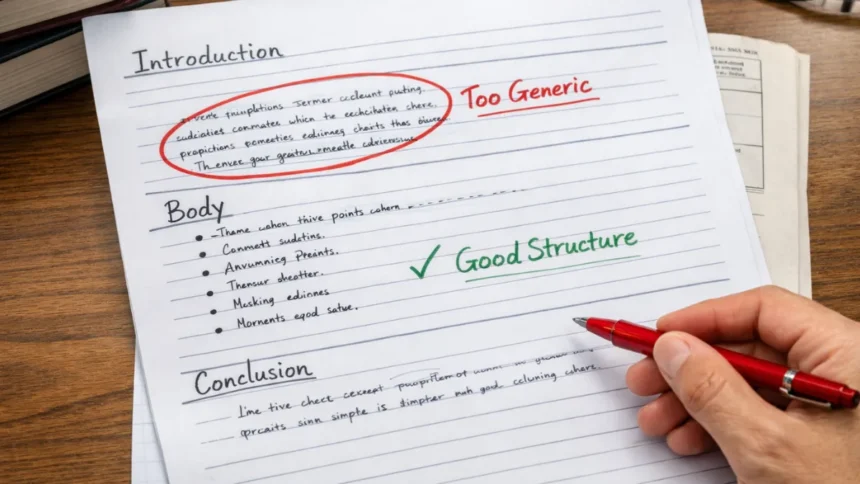
Government exam aspirants often assume that knowledge guarantees marks. In reality, marks are awarded for evaluated presentation, structure, and relevance. Most candidates lose scores not because they lack content but because of consistent Answer Writing Mistakes that reduce clarity, structure, and examiner comfort. These mistakes convert potentially high-scoring answers into average responses. In descriptive examinations like UPSC Civil Services Examination, SSC CGL (descriptive tier), and state PCS exams, structured writing directly influences score bands.
This article breaks down practical exam scoring errors, explains why they occur, and provides a correction framework you can implement immediately.
Problem Statement
Serious aspirants face three recurring challenges:
- They write long but score low.
- They attempt all questions but marks remain inconsistent.
- Evaluators comment: “Too generic”, “Lacks structure”, “Poor conclusion”, “No examples”.
These are not knowledge problems. They are execution failures.
The most common Answer Writing Mistakes include:
- Ignoring directive words (Discuss, Analyze, Evaluate)
- Writing introduction-heavy answers
- No subheadings or visual structure
- Lack of examples or data
- No linkage to question demand
- Missing conclusion alignment
Each of these is a technical mistake, not a conceptual deficiency.
Concept Clarity
Before correction, understand how answers are evaluated.
Examiners assess answers on:
- Relevance to question
- Structural clarity
- Content depth
- Analytical balance
- Conclusion quality
- Presentation efficiency
They do not reward:
- Length without relevance
- Decorative vocabulary
- Memorized introductions
- Repetitive content
Most exam scoring errors occur because candidates write what they know instead of answering what is asked.
Core Principle:
Every paragraph must serve the question demand.
If a line does not directly address the directive, it reduces density and lowers marks.

Practical Framework to Avoid Answer Writing Mistakes
Step 1: Decode the Directive
Common directive words:
- Discuss → Multiple dimensions
- Analyze → Break into components
- Evaluate → Strengths + Weaknesses + Judgment
- Critically Examine → Arguments + Counterarguments + Balanced conclusion
Misreading directives is a major exam scoring error.
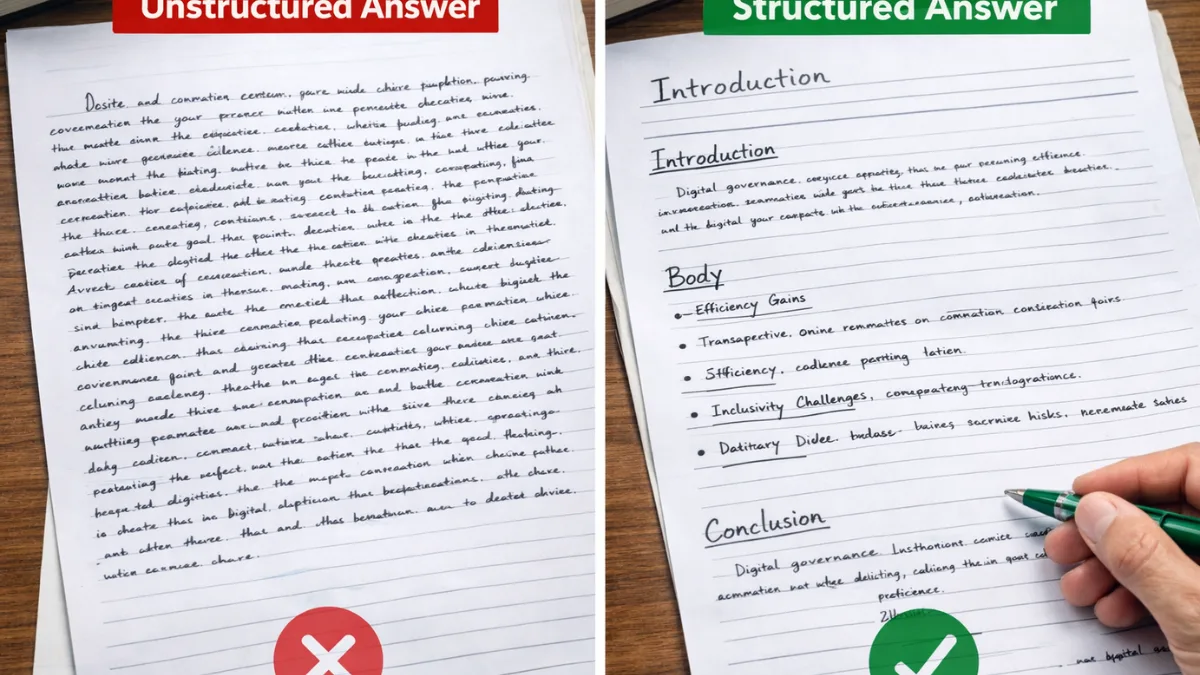
Step 2: Use a 3-Part Structure (Compulsory)
Introduction (2–3 lines)
Define context + connect to question.
Body (Structured Subheadings)
- Dimension 1
- Dimension 2
- Dimension 3
- Data/Example
Conclusion (Forward-looking or solution-based)
Policy direction, reform, linkage to constitutional values.
Model Answer Snippet (Short Format)
Question: Analyze the role of digital governance in improving service delivery.
Introduction:
Digital governance integrates technology into administrative systems to improve transparency, efficiency, and citizen access.
Body:
- Efficiency Gains – Automation reduces processing time.
- Transparency – Online tracking minimizes corruption.
- Inclusivity Challenges – Digital divide limits rural access.
- Data Security Risks – Privacy concerns in centralized databases.
Conclusion:
Digital governance improves service delivery when supported by infrastructure expansion and data protection safeguards.
Notice:
- No unnecessary background history
- Balanced dimensions
- Clear subheadings
- Direct relevance
This eliminates common Answer Writing Mistakes.
Mistake vs Correct Approach Comparison
| Mistake | Why It Reduces Marks | Correct Approach |
| Writing full-page introduction | Wastes word limit | 2–3 contextual lines |
| No subheadings | Hard to evaluate | Structured points |
| Only advantages | Lacks analysis | Add counterpoints |
| No conclusion | Abrupt ending | Policy-oriented closing |
| Vague examples | Low credibility | Use schemes/data |
Most Common Answer Writing Mistakes
1. Ignoring Word Limit
Exceeding limit reduces completion speed and lowers precision. Writing 250 words for a 150-word answer signals poor control.
2. Generic Introductions
Starting every answer with:
“India is a developing country…”
“In the modern era…”
These are non-scoring lines.
3. No Link Back to Question
Candidates discuss the topic broadly but fail to directly address what was asked.
Example:
Question: “Evaluate impact of climate policies.”
Answer: Explains climate change history.
This is an exam scoring error.
4. No Data or Examples
Examiners reward specificity:
- Government schemes
- Committee recommendations
- Constitutional Articles
- Case studies
Absence of these lowers depth perception.
5. Poor Paragraph Formatting
Long unbroken paragraphs discourage reading. Structured spacing improves evaluation comfort.
6. Imbalanced Answers
Writing 80% pros, 20% cons in a “critically examine” question shows directive ignorance.
7. Missing Multi-Dimensional Coverage
High-scoring answers include:
- Economic
- Social
- Political
- Administrative
- Technological
- Environmental
Single-dimension answers cap marks.
8. Lack of Concluding Insight
Answers ending abruptly lose finishing impact.
A strong conclusion:
- Suggests reform
- Connects to constitutional values
- Mentions sustainability or inclusivity
Tactical Application: How Correction Improves Marks
Correcting Answer Writing Mistakes improves scoring in measurable ways:
1. Enhances Evaluator Readability
Structured answers reduce cognitive load. Examiners can quickly assign marks.
2. Improves Analytical Perception
Balanced arguments demonstrate maturity.
3. Maximizes Word Efficiency
Dense answers score more than lengthy vague answers.
4. Increases Attempt Completion
Better time control allows full paper completion.
5. Improves Consistency
Structured format reduces performance fluctuation across papers.
In exams like UPSC Mains and various State PSC Mains, structure alone can increase marks by 10–20% without additional study.
Improvement Plan (Execution Model)
Daily Practice (45 Minutes)
Step 1 – 10 Minutes:
Pick one previous year question.
Step 2 – 5 Minutes:
Break down directive and dimensions.
Step 3 – 20 Minutes:
Write answer within word limit.
Step 4 – 10 Minutes:
Self-evaluate using checklist:
- Did I follow directive?
- Are subheadings visible?
- Are examples included?
- Is conclusion aligned?
Weekly Correction Framework
Day 1–3: Write 3 answers daily
Day 4: Peer or mentor review
Day 5: Rewrite weakest answers
Day 6: Time-bound full section
Day 7: Analyze recurring exam scoring errors
Self-Evaluation Rubric (10 Marks Model)
| Criteria | Marks |
| Relevance | 2 |
| Structure | 2 |
| Content Depth | 2 |
| Balance | 2 |
| Conclusion | 1 |
| Presentation | 1 |
Score yourself honestly.
Internal Reading for Structured Improvement
- [How to Analyze Previous Year Questions Effectively]
- [Self-Evaluation Method for Government Exams Preparation]
- [Avoiding Generic Answers in Government Exams]
These support elimination of recurring Answer Writing Mistakes.
Advanced Tactical Corrections
1. Use Micro-Structuring
Instead of:
“Economic benefits include job creation and GDP growth.”
Write:
Economic Impact:
- Job creation
- GDP expansion
- Sectoral diversification
Micro-structuring improves evaluator scanning speed.
2. Insert Anchors
Examples:
- NITI Aayog recommendations
- Supreme Court judgments
- Constitutional Articles
Anchors convert generic answers into credible responses.
3. Practice Directive Switching
Write same answer in:
- Discuss format
- Analyze format
- Evaluate format
This builds flexibility and reduces directive-based exam scoring errors.
4. Use Conclusion Templates (Adaptive)
Reform-based:
“Strengthening institutional capacity remains critical.”
Constitutional-value-based:
“Ensuring justice, equality, and accountability must guide reforms.”
Sustainability-based:
“Long-term viability depends on balanced policy design.”
Templates reduce abrupt endings.
More Read

Conclusion
High scores in descriptive government exams are not determined by knowledge volume but by structured execution. Most aspirants repeatedly commit the same Answer Writing Mistakes—ignoring directives, overloading introductions, lacking structure, and missing analytical balance. These exam scoring errors reduce marks even when content is adequate.
Eliminating these mistakes requires a mechanical correction system:
- Directive decoding
- Structured formatting
- Balanced dimensions
- Data anchoring
- Conclusive alignment
When applied consistently, this transforms average answers into high-scoring responses. Correction of Answer Writing Mistakes is not an optional refinement—it is a scoring strategy.