

Why Tech Companies Invest in AI: The Real Race Behind the Hype


The moment you open your phone and your apps already seem to know what you want, the story quietly reveals itself. Recommendations feel sharper. Searches feel faster. Even customer service feels less human—and strangely more efficient. None of this is accidental. It is the visible surface of a much deeper shift: why tech companies invest in AI is no longer a question of curiosity, but survival.
What used to be a futuristic experiment has now become a baseline expectation. Companies aren’t just building AI products; they are restructuring entire businesses around it.
The Quiet Shift: From Tool to Core Strategy
A decade ago, artificial intelligence was mostly an add-on—a feature. Today, it is the foundation. Companies like Google, Microsoft, and Amazon are not investing in AI because it’s trendy. They are doing it because AI is redefining how value is created.
Search engines are no longer just indexing pages; they are generating answers. Cloud platforms are no longer just storage; they are intelligence layers. Even operating systems are evolving into predictive ecosystems.
The shift is subtle but profound: AI is no longer a tool companies use—it is becoming the system companies are built on.
Why Tech Companies Invest in AI for Competitive Advantage
Competition in tech has always been about speed—who can build faster, scale faster, and adapt faster. AI changes all three.
When a company integrates AI deeply, it doesn’t just improve efficiency; it accelerates decision-making. Algorithms can analyze patterns across millions of data points in seconds, something no human team can replicate at scale.
This creates a feedback loop:
- More users → more data
- More data → smarter AI
- Smarter AI → better user experience
- Better experience → more users
This loop is what makes AI such a powerful competitive moat. Once a company gains an edge, it becomes incredibly difficult for others to catch up.
That’s why tech companies are investing aggressively—not just to grow, but to avoid falling behind.
[caption id="attachment_9984" align="alignnone" width="1200"] Artificial intelligence transforming data into insights visualization[/caption]
Automation Is Just the Beginning
A common misconception is that AI is primarily about automation—replacing repetitive tasks. While that’s true, it’s only the entry point.
The real value lies in augmentation.
AI doesn’t just replace work; it reshapes it. Developers now write code with AI assistance. Designers brainstorm with generative tools. Marketers analyze campaigns using predictive insights.
Instead of removing humans from the process, AI changes what humans focus on:
- Less time on execution
- More time on strategy and creativity
This shift is why companies see AI not as a cost-cutting tool, but as a productivity multiplier.
Data Is the New Infrastructure
If oil defined the industrial age, data defines the digital one. And AI is the engine that makes that data useful.
Tech companies have spent years collecting massive datasets—user behavior, preferences, interactions. But raw data alone has limited value. AI transforms that data into actionable intelligence.
This is another reason why tech companies invest in AI so heavily: it unlocks the value of what they already own.
For companies like Meta, AI powers everything from ad targeting to content moderation. For streaming platforms, it drives recommendation systems that keep users engaged. For e-commerce giants, it predicts what customers might buy next before they even search.
The more data a company has, the more powerful its AI becomes—and vice versa.
The Economics of AI: Scale Changes Everything
Traditional business growth often requires proportional increases in resources—more customers, more employees, more infrastructure.
AI breaks that pattern.
Once an AI system is trained, it can scale to millions of users with relatively low incremental cost. A chatbot can handle thousands of conversations simultaneously. A recommendation engine can serve millions of users in real time.
This scalability is one of the biggest economic incentives behind AI investment.
It allows companies to:
- Expand globally without proportional hiring
- Maintain consistency across large user bases
- Deliver personalized experiences at scale
In simple terms, AI enables companies to do more with less—and do it faster.
Why Tech Companies Invest in AI for Innovation, Not Just Efficiency
Efficiency explains part of the story. Innovation explains the rest.
AI is opening doors to entirely new categories of products:
- Generative AI tools for content creation
- Autonomous systems in transportation
- Intelligent assistants that go beyond basic commands
These are not incremental improvements—they are new markets.
Companies investing in AI today are not just optimizing existing products; they are positioning themselves to define the next generation of technology.
This is why AI investment often looks excessive from the outside. Billions are being poured into research, infrastructure, and talent—not for immediate returns, but for long-term dominance.
[caption id="attachment_9986" align="alignnone" width="1200"]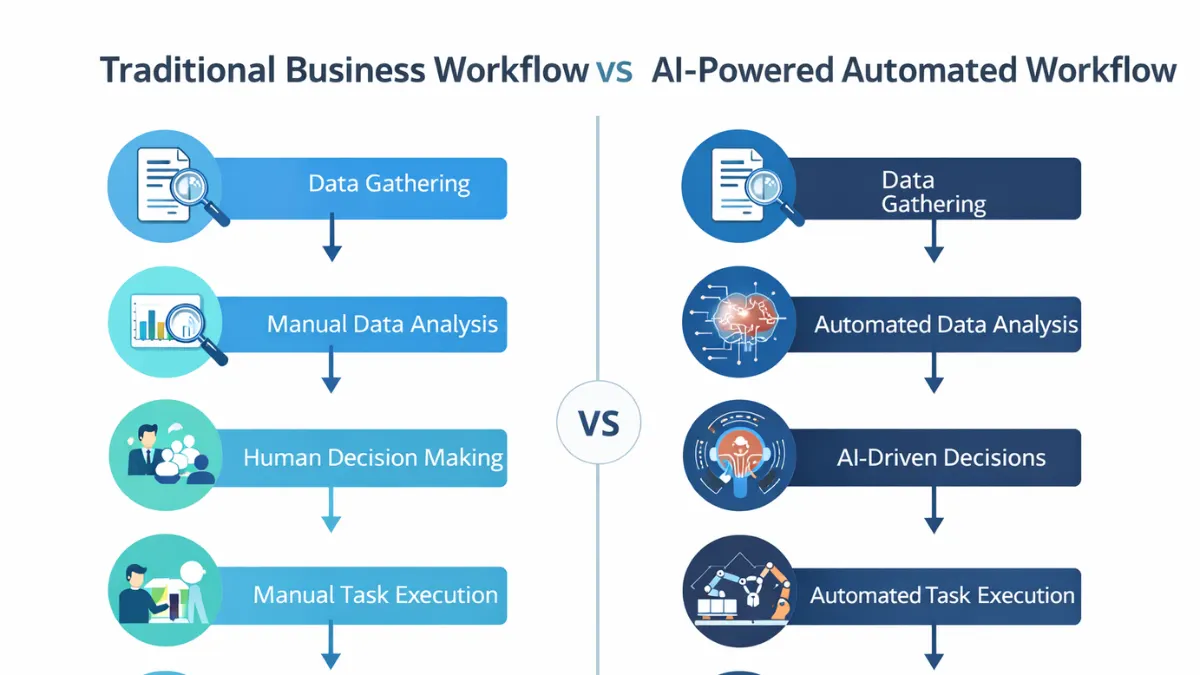 Comparison of traditional workflow and AI-powered automation system[/caption]
The Talent War Behind AI
One of the less visible aspects of AI investment is the race for talent.
Top AI researchers and engineers are among the most sought-after professionals in the world. Companies are offering massive compensation packages to attract and retain them.
Why? Because AI is not just about technology—it’s about who builds it.
A breakthrough model, a more efficient algorithm, or a better training method can shift the balance of power in the industry. Talent becomes a strategic asset.
This is why partnerships, acquisitions, and research labs are becoming central to AI strategy.
The Risk Factor: Why Not Investing Is More Dangerous
Perhaps the most important reason why tech companies invest in AI is risk avoidance.
Not investing carries its own cost.
Companies that ignore AI risk becoming irrelevant. We’ve seen similar patterns before—businesses that failed to adapt to the internet, mobile, or cloud computing eventually lost their edge.
AI represents a similar inflection point.
It’s not just about gaining advantage; it’s about staying in the game.
The Psychological Layer: Control and Prediction
Beyond business metrics, there’s a deeper layer to AI investment—control over uncertainty.
AI allows companies to predict behavior:
- What users will click
- What they will buy
- When they might leave
This predictive capability reduces uncertainty in decision-making. It gives companies a sense of control in an otherwise unpredictable market.
In many ways, AI is not just a technological investment—it’s a psychological one.
What This Means for the Future
The trajectory is clear. AI will continue to move closer to the center of every major tech company’s strategy.
We are likely to see:
- More AI-native products (not just AI-powered features)
- Deeper integration across platforms
- Increased regulation and ethical debates
- Greater dependence on AI for everyday decisions
The companies that succeed will not be the ones that use AI occasionally, but the ones that build around it entirely.
[ruby_related heading="More Read" total=5 layout=1 offset=5]Conclusion
The question is no longer whether AI will shape the future—it already is. The real question is who will shape AI.
Why tech companies invest in AI comes down to a mix of ambition and necessity. It’s about building faster, thinking smarter, and staying relevant in a landscape that changes overnight.
The technology itself is powerful. But the decisions around it—how it’s used, scaled, and controlled—will define the next era of business.
Final Insight
At The Vue Times, we don’t just track trends—we decode the thinking behind them. AI isn’t just transforming technology; it’s reshaping how companies compete, innovate, and survive. The smarter question isn’t whether AI will dominate—it’s how intelligently it will be used.
Frequently Asked Questions
What is the main reason tech companies invest in AI?
Tech companies invest in AI primarily to gain a competitive advantage. It helps them process data faster, improve user experiences, and scale operations efficiently.
Is AI investment only about automation?
No, automation is just one part. AI also enhances decision-making, creativity, and innovation across different business functions.
How does AI help companies make money?
AI improves personalization, reduces costs, and increases efficiency. It also enables new products and services, creating additional revenue streams.
Why is data important for AI?
AI relies on data to learn and improve. The more quality data a company has, the better its AI systems perform.
Will all tech companies need AI in the future?
Yes, AI is becoming a core part of digital infrastructure. Companies that fail to adopt it risk falling behind competitors.















Comments (0)