India is reportedly among the highest growing major economies in the globe. This is boasting about GDP growth and rising digitalization, the success of startups and fame abroad. But in the Indian homesteads, the case is entirely different.
Families feel poorer. Savings are shrinking. Salaries feel inadequate. Monthly budgets are no longer expanded up to the month end.
Such paradox begs the important question, why is the cost of living increasing at a higher rate than the income in India, despite the growth of the economy.
It is not an issue of perception. Millions of people live it as reality. In metro cities and small towns, among high-paid employees and the self-employed, the cost of living has been rising in India, becoming a silent crisis.

This explainer dissects the problem into historical background, the current reality on the ground, the governmental data views and careless future analysis.
When Growth Numbers Fall Short of Household Reality
The Indian economic development usually appears glamorous in the books. The growth of the GDP, development of infrastructure, and foreign investment indicate improvement. India has a different story to tell, however, about income vs inflation.
The pay increase has been slow and irregular, whereas essentials have been increasing their prices steadily. Income growth is not keeping up with basic inflation or even with basic inflation to many households and this has decreased the real income in India.
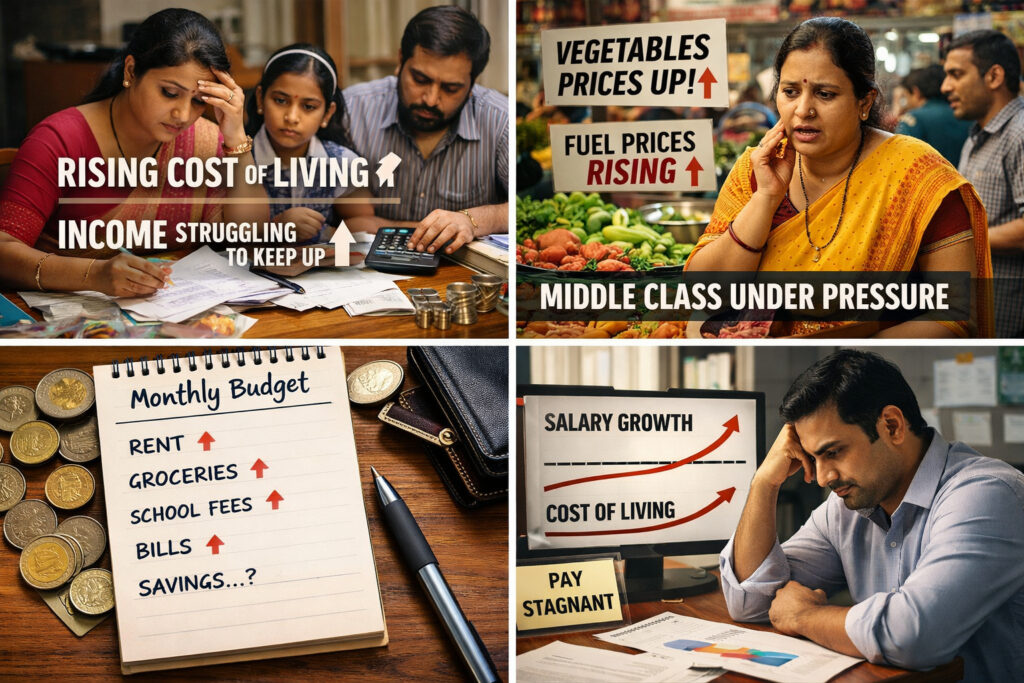
This disjuncture is what makes the Indian middle class crisis a prevailing social problem.
Learning Inflation Beyond Headlines
The effect of inflation is very much personal, though we talk about inflation as a figure.

Inflation means:
- Higher food prices
- Rising fuel costs
- Expensive housing
- Costlier healthcare
- Increasing education fees
Although the official price of inflation may seem to be under/controlled, in India where it has the greatest impact, on households, it means the rise of prices on the daily necessities.
That is why the inflation effect on middle class India is more acute than indicated by macro indicators.

An overview: The Onset of the Cost-of-Living Shift
At the beginning of 2000s, salary increments in India were higher than living expenses among urban professionals. The upward mobility was created through the liberalization, expansion in IT and development of service sectors.
As time went on, a number of changes took place:
- Urbanization accelerated
- Appetites among consumers grew.
- There was increased reliance on private services.
- Real demand was in advance of public services.
Such developments gradually transformed the economics of households, and the current crisis of cost of living in India.
The reason why salaries are not rising in India
Reasons why the salaries are not rising in India at a rate that people desire is one of the greatest causes of financial stress.
Key reasons include:
- Unemployment among skilled labor forces.
- Gig-based and contractual jobs.
- For example, automation that lowers the staffing requirements.
- Cost-cutting by companies
Employers have shifted interest towards efficiency rather than expansion decreasing wage growth despite the growth in workloads.
This idleness contributes to financial tension among middle classes in India.

Housing: The Suburban Elephant
The cost of housing has been on an upward trend relative to nearly any other cost.
Urban realities include:
- Rising rents in metros
- Increased home loan EMIs
- Service and maintenance fees.
In most households, housing is the sole expenditure that occupies 30-50% of the income hence, no savings.
The situation contributes significantly to household costs rising in India.
Daily Struggle and Food Inflation
Food inflation affects everybody, and it is the middle classes who are the worst affected.
Rising costs of:
- Vegetables
- Cooking oil
- Pulses
- Milk
Even smaller monthly grocery raises just escalate to high annual stress, further augmenting the cost of living vs salary growth India disparity.
Healthcare: Safety Net to Financial Risk
The healthcare cost has also increased significantly, particularly the private care.
Factors driving costs:
- Low public healthcare capacity.
- Expensive diagnostics
- Rising medicine prices
One medical emergency can eliminate years of savings which make the Indian middle class crisis.
Education Prices and generational load
Education is no longer merely in school fees.
Parents now pay for:
- Coaching classes
- Digital learning tools
- Skill certifications
Although education is perceived as an investment, the increasing cost is increasing the burden of middle-class India, particularly when there is uncertainty in future employment.

Hidden Inflation, Fuel, and Transport
Everything is influenced by fuel prices, including food transportation or daytime commuting.
The effect of fuel price increase even though it may stay stagnant in the short run is cumulative as it is silently increasing the rising cost of living in India.
Rural/ Urban: Living Different, Pressure the same
Whereas urban India has been experiencing inflation of rent and services, rural India is experiencing:
- Rising input costs
- Limited income growth
- Fewer stable jobs
The two have the same fate; income does not match the cost.
True-Life Story: The real world of a Middle-Class family
Take the example of Meena who is a school teacher in a city that is in tier-2.
Her wages went up a slightly before five years, however:
- Rent doubled
- School fees rose sharply
- Healthcare costs increased
Her family does not save as much money today as it was ten years ago even with stable employment. Her narrative is similar to millions of people with diminished real income in India.
What Government Data Implicates
Discussions on policies repeated numerous times by PIB and NITI Aayog point out:
- Lower and middle-income groups have disproportionate incidences of inflation.
- There is an imbalanced growth in wages.
- Financial stress is altering consumption behavior.
These insights appreciate the existence of a disparity between an economic development process and a comfortable household.

The Reason why the Middle Class is Feeling Trapped
The Indian middle-class tend to be in between two worlds
- Too “rich” for subsidies
- Too “poor” to absorb shocks
This leaves them as the most susceptible group in the cost of living crisis in India.
The Psychological Price of Increasing Costs
Financial stress affects:
- Mental health
- Family relationships
- Career satisfaction
The anxiety of struggling to maintain when the income is not increasing compounds anxiety within the households.
Inflation Strikes Bare necessities, Not luxuries
All costs are not similarly impacted by inflation in India. Families are denied the right to reduce expenses, the worst being in the most indispensable goods that see substantial price increases.
Key pressure points include:
- Pulses, vegetables, edible oil and milk.
- City rental prices and upkeep expenses.
- Cutting fuel costs on transport and logistics.
- Medical services and drugs.
- School fees, coaching classes and training of skills.
With the rise in essentials exceeding income, the households have to either give up savings, quality of life or long-term security.
Wage Increment is less than Inflation of cost
A primary factor behind the increase in cost of living as compared to the income in India is the wage stagnation in sectors.
Numerous workers in the private sector have had:
- Delayed salary increments
- Backward-looking minimum annual increases that are not adjusted to inflation.
- Unstable performance pay.
- Temporary and contract jobs that are substituting permanent jobs.
Even PSU and government wages, which are more stable, can hardly keep up with real inflation, when adjusted by the cost of living.
Urban India Is First to Feel the Pressure
Cities are the place of opportunity, but more expensive living. Urban households face:
- Increased rent as a result of a shortage of housing.
- Higher and commuting costs.
- Increased medical expenses and education.
- Hardly avoidable lifestyle costs.
It has become the norm among young professionals and migrant workers both to operate on a paycheck-to-paycheck basis even in the so-called high-paying jobs.
Rural India No Longer Untouched
Previously, the increased costs were perceived as a metropolitan issue. That is no longer true.
In rural households they are experiencing:
- Increased food costs as a result of inflation of the supply chain.
- Between 50 and 100 per cent higher prices of fertilizers and seeds and fuel.
- Public costs of health care because of absence of facilities.
- Migration pressure spending families more.
Increase in rural incomes has not been matched with rising prices, making them more vulnerable to debts.
Education has become a Financial Strain
Education which is viewed as a long term investment has become a significant source of financial strain.
Parents now spend heavily on:
- Tuition classes and private schools.
- Competitive exam coaching
- Professional development programs to enhance the ability to work.
However, in spite of these costs, employment results are not yet assured, a situation that is aggravating the middle-class families.
Costs in Healthcare Are Soaring Uncovered
One of the fastest rising cost factors in India is healthcare inflation.
Key issues include:
- High cost of diagnostics and treatment.
- Rising medicine prices
- Limited insurance coverage
Healthcare spending is dominated by out-of-pocket spending.
One medical crisis is enough to erase years of savings, particularly of middle-income families.
The Maximum Burden is Being Shouldered by the Middle Class
Indian middle-class lies between two realities:
- Too wealthy to receive the majority of government subsidies.
- Too destitute to comfortably absorb soaring individual costs.
This group faces:
- Huge taxation when compared to benefits.
- Limited social security
- Pressure to sustain social status all the time.
Because of this, the financial stress experienced by the middle-class population in India is attaining structure rather than a transitional period.
Consumerism Is Adding Hidden Costs
Costs are also increasing due to modern lifestyle.
Recurring services, online payments, and luxury extensions tend to seem minor charges on an individual basis, but add up to sorely taxing monthly expenses.
Most families do not appreciate:
- Recurring digital expenses
- Salary increases followed by lifestyle inflation.
- Credit-based consumption
By these factors the real income is diminished unobtrusively.
What Needs to Change: Structural Solutions
To solve the problem of rising cost of living relative to earnings in India, reforms on a systemic basis are needed:
- Growth in wages in association with productivity.
- Even better social healthcare and education.
- Housing policies that are affordable.
- Improved social security of private employees.
Tax relief to middle-income earners: as inflation rises, the relief decreases.
What People Can Do at the current moment
Essentials in actions to be taken in homes:
- Track expenses rigorously
- Build emergency savings
- Upskill in order to earn more income.
- Avoid lifestyle inflation
- Use credit cautiously
Systemic issues cannot be addressed on an individual basis but can be mitigated.
The Secret Border between Costs and Profits
Paper-wise, the economy of India is expanding. The GDP indicator is good, the infrastructure development is active, and digital services become a success. However, not easier but harder, monthly survival is becoming reality to millions of Indian households.
Unemployment is not the fundamental issue. It is the increasing divide between the rise in income and the cost of living. Salaries can increase by 5-8 percent every year, yet basic expenses such as food, housing, healthcare, education, transportation are increasing much higher.
This unspoken discrepancy is the reason why most Indians are poorer than they appear to be, because they are working.
How Professionals Can Adapt
Professionals should:
- Also update skills constantly.
- Diversify into other types of income.
- Negotiation compensation.
Adaptability becomes important in an economy where nothing is stable any longer.
Looking for the Future: Future Bolds
The growth story of India is still rocketing, but unless the well being of households improves it would remain at this point in time.
In case income growth is not kept up to living costs, social and economic strains would be deteriorated.
The Indian middle-class crisis cannot be solved casually but it is required to be addressed as the long-term stability will rely on it.
More Read

Final Takeaways
There is an increase in the cost of living but it is outpacing income.
- Necessities are the most affected by inflation.
- The increase in salaries is still not balanced.
- There is great pressure on the middle class.
- Enlightenment and conformity are essential.
Whether India is growing is not the question–but who is actually benefiting from that growth.