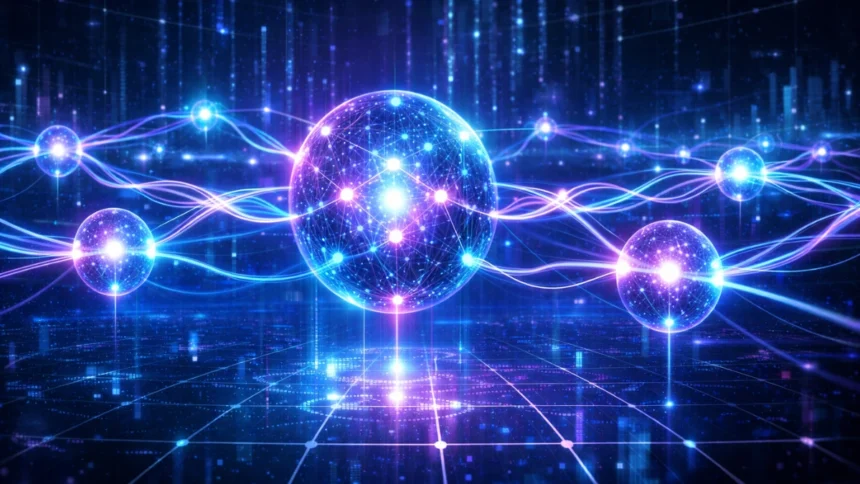
Late at night in a quiet research lab, a pair of photons are being separated. One is sent across a fiber cable, the other stays behind. Nothing unusual—until a measurement is made. Instantly, the state of the distant photon changes, as if the two are still connected despite the distance. No signal travels between them in the conventional sense. No delay. Just correlation.
This is not science fiction anymore. It’s the foundation of something that could redefine how the internet works: the quantum internet.
Understanding What Is Quantum Internet? requires stepping away from our привычный idea of data—emails, videos, messages—and into a world where information behaves differently, where copying data is impossible and where security isn’t a feature but a property of physics itself.
What Is Quantum Internet? A Different Kind of Network
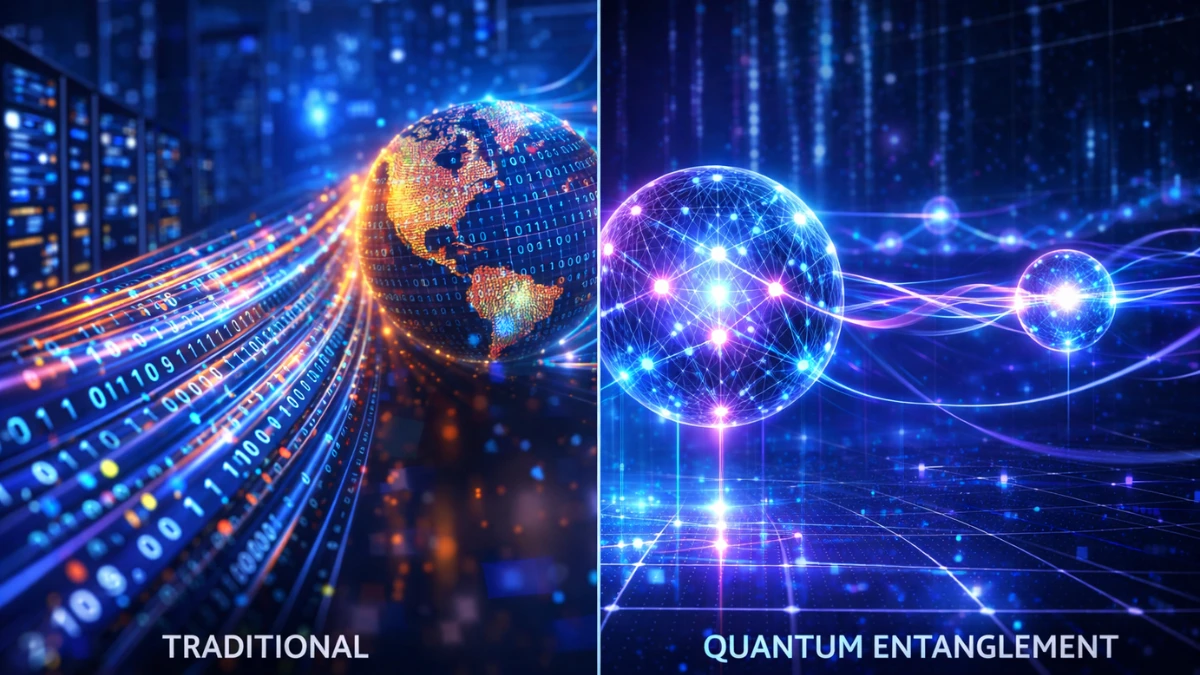
The classical internet moves bits—0s and 1s—through cables, satellites, and routers. It’s fast, scalable, and deeply embedded in modern life. But it has limits, especially when it comes to security and computational complexity.

The quantum internet operates on qubits instead of bits. These qubits rely on principles like superposition and entanglement. That means information isn’t just transmitted—it’s shared in a fundamentally different way.
At its core, a quantum internet is a network that connects quantum devices, allowing them to exchange quantum states instead of classical data. The most crucial mechanism here is quantum entanglement, where two particles remain linked regardless of distance.
Instead of sending information directly, quantum networks distribute entangled particles. When one is measured, the other reflects that measurement instantly, enabling a new type of communication protocol.
This isn’t about replacing your current internet overnight. It’s about building a parallel layer—a network for tasks that classical systems simply cannot handle efficiently.

How Quantum Internet Actually Works
It helps to think of the quantum internet less as a faster pipeline and more as a different logic altogether.

1. Entanglement Distribution
Quantum networks rely on creating and distributing entangled particles across nodes. These nodes could be quantum computers, sensors, or communication devices.
2. Quantum Teleportation
Despite the dramatic name, this doesn’t involve moving objects. Instead, it allows the transfer of quantum information from one location to another using entanglement and classical communication.
3. Quantum Repeaters
Unlike classical signals, quantum states can’t simply be amplified. Quantum repeaters are used to extend the range of quantum communication without destroying the delicate states.

4. No-Cloning Principle
In classical networks, data can be copied endlessly. In quantum systems, copying information is fundamentally impossible. This property is what makes quantum communication inherently secure.
These mechanisms make the system slower in some respects but far more powerful in specific applications—particularly in cryptography and distributed computing.
Why It Matters: Security Beyond Encryption
The modern internet runs on encryption. Banking systems, messaging apps, government communications—all depend on mathematical algorithms that are, for now, difficult to break.
But the rise of quantum computing threatens this balance.
A sufficiently powerful quantum computer could crack many of today’s encryption methods. That’s where the quantum internet becomes not just relevant, but necessary.
Quantum Key Distribution (QKD)
Quantum internet enablesh QKD, a method of sharing encryption keys in a way that immediately reveals any attempt at eavesdropping. If someone tries to intercept the key, the quantum state changes—alerting both parties.
This is security not based on complexity, but on physics.
In a world increasingly concerned about data breaches, surveillance, and cyber warfare, this shift is profound. It moves the conversation from “hard to hack” to “impossible to hack without detection.”
Beyond Security: A New Computing Ecosystem
Security tends to dominate the conversation, but the implications go further.
A quantum internet could connect quantum computers into a distributed network, enabling them to work together on problems that are currently unsolvable.
Imagine:
- Drug discovery simulations running across interconnected quantum processors
- Climate models with unprecedented accuracy
- Optimization problems in logistics and finance solved in real time
This isn’t just faster computing—it’s a new category of problem-solving.
There’s also a quieter application: quantum sensing networks. These could detect gravitational changes, seismic activity, or even subtle environmental shifts with extraordinary precision.
Why Now? The Timing of the Quantum Push
The question often arises: why is the quantum internet gaining attention now?
Part of the answer lies in the maturity of quantum computing research. Governments and private companies are investing heavily, and the limitations of classical systems are becoming clearer.
Another factor is geopolitical.
Countries are racing to develop quantum communication infrastructure. China has already demonstrated satellite-based quantum communication. Europe and the United States are building experimental quantum networks.
This isn’t just a technological race—it’s strategic.
Control over secure communication channels has always been a cornerstone of power. The quantum internet raises the stakes.
The Challenges No One Can Ignore
For all its promise, the quantum internet faces significant obstacles.
Fragility of Quantum States
Quantum information is extremely sensitive. Even minor disturbances—temperature changes, vibrations—can disrupt the system.
Infrastructure Limitations
Current internet infrastructure isn’t designed for quantum communication. Building a quantum network requires new hardware, including specialized fibers and repeaters.
Scalability
Creating entanglement over long distances reliably remains a major challenge. While experiments have succeeded over hundreds or even thousands of kilometers, scaling this globally is another matter.
Cost and Practicality
At this stage, quantum networks are expensive and complex. Widespread adoption will depend on making the technology more accessible and cost-effective.
These challenges are not trivial. But they’re also not insurmountable.
A Subtle Shift in How We Think About Information
What makes the quantum internet fascinating isn’t just its technical potential—it’s how it changes our understanding of information itself.
In classical systems, information is something you can copy, store, and transmit freely.
In quantum systems, information becomes fragile, contextual, and deeply tied to observation. It resists duplication. It reacts to measurement. It behaves less like a static object and more like a dynamic relationship.
This shift has philosophical implications as much as technological ones.
It forces us to rethink assumptions about privacy, ownership, and control in the digital world.
Future Implications: A Layer, Not a Replacement
It’s unlikely that the quantum internet will replace the classical internet entirely. Instead, it will function as a specialized layer.
For everyday browsing, streaming, and social media, classical networks will remain dominant.
But for:
- Secure communications
- High-stakes data transfer
- Advanced scientific computation
…the quantum internet could become indispensable.
Over time, the integration between classical and quantum networks will likely deepen. Hybrid systems will emerge, blending the strengths of both.
More Read

Conclusion
The idea behind What Is Quantum Internet? isn’t just about faster connections or better encryption. It’s about redefining what a network can do.
For decades, the internet has been about moving information efficiently. The quantum internet introduces a different goal: preserving and manipulating information in ways that were previously impossible.
There’s still a long road ahead—technical hurdles, economic barriers, and unanswered questions. But the direction is clear.
The next evolution of the internet won’t just connect devices. It will connect realities—classical and quantum—reshaping how we communicate, compute, and secure the digital world.
Final Insight
The quantum internet isn’t arriving tomorrow—but it’s already shaping decisions today. For businesses, policymakers, and technologists, ignoring it isn’t an option anymore.
💡 Stay ahead of the future of technology with The Vue Times—where complex innovations are explained with clarity and depth.
Frequently Asked Questions
What is Quantum Internet in simple terms?
→ Quantum internet is a new type of network that uses quantum physics to transmit information securely and efficiently, often using entangled particles instead of traditional data signals.
How is quantum internet different from the current internet?
→ The current internet uses bits (0s and 1s), while quantum internet uses qubits that can exist in multiple states. It enables ultra-secure communication and advanced computing capabilities.
Is quantum internet faster than regular internet?
→ Not necessarily faster in speed, but far more powerful for specific tasks like encryption, scientific simulations, and secure communication.
When will quantum internet be available?
→ Early versions already exist in research settings. Widespread adoption may take 10–20 years as technology and infrastructure mature.
Why is quantum internet important for cybersecurity?
→ It uses principles like quantum key distribution, which can detect any hacking attempt instantly, making communication extremely secure.