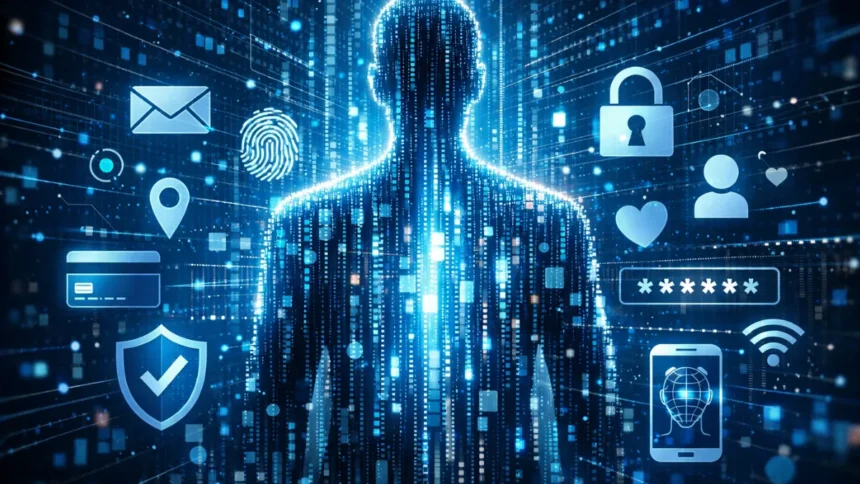
It rarely announces itself. No notification pops up saying your digital identity has just been updated. Yet every swipe, every login, every quiet scroll at midnight leaves a trace—small, invisible, but persistent.
A person might wake up, unlock their phone with a fingerprint, check emails, browse social media, make a payment, and perhaps sign into a work dashboard. By noon, they’ve interacted with a dozen platforms. By night, they’ve expanded a profile they never consciously built—but one that exists nonetheless.
That invisible profile is what we call digital identity.
And the more connected the world becomes, the less optional it is.

What Is Digital Identity? A Practical Understanding
Strip away the jargon, and what is digital identity? It is the collection of data that represents you in the digital world.
Not just your name or email—but a layered system of identifiers, behaviors, and credentials. It includes:
- Login details (usernames, passwords, biometrics)
- Personal information (age, location, preferences)
- Behavioral data (what you click, watch, search)
- Transaction history (payments, subscriptions)
- Device and network data (IP address, device IDs)
It’s not a single file stored somewhere. It’s fragmented, distributed, and constantly evolving across platforms.
In many ways, it behaves like a shadow—always present, shaped by your movement, but never fully visible to you.

From Paper Identity to Digital Presence
There was a time when identity was tied to physical proof: passports, voter IDs, signatures. Verification meant standing in line, presenting documents, waiting for approval.

The digital shift changed that entirely.
Today, identity travels faster than the person. You can open a bank account online, verify yourself with facial recognition, and sign documents digitally—all without stepping outside. Governments and corporations alike have invested heavily in digitizing identity systems.
In India, for instance, biometric-linked identity frameworks have redefined access to services. Globally, similar systems are emerging, blending convenience with centralized control.

But something subtle changed in the process. Identity is no longer something you present occasionally. It is something you continuously generate.
Why Digital Identity Suddenly Matters More
For years, digital identity existed quietly in the background. Now it sits at the center of how modern life functions.
Three shifts explain why.
First, everything is becoming account-based.
From streaming services to healthcare portals, access is tied to who you are digitally.
Second, personalization has become the default.
Algorithms depend on your identity to decide what you see—news, ads, recommendations. Your digital identity shapes your digital reality.
Third, security risks have escalated.
As identity becomes the gateway to financial systems, work platforms, and personal data, it also becomes the primary target for cyber threats.
A stolen password is no longer just an inconvenience. It can be a breach of your entire digital life.
The Layers You Don’t See
What makes digital identity complex isn’t just what it includes—it’s how much of it operates without your awareness.
There’s the declared identity—the information you knowingly provide.
There’s the observed identity—data collected based on your behavior.
And then there’s the inferred identity—assumptions made about you using algorithms.
For example, you may never explicitly say you’re interested in a topic. But your clicks, pauses, and search patterns tell a story. Over time, platforms build a version of you that may be surprisingly accurate—or sometimes uncomfortably wrong.
This layered construction is what powers modern digital ecosystems. It’s also what raises deeper questions about control and consent.
The Business of Knowing You
Digital identity is not just a technical concept. It’s an economic engine.
Companies don’t just serve users—they analyze them. Your identity fuels targeted advertising, product recommendations, and platform design.
The more precisely a company understands your digital identity, the more effectively it can predict your behavior. That prediction translates into revenue.
This is why free platforms often come at a hidden cost: your data.
And the trade-off is subtle. Convenience in exchange for visibility. Personalization in exchange for privacy.
Most users accept this exchange without fully examining it.
What Is Digital Identity in the Age of Trust and Risk
Trust used to be institutional. You trusted banks, governments, and organizations because they held authority.
Now, trust is increasingly digital—and fragile.
A single data breach can expose millions of identities. A phishing attack can mimic legitimate systems convincingly. Deepfake technologies blur the line between real and fabricated identities.
This is where digital identity becomes both a shield and a vulnerability.
Systems are evolving to strengthen authentication—multi-factor verification, biometrics, encryption. Yet the more complex the system becomes, the more valuable identity becomes as a target.
It’s no longer just about protecting accounts. It’s about protecting representation itself.

The Psychological Layer of Digital Identity
There’s a quieter dimension to this discussion—one that goes beyond security and economics.
Digital identity is also about perception.
The version of yourself that exists online is often curated. Profiles are edited, posts are selected, interactions are filtered. Over time, this curated identity begins to influence how others see you—and sometimes, how you see yourself.
There’s a feedback loop at play.
You present a version of yourself → the world responds → you adjust that version.
This dynamic isn’t new, but the scale is unprecedented. Millions of interactions, constant visibility, and algorithmic reinforcement amplify its impact.
The result is a digital identity that is partly authentic, partly constructed, and constantly negotiated.
Where It’s All Heading
The future of digital identity is not just about better passwords or stronger security. It’s about redefining ownership.
Emerging systems are exploring self-sovereign identity—where individuals control their own data rather than relying on centralized platforms. Blockchain-based identity frameworks aim to give users verifiable credentials without exposing unnecessary information.
Imagine proving your age without revealing your birthdate.
Or verifying your degree without sharing your entire academic history.
These shifts suggest a move toward selective transparency—where identity becomes more precise, yet more private.
At the same time, the integration of identity across devices, platforms, and even physical environments is accelerating. Smart cities, digital wallets, and integrated services all depend on seamless identity systems.
The challenge will be balancing efficiency with autonomy.
More Read

Conclusion
Digital identity is no longer a technical layer beneath the internet. It is the structure holding it together.
It defines access, shapes experience, drives economies, and influences perception. It is both a tool and a risk, a convenience and a question.
Understanding what is digital identity is less about definitions and more about awareness. Awareness of what is being created, who controls it, and how it is used.
Because in a world where identity is constantly being recorded, the real question is no longer whether you have a digital identity.
It’s whether you understand the one you’re building.
Final Insight
Your digital identity is not something you log into—it’s something you leave behind. The more connected the world becomes, the more intentional you must be about the traces you create. Stay Informed-Stay Updated-The Vue Times
Frequently Asked Questions
1. What is digital identity in simple terms?
Digital identity is the collection of data that represents you online, including your personal details, login credentials, and activity across websites and apps.
2. Why is digital identity important?
It enables access to services, personalizes online experiences, and plays a key role in security, making it essential in modern digital systems.
3. What are examples of digital identity?
Examples include your email account, social media profiles, online banking login, biometric authentication, and even your browsing behavior.
4. How is digital identity created?
It is built through the information you provide and the data collected about your online behavior over time across different platforms.
5. Is digital identity safe?
It can be secure if protected properly, but risks like data breaches, hacking, and misuse of personal data make it important to manage carefully.