
UPI Charges Explained
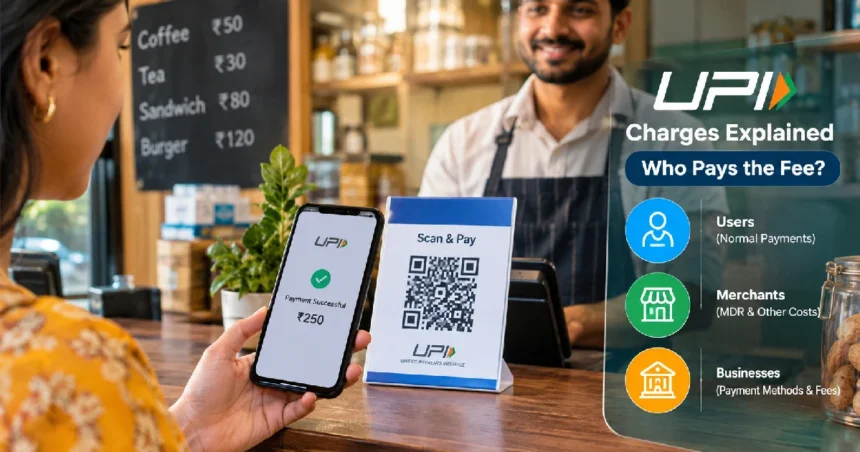
Suppose you go to your local café, which has a QR code at the counter, and you scan it with the UPI app to pay for your ₹250 coffee.Now, if you were to visit your local cafe, where you find the QR code at the entrance and you scan it using the UPI app to pay for your ₹250 coffee.
You pay ₹250, enter your UPI ID, UPI PIN and the money is deducted.
It’s easy for you, you spent ₹250 and received ₹250 from the merchant.
But, there’s another question that’s never really on the mind of most customers:
Is there a fee that someone has to pay for that UPI?
This is where the debate with regard to UPI charges can get complicated.
The news you may come across include UPI news, merchant charges news, MDR or charges associated with specific kinds of digital payment. But this doesn’t mean that all the UPI users, who are making a normal payment are now required to pay a payment fee.
So, whose money is it anyway?
Let’s do this in a very simple way.
First, What Is UPI?
UPI is an acronym of Unified Payments Interface. Developed by the National Payments Corporation of India (NPCI), it is an instant payment system that is regulated by the RBI.
It enables users to fund their bank accounts and pay merchants using these apps that are UPI-enabled.
For the common customer the process can be as simple as:
Scan → Enter Amount → Check Details → Enter UPI PIN → Pay
No need to provide a bank account number and IFSC code at each and every transaction.
One of the reasons for UPI’s becoming familiar in India is that it is a very simple process.
However, there are multiple entities involved in the background in this payment process such as the customer’s bank, the merchant’s bank, UPI apps and other payment service providers.
It’s in the cost part where things get a bit more complicated.
Do the Normal UPI Users pay any fee?
As a regular UPI customer, the customer is not likely to notice any separate UPI transaction cost extra for their regular transaction from their bank account.
If ₹1000 worth of groceries is bought on your bank account and you pay using UPI, the extra UPI fee would not be an additional amount that you would be liable to pay since the amount you see would be ₹1000, not ₹1000 + UPI fee.
NPCI’s UPI system is meant to allow for immediate bank account payment and its FAQ indicates that there is no requirement for the customer to pay charges for PPI transactions via UPI.
But that doesn’t imply that all the potential transactions that can be made with UPI have the same pricing.
Various payment products and transaction conditions can have varying rules.
That’s a significant difference.
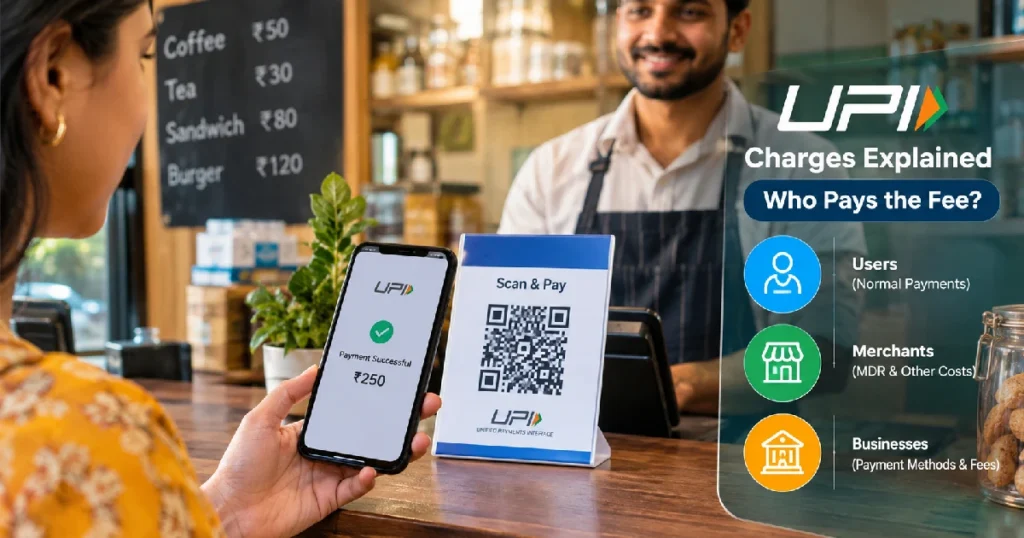
Then Where Do UPI Charges Come From?
This is where the fun of the merchant part starts.
There may be multiple organisations involved in a digital payment where the shop accepts a digital payment.
For example:
Customer → UPI App → Payment Service Provider → Banks → Merchant
The customer will be notified of a successful payment.
In the background, there must be a payment and it needs to be sorted out.
Costs can be present within the payment ecosystem between the parties involved in the payment in different payment methods and agreements.
You’ll come across a few terms in this discussion, one of which is MDR.
What Is MDR?
MDR is an insurance policy known as Merchant Discount Rate.
Simply put, it is a payment amount of some merchants.
It is, however, crucial not to impose an MDR on each and every UPI transaction.
These relevant economics may vary according to the payment instrument and the rules that are allowed to apply to that type of payment.
That’s why it is important to state the type of transaction when announcing the presence of a fee for UPI.
Different payment methods can be supported by the same UPI app and there can be different rules for different payment methods.
UPI Bank Payment is better than other payments.
Suppose if two customers buy a product of the same price of ₹2000.
Customer A pays directly using UPI from his/her bank account.
Customer B utilises a payment option that is related to a credit facility or other instrument that is accepted by the UPI.
Both can have the same transaction type (UPI payment) but the payment mechanism can be different.
This is especially true concerning RuPay credit cards coupled with UPI.
The operating guidelines for RuPay credit cards on UPI cover the merchant transactions as well and highlight Merchant Discount Rate (MDR) and Interchange arrangement. Under the above framework, for instance, eligible small offline merchants will have a nil MDR for transactions of up to ₹2,000.
Therefore, it is important for a customer to not take any payment via UPI interface to be automatic without any fees at all.
What is the significance of all this for the small shop?
Now picture a little shop that sells clothes.
The shop owner places a UPI QR code at the cashier, because the customers prefer fast digital payments.
The shopkeeper is not concerned with whether or not:
“Is UPI free?”
Rather, the most important question would be:
What is the method of payment that I am taking, and what costs do I have to pay that method?
The merchant can have different payment arrangements depending on the provider, whether the payment instrument is used will depend on the type of transaction and or whether the merchant is a retailer or not.
That’s why business owners should read what their bank, payment service provider or payment platform has to say about the commercial terms involved as opposed to what is being posted on social media about there being a specific percentage on every UPI payment.
Why Do People Keep Hearing About UPI Charges?
Part of the confusion stems from the fact that UPI is an ecosystem, it’s not one fee.
There are customers.
There are merchants.
There are banks.
There are payment service providers out there.
There are UPI apps.
Payment instruments are used in various ways.
There are also different rules for various use-cases.
For instance, according to official information about the UPI from NPCI, these are the participants of a UPI ecosystem – users, merchants, payer PSP, payee PSP, banks, UPI apps.
Thus, if you are hearing that a specific charge associated in the UPI has changed, the initial question ought to be:
Which transaction and which participant does this change relate to?
There’s a lot of confusion that can be avoided if you have only one question.
What Should Normal Users Do?
If you are any of the average consumers, there’s no need to halt using UPI just because you hear about the UPI charges debate.
Instead, take some simple practices.
Always verify the name of the merchant, as well as the amount of the payment that appears on your UPI app before making the payment.
Do not enter your UPI PIN with anyone just asking you to receive the money.
And remember that your UPI PIN is used to authorise transactions. NPCI has warned users that they should not give out their UPI PIN, even to those who pretend to be customer service representatives.
If an app shows a certain fee before making a transaction, take time to read the information before confirming the transaction.
The trick is to learn the transaction and not take for granted that each UPI payment will follow the same rules.
What do Merchants need to do?
It’s a slightly different story for merchants.
As a business, café, shop, salon or online business, don’t just select a payment provider that provides a QR code solution.
Check:
If there is any merchant fee that applies to the payment method, whether or not the merchant fee has been waived.
- Settlement timing
- Refund/Dispute procedures
- Transaction limits
- Is it a bank account UPI payment or other supported instrument or method?
- The provider’s newest business conditions.
- This is particularly important when it grows.
The needs of a small shop where a few hundred payments are made can vary from that of an online business that would process large value payments.
Will UPI be available to all for money?
It is one of the greatest misconceptions concerning the topic.
When talking about a payment at a specific UPI, it does not indicate that all customers will then have to pay a fee each time they scan a QR code.
The answer will be different depending on the UPI transaction in question and which party is to be charged.
Hence, it is advisable for the customers to check from their bank, NPCI or official sources for information and not just social media posts.
NPCI will keep on releasing rules, circulars and ecosystem related information regarding UPI on its official forums.
A Simple Example
Let’s go back to the ₹250 bill for the café.
For the customer
Pay ₹250 by scanning the QR code.
The transaction is verified in your UPI app.
The payment is typically shown with UPI charge as ₹250 instead of ₹250 + UPI charge for a regular bank account UPI payment.
For the merchant
The merchant gets the payment via the payment system.
The appropriate commercial provision will be set out according to the type of payment and service utilized.
For the payment system
The banks, PSPs, apps and other players could have different dynamics and roles in the transaction.
That’s why a small payout that you see on your phone means a big system at work.
The Bottom Line
People are often led to believe that whenever people hear about “UPI charges coming” it will be an increase in charges for all the customers.
But the big one is which UPI transaction should we discuss?
For the common user, it’s normal UPI payments from bank accounts, which are rather directly paid without any fee to the user being directly charged.
This may become more complex for merchants or businesses as various payment instruments and payment arrangements may have different costs and rules.
The reason for this is that the amount of money you will have to pay for UPI transactions ought to be recognized transaction by transaction and not as one large fee.
To the customer, UPI could be just a QR code scan, but it is a whole payment ecosystem behind it.
But when the rules shift on one aspect of that eco-system, it does not necessarily happen to all.
Prior to the new UPI charge, one simple question should be asked: For which specific transaction are they being charged, and who will they be charged for?