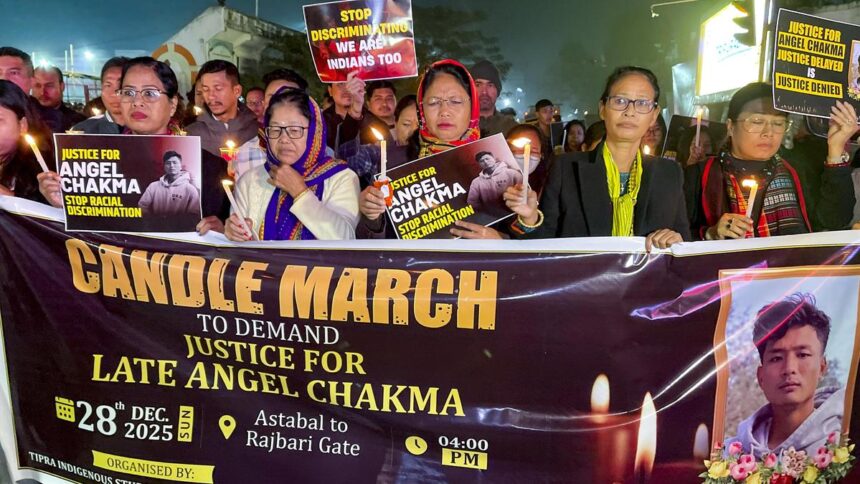
India has a way of glorifying diversity. The concept of One Nation is embedded in the national history, starting in schoolbooks to the words of the speech of Independence Day. However, recent events such as the Tripura student case of a 25-year old MBA student disclose an even more awkward reality, that northeast India is positioned as a different, distinct, and typically invisible entity of mainstream Indian mentality.
This is not just a case of a single student and a single state. It concerns a long-running perception issue that is inflicted on millions of citizens of Tripura, Assam, Manipur, Mizoram, Nagaland, Meghalaya, Arunachal Pradesh, and Sikkim. The Tripura student episode has compelled India to peep inwards one more time and pose hard questions regarding identity, inclusion and discrimination.
On one hand, what had happened might seem to be an individual incident on its own, yet the response, the wording, and the overall discourse on the matter points to a larger issue, a system bias that has been there since time immemorial.
The Tripura Student Incident: What Put the Northeast Back in the Limelight
The Tripura MBA student news covered attention not because cases of student related incidences are uncommon in India but because of the speed at which the story changed as soon as the student regionality appeared. It was revealed through commentary in social media and sensational headlines, as well as through the mainstream discourse of discussing seemingly how casually Northeast Indians continue to be treated as non-native even though they are Indian, legally, historically, and culturally.

In most of the online debates, attention moved away to the facts and towards stereotypes. The student was not merely a graduate student of an MBA. Many times we heard him called from Tripura,– as though it was his name which made the matter or defined the event.
It is a common trend in the news of Northeast India. Whenever a positive thing occurs, it is rather disregarded. In case of something controversial, the regional identity is made the headline.

Why Northeast India Still Feels Like it is not Part of the Mainland Story?
In an attempt to understand why the incidents such as the Tripura student case have such reactions, history, geography and politics of representation may be revisited.
The Northeast part of India is linked to the rest of the nation through a thin line and is commonly termed the Siliguri Corridor. This geographical distance has in the past been translated to psychological and cultural distance.

Northeast India has been stereotyped and under-represented in the mainstream Indian media, cinema and textbooks for decades. When they do exist it is usually in cliches – insurgency, boundary strife or exotic culture.
This leads to the fact that most Indians grow up knowing little about the history of Northeast and their language, and their contributions to the world. This insensitivity silently forms prejudice.
The Mentality of Mainland India and the origins of prejudice
The separate leading to the Northeast India divide is not formally parted though it exists in day to day communication, employment, lack of housing based discrimination and informal discussions.

Even students in Tripura and other northeastern states testify to the same thing:
- Getting questioned whether they are Chinese or foreigners.
- Suspected because of facial features.
- Lacking social affiliation.
- A feeling that they are treated as temporary residents but not citizens.
The Tripura student incident was extra felt as it was a reflection of what many of the Northeast students quietly go through in the Indian cities.
This is not necessarily fueled by hate. It is often rooted in ignorance, however it is discrimination when it is perpetuated over a long period.
Discrimination in Education Organization in Northeast India
Colleges are supposed to be inclusive, debatable, and free to think. However, they make campuses alienated to many Northeast students.
Northeast students have encountered: in a number of incidences reported by student unions and rights groups, the students have endured:
- Racial slurs and mockery
- Discriminatory disciplinary investigation.
- Peer and faculty stereotyping.
- Hostel cultural isolation.
The case of Tripura MBA student has once again sparked debates on whether educational institutions in India are well equipped to accommodate students of different cultural background.
It is not only the issue of curriculum in education. It is about environment. And to most Northeast students, it is still an unfriendly or indifferent atmosphere.
Representation in the Media and the Productive Narratives
The manner in which the Tripura student incident was reported by parts of the media was one of the most worrying issues with the case.
As opposed to the normal reading based on the verifiability of facts, some of the coverage was very much biased towards the regional identity. Other words such as Northeast Student were also stressed more than professional/Academic qualification.
This trend supports a us vs them discourse.
In the cases of similar cases of students who live in metro cities, the identity of the region is seldom emphasized. However, geography takes centre stage when the student is a Tripurian or any other Northeast.
This discriminatory framing is a contributor to Northeast India bias.
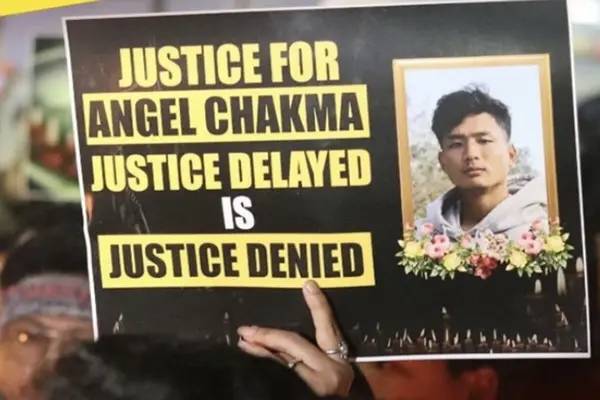
Historical Context: The Impact of Northeast India’s Absorption, not Integration
Northeast India joined the Indian Union after Independence after a complicated process of treaties, formation of states and bargaining on a political front.
Even though the administrative integration occurred, cultural integration was left undone.
There was a tendency of imposing policies without sufficient consultations on the side of the locals. Development paradigms borrowed in mainland India were disregarding local realities. This produced distrust and neglect.
This meant that the Northeast was not considered a cultural centrism in the long run but rather a border region.
It is crucial to the current problems of Northeast India identity due to this historical background.
Government Data and the Reality Gap
Northeast India benefits in receiving special project packages, infrastructural projects as well as education funding by government statistics in policy circles and national planning forums.
But figures do not turn into a respect and belonging.
As roads and institutions have become better, there has been no corresponding improvement in social attitudes.
It is development that is devoid of empathy which makes it hollow.
The incident in Tripura on a student incident is an eye opener that inclusion is not displayed in spending alone.
True-To-Life Case: The Silent struggle of a Student
Take the case of a Post graduate student originally of rural Tripura learning in a leading city of India.
She does not talk in school in fear of being mocked because of her accent despite academic excellence. She restricts socialization following many requests as to whether she eats strange food. Instead of authenticity she prefers anonymity.
These tales seldom feature on headlines. But they create the emotionally loaded background in which a story such as the Tripura student case is hurled into the limelight.
The vividness of in day-in day-out discrimination is more destructive than the solitary scandals.
Social Media: Amplifier or Equalizer?
Social media has played a dual role in the Tripura student incident.
On one hand, it amplified stereotypes, misinformation, and hateful commentary.
On the other, it gave Northeast voices a platform to speak back, share experiences, and challenge mainstream narratives.
For the first time, many mainland Indians were exposed to personal stories from Northeast students describing daily microaggressions.
This digital visibility is powerful — but it also highlights how long these voices were ignored.
Why Positive Northeast Stories Rarely Trend
India celebrates achievers from metro cities with pride. But success stories from Tripura or other Northeast states often remain regional news.
This imbalance reinforces the perception that Northeast India is only newsworthy during conflict or controversy.
The Tripura student incident became national news not because Tripura is suddenly important, but because controversy sells.
This selective attention deepens the emotional distance between regions.
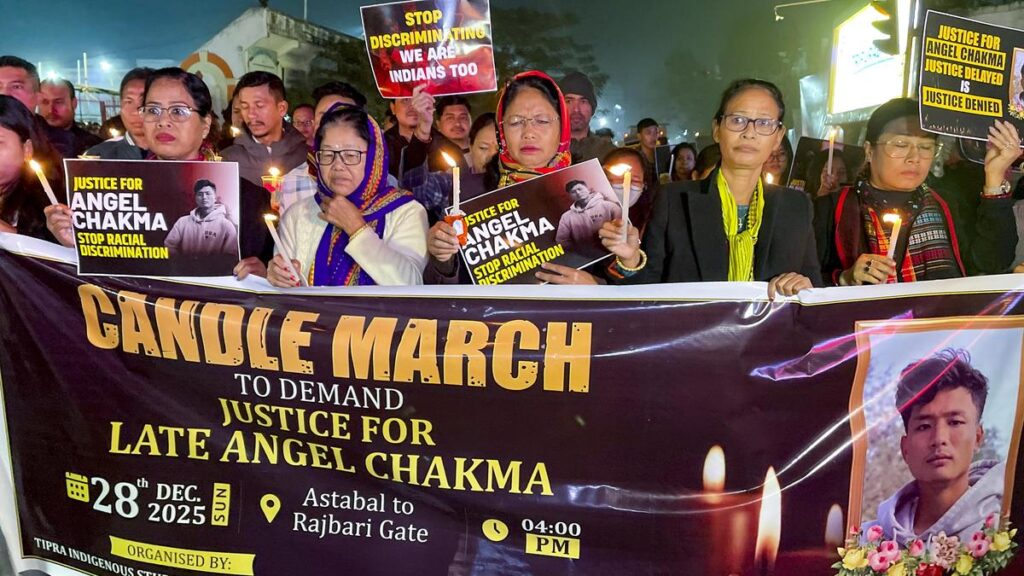
Discrimination Against Northeast Students Is Not New
The Tripura student case is part of a larger pattern.
Over the years, there have been repeated reports of Northeast students facing racial abuse, physical attacks, and institutional neglect in cities like Delhi, Bengaluru, and Mumbai.
Each incident sparks outrage. Each time, promises are made. And then silence returns — until the next case.
This cycle suggests that India has not yet addressed the root cause.
What This Means for India’s Idea of Unity
India’s strength lies in its diversity. But diversity without respect becomes fragmentation.
When an Indian citizen from Tripura is made to feel like an outsider, the idea of national unity weakens.
The mainland India mindset must evolve from tolerance to acceptance.
Unity is not achieved by asking people to assimilate silently. It is achieved by recognizing differences without hierarchy.
The Role of Education in Changing Perception
One of the most effective ways to address Northeast India discrimination is through education reform.
Indian school curricula still dedicate minimal space to Northeast history, literature, and political movements.
As a result, generations grow up without understanding the region’s contribution to India’s freedom struggle, art, and culture.
Without knowledge, empathy cannot grow.
What Students Can Do
Students from Northeast India, including Tripura, can take proactive steps:
- Build support networks within campuses
- Document incidents responsibly
- Engage in intercultural dialogue
- Use institutional grievance mechanisms
- Share narratives through credible platforms
At the same time, mainland students must actively listen rather than defend.
What Institutions Must Change
Educational institutions must move beyond symbolic gestures.
Key steps include:
- Mandatory diversity sensitization programs
- Clear anti-discrimination policies
- Strong student support systems
- Representation of Northeast voices in leadership
- Accountability mechanisms
Without institutional backing, individual resilience has limits.
The Way Forward: From Visibility to Belonging
The Tripura student incident has forced India to confront uncomfortable realities.
But awareness alone is not enough.
The real challenge lies in transforming temporary outrage into long-term change.
Belonging cannot be conditional. Citizenship cannot be regional.
Until a student from Tripura is seen simply as an Indian student — without qualifiers — the work remains unfinished.
More Read
Final Takeaways
- The Tripura student incident is not isolated; it reflects systemic bias
- Northeast India discrimination stems from history, media, and education gaps
- Mainland vs Northeast India narratives must be dismantled
- Inclusion requires empathy, policy, and cultural reform
- India’s unity depends on how it treats its margins
True national integration will begin when stories from Tripura and the Northeast are not treated as “different,” but as inherently Indian.