
There’s a familiar scene playing out in cities and small towns alike. Two people meet, talk endlessly, share playlists, inside jokes, late-night confessions. They spend weekends together, sometimes even introduce each other to friends—but when someone asks, “So, what are you guys?” the answer hangs awkwardly in the air.
Not quite single. Not quite committed. Something in between.
That in-between space has a name now: Situationship.
It’s not just a buzzword. It’s become a defining feature of modern relationships—one that says as much about emotional habits as it does about the times we live in.

What Is a Situationship, Really?
A Situationship is a romantic or emotional connection that lacks clear definition, boundaries, or commitment. It’s more than casual dating but stops short of a relationship label.
There’s emotional intimacy. Often physical closeness. Regular communication. But no agreement about exclusivity, future, or expectations.
It exists in ambiguity—and that ambiguity is both its appeal and its problem.
Unlike traditional relationships that move through identifiable stages, a situationship resists structure. It thrives in uncertainty. And sometimes, that uncertainty is deliberate.

How Did Situationships Become So Common?
It’s easy to assume that situationships are just another dating trend. But their rise is tied to deeper cultural shifts.

Modern dating operates in a landscape shaped by apps, infinite options, and an underlying fear of settling too soon. There’s always the possibility of “something better” just a swipe away.
At the same time, people are more self-aware than ever. Careers, independence, and personal growth often take priority over long-term commitment—at least in early adulthood.
This creates a paradox:
People want connection, but not necessarily the responsibility that comes with it.

Situationships sit perfectly in that gap.
They offer companionship without obligation. Intimacy without long-term pressure. A sense of belonging—without fully committing to it.
The Emotional Logic Behind a Situationship
On the surface, a situationship can feel liberating. No labels. No pressure. No expectations.
But beneath that freedom lies a complex emotional structure.
For some, it’s about avoiding vulnerability. Labels force clarity, and clarity requires risk—risk of rejection, loss, or incompatibility. A situationship delays that moment.
For others, it’s about control. Keeping things undefined means keeping options open. It reduces accountability.
And then there’s a third group: people who genuinely don’t realize they’re in one. They assume the relationship is evolving—until it doesn’t.
The problem isn’t always the situationship itself. It’s the mismatch in expectations.
One person may see it as temporary. The other, as the beginning of something real.
That’s where the tension begins.
Why Situationships Feel So Intense
Interestingly, situationships often feel more emotionally charged than traditional relationships.
There’s a reason for that.
Ambiguity creates psychological tension. When something is uncertain, the brain becomes more invested. It seeks clarity, meaning, resolution.
In a situationship, every message matters more. Every interaction is analyzed. Silence feels heavier. Small gestures feel significant.
It’s not necessarily love—it’s often heightened emotional engagement driven by uncertainty.
That’s why situationships can feel addictive.
They operate on a cycle of hope and doubt, closeness and distance. And that unpredictability keeps people emotionally hooked.
The Role of Modern Dating Culture
The rise of the situationship is closely tied to how dating has evolved.
Dating apps have transformed relationships into something closer to a marketplace. Choice is abundant, but attention is fragmented.
People are talking to multiple people at once. Emotional investment is spread thin. And commitment becomes a decision postponed rather than pursued.
At the same time, social media adds another layer.
Relationships are no longer just private experiences—they are public narratives. Labels carry weight, expectations, and visibility.
Avoiding labels can feel like avoiding pressure.
But it also removes clarity.
Situationships thrive in this environment because they require neither decision nor declaration.
When a Situationship Works—and When It Doesn’t
Not all situationships are inherently negative.
For some people, they serve a purpose. They provide companionship during transitional phases—after a breakup, during career shifts, or while figuring out personal priorities.
When both individuals are aligned—clear about the lack of commitment and comfortable with it—a situationship can function smoothly.
The problem arises when there’s asymmetry.
When one person starts wanting more. When expectations shift but aren’t communicated. When emotional investment deepens on one side but not the other.
That’s when a situationship becomes emotionally draining.
Because unlike a defined relationship, there’s no framework to address the imbalance.
The Psychological Cost of Staying Too Long
The longer a situationship continues, the harder it becomes to exit.
Time creates attachment. Shared experiences create meaning. And ambiguity creates hope.
People often stay longer than they should—not because the connection is fulfilling, but because they’re waiting for it to become something else.
This can lead to:
- Emotional confusion
- Reduced self-worth
- Difficulty trusting future relationships
- Fear of asking for clarity
There’s a subtle shift that happens. Instead of asking, “Is this right for me?” people start asking, “What if this turns into something more?”
And that question can keep someone stuck for months—or even years.
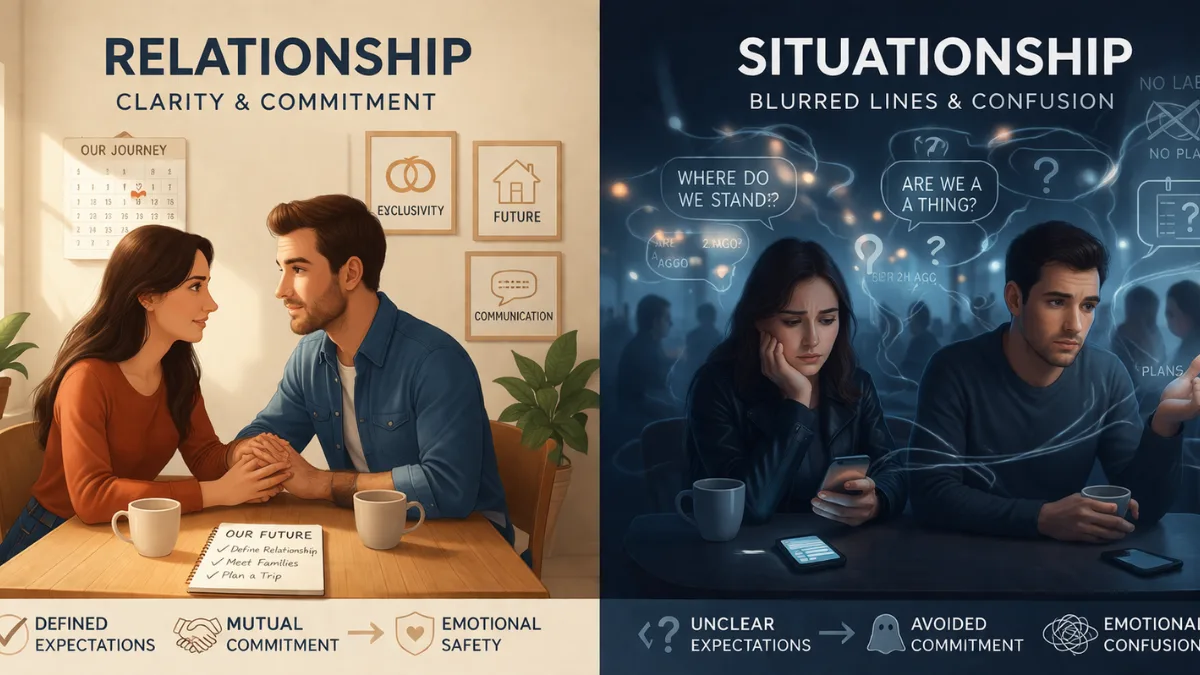
Situationship vs Relationship: The Key Difference
The difference isn’t about intensity or time spent together.
It’s about clarity and intention.
A relationship has defined expectations. There’s mutual understanding—about exclusivity, communication, and future direction.
A situationship avoids that definition.
It exists in a space where things are felt but not stated. Where emotional investment exists, but responsibility does not.
And that difference matters more than it seems.
Because clarity isn’t just about labels—it’s about emotional safety.
Why People Struggle to Leave Situationships
Leaving a situationship isn’t as simple as walking away.
There’s no official breakup. No clear endpoint. No closure.
That makes it harder.
People often wait for a defining moment—an argument, a realization, a clear sign that things won’t change.
But situationships rarely provide that clarity.
They fade slowly. Or continue indefinitely.
What keeps people in them isn’t just attachment—it’s uncertainty combined with possibility.
As long as something feels unfinished, it’s hard to let go.
The Future of Relationships: More Situationships Ahead?
Situationships aren’t likely to disappear anytime soon.
If anything, they may become more common.
As dating continues to evolve—shaped by technology, individualism, and shifting social norms—the traditional relationship model is being redefined.
Commitment is no longer assumed. It’s negotiated.
And for many, that negotiation remains open-ended.
But there’s also a counter-trend emerging.
People are beginning to value clarity over convenience. Emotional boundaries over ambiguity. Direct communication over silent assumptions.
Situationships may continue—but so will the push against them.
Because at some point, ambiguity stops feeling freeing—and starts feeling limiting.
More Read

Conclusion
A Situationship is less about what’s happening between two people and more about what isn’t being said.
It reflects a modern tension—between wanting connection and avoiding commitment. Between emotional intimacy and personal independence.
For some, it works. For many, it doesn’t.
The real question isn’t whether situationships are good or bad. It’s whether they align with what someone actually wants.
Because clarity, while uncomfortable, is often more honest than ambiguity.
And in relationships, honesty tends to matter more than anything else.
Final Insight
At The Vue Times, we believe modern relationships deserve modern clarity. A situationship isn’t a failure—it’s a signal. It tells you where communication is missing and where expectations need to be defined.
If you’re navigating one, don’t settle for confusion. Define your boundaries, express what you want, and choose emotional honesty over silent assumptions. Because the right connection won’t leave you guessing—it will meet you with clarity.
Frequently Asked Questions
What is a situationship?
A situationship is a romantic connection without a clear label or commitment. It involves emotional or physical intimacy but lacks defined expectations or boundaries.
Is a situationship the same as casual dating?
Not exactly. Casual dating is usually understood as non-committal from the start, while a situationship often involves deeper emotional involvement but unclear status.
Why do people stay in situationships?
People stay due to emotional attachment, hope for progression, or fear of losing the connection. The ambiguity makes it hard to define when to leave.
How long should a situationship last?
There’s no fixed timeline, but if it continues without clarity for too long, it can lead to confusion and emotional stress. Most experts suggest addressing it early.
Can a situationship turn into a relationship?
Yes, but only if both people communicate openly and agree on commitment. Without that conversation, it often remains undefined.