
The Indian Startup Ecosystem has developed very fast within the past ten years, though its structural basics are very dissimilar to international startup systems. Although on the surface, growth in valuations, the number of unicorns, and sizes of different funding rounds have become the primary metrics for comparison, the actual difference is found in the way capital flows, regulatory structures, and business frameworks interact with the underlying economic realities.
This article comes up with an international comparison of startups based on structure- rather than stories. This is aimed at questioning how the systems work, where they are failing, and what it means to the founders, policymakers, and capital allocators.
Startup Context
System design is the key problem of comparing ecosystems–not scale.
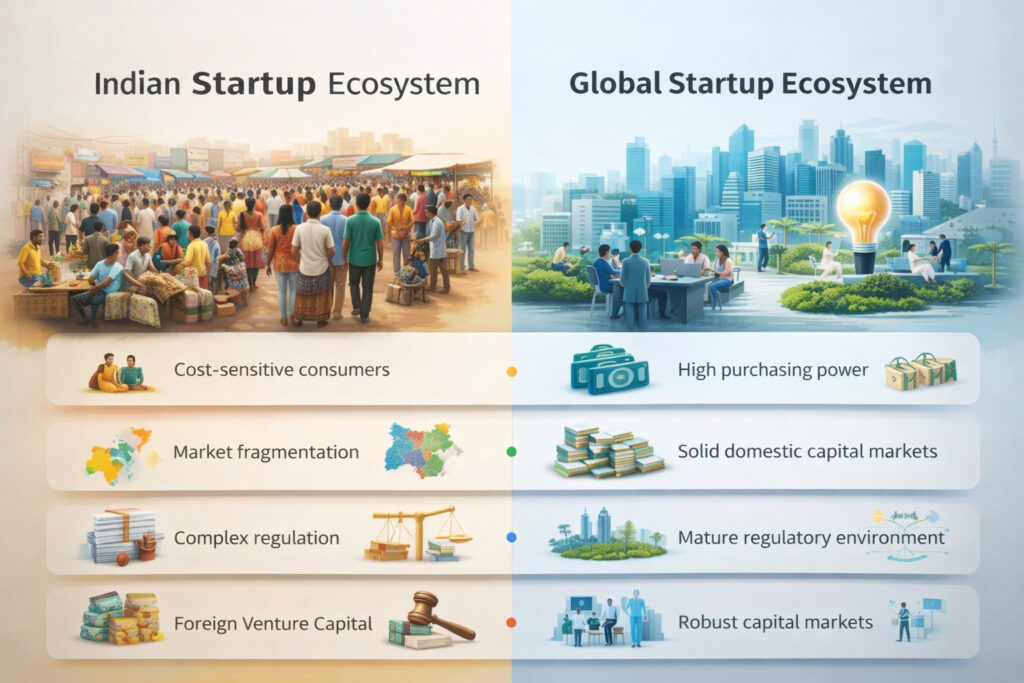
Startup ecosystems, including the ones in the United States, China, and some European regions, exist in the mature financial markets and high per capita income settings and stable regulatory regimes around the world. On the contrary, the Indian system works in:

- Lower per capita income
- Consumer markets that are price sensitive.
- Fragmented infrastructure
- Regulatory variability
This brings about an underlying dissent:
- The world ecosystems are streamlined to innovativeness.
- The Indian ecosystem is cost-efficient and adapted to the market.
- It does not make the system weaker, it makes it structurally different.
Structural Breakdown of the Indian Startup Ecosystem.
2.1 Funding Structure
External capital is very dominant in the funding ecosystem of India.
Key Characteristics:
- Gross reliance on foreign venture capital.
- Poor domestic institutional involvement.
- Capital at a later stage is more available than early-stage risk capital.
Global Comparison:
| Aspect | India | Global (US/Europe) |
| Early-stage funding | Limited | Abundant |
| Domestic capital | Weak | Strong |
| Pension fund participation | Minimal | Significant |
| Exit mechanisms | Developing | Mature |
Pension funds, insurance companies and endowments are aggressive in allocating to venture capital in the global markets. In India, such pools are not fully exploited because of the regulatory and risk limitations.

Implication:
Indian startups have a tendency of growing small when faced with external pressure and not the reality of the local market.
2.2 Business Model Logic
Indian startups often are based on optimization of unit economics under constraint, and not on pure disruption that is driven by innovation.

Common Patterns:
- Models of marketplace aggregation.
- High discount customer acquisition.
- Arbitrage of operation (logistics, labor, pricing)

Global Systems:
- Deep-tech (AI, biotech, SaaS) innovation.
- Businesses based on intellectual property.
- High-margin software models
Structural Difference:
- India: Market-building + efficiency.
- Worldwide: New product development + expansion.
This results in a conflict of valuation logic and sustainability.
2.3 Regulatory Environment
India has a multi-layered regulatory system.
Key Features:
- Complicated compliance policies.
- Frequent policy changes
- State / central regulatory overlaps.
Global Benchmark:
- Much more foreseeable structures.
- Accelerated incorporation and compliance.
- Clear tax structures
Example Challenges in India:
- GST difficulty of startups in early stages.
- Localization of data requirements.
- Dependence on licensing in the areas of fintech and healthtech.
Outcome:
Legal impediment adds overheads to operations and delays the process of iteration.
Economic Rationality of the two systems.
To comprehend the functioning of each system it is necessary to analyse the economic situation.
3.1 Indian Economic Logic
India operates on:
- Large population
- Weak buying capacity per capita.
- High price sensitivity
This drives:
- Growth strategies based on volumes.
- Thin margins
- Long paths to profitability
Startups must prioritize:
- Cost control
- Distribution efficiency
- Massive customer acquisition.
3.2 Global Economic Logic
In developed economies, Global startup ecosystems work on:
- High disposable income
- Full-fledged digital infrastructure.
- Strong enterprise demand
This enables:
- Premium pricing
- Faster monetization
- Higher margins
3.3 Structural Outcome
| Factor | India | Global |
| Revenue per user | Low | High |
| Customer acquisition cost sensitivity | High | Moderate |
| Profitability timeline | Long | Shorter |
| Capital efficiency | Critical | Flexible |
Economic conclusion of logic:
The Indian startups have to attain scale prior to getting profitability whereas the global startups can attain profitability at the earlier stages since their margins are higher.
Operational Challenges
4.1 Compliance Burden
Startups in India face:
- Tax compliance complexity
- The regular changes in regulations.
- Industry-specific licensing
This increases:
- Legal costs
- Administrative overhead
- Time-to-market delays
4.2 Capital Constraints
In spite of the rising headlines of more funds, structural problems continue to exist:
- Poor intensity of seed stage financing.
- Concentration within the metro cities.
- Biases of investors to old models.
4.3 Market Fragmentation
India is not a single market.
Challenges include:
- Language diversity
- Geographical consumption behaviour.
- Infrastructure disparity
This impacts:
- Product standardization
- Marketing strategy
- Distribution logistics
4.4 Scalability Constraints
Scaling in India requires:
- Offline + online integration
- Logistics optimization
- Regional customization
International startups tend to grow digitally with less physical limitations.
Policy Interaction
The Indian Startup Ecosystem is largely influenced by government policy.
5.1 Positive Interventions
- Startup India initiative
- Digital infrastructure in India.
- UPI-based financial systems
These have improved:
- Ease of digital payments
- Formalization of the businesses.
- Startup recognition
5.2 Structural Limitations
Policy concerns however are still:
- Tax uncertainty (angel tax issues in the past)
- Slow judicial processes
- Poor efficiency in bankruptcy.
5.3 Global Policy Comparison
| Policy Area | India | Global |
| Ease of doing business | Improving | Mature |
| Bankruptcy resolution | Slow | Efficient |
| Innovation grants | Limited | Extensive |
| R&D incentives | Moderate | Strong |
Key Insight:
The policy regime in India facilitates the establishment of startups, but does not favor startup growth and exit.
Founder Implications
The structural realities have a direct influence on the decision making of the founders.
6.1 Capital Strategy
Indian founders must:
- Optimize burn rate
- Meet the expectations of investors.
- Trade-off between balance growth and sustainability.
Global founders have:
- More freedom in capital investment.
- Availability of various sources of funds.
6.2 Business Model Decisions
In India:
- The price policy is paramount.
- Incentives are needed to retain the customers.
- Profitability usually lagged.
Globally:
- More feasible value-based pricing.
- Tougher subscription models.
- Accelerated way to expand margin.
6.3 Operational Priorities
Indian founders need to work on:
- Execution efficiency
- Cost control
- Market adaptation
Global founders prioritize:
- Innovation
- Product differentiation
- IP development
6.4 Risk Profile
| Risk Type | India | Global |
| Market risk | High | Moderate |
| Regulatory risk | High | Low |
| Capital risk | Moderate | Low |
| Execution risk | High | Moderate |
Future Outlook
The Indian Startup Ecosystem is shifting to efficiency-led consolidation and no longer growth-led expansion.
7.1 Emerging Trends
- Shift toward profitability
- Greater involvement of domestic capital.
- Expansion in SaaS and deep-tech.
7.2 Structural Shifts Expected
Domestic Capital Expansion
Family offices and Pension funds could become more involved.
Regulatory Stabilization
There is a likelihood of simplifying compliance structures.
Sectoral Maturity
Structured development will be fintech, SaaS and healthtech.
7.3 Global Alignment
India will not imitate world systems- but will develop its hybrid model:
- Cost-efficient operations
- Selective layers of innovation.
- On-demand digital infrastructure.

7.4 Risks Ahead
- Overvaluation corrections
- Capital tightening cycles
- Policy unpredictability
Conclusion
The Indian Startup Ecosystem cannot be rated in the same perspective as the world systems. The global startup comparison should be meaningful which can only be possible with structural, economic, and regulatory differences.
The ecosystem of India is characterized by:
- Capital constraints
- Price-sensitive markets
- Operational complexity
The characteristics of global ecosystems are:
- Capital abundance
- Increased power of the consumers.
- Innovation-driven growth
The difference is not its weakness- it is a difference in design.

For founders, this means:
- Constructions in India have to be based on different assumptions than the construction in the global markets.
- Efficiency is not a choice, but a construction.
- Sustainability in scale is gradually becoming unsustainable.
Finally, the development of the Indian Startup Ecosystem will be determined by the ability to address the local limitations and global opportunities, instead of trying to force them outside of the structure without aligning to the whole system.
FAQs
What is the Structural definition of the Indian Startup Ecosystem?
The Indian Startup Ecosystem is characterized as relying on external financing, price-sensitive consumer markets and complexity of regulation. However, it is not a global ecosystem, with per capita income being lower, where startups need to focus on scale and cost-effectiveness rather than high margin models of innovation.
What are the differences between the Indian startup ecosystem and the global startup systems?
The most important distinction of a global start up comparison is in terms of economic and financial infrastructure. Domestic capital, developed exit markets, and consumer spending power are found to be advantageous to the global ecosystems whereas foreign investment and volume-based growth strategies are more valuable in India.
Why do Indian startups emphasize scale over profitability?
Startups in the Indian Startup Ecosystem have lower revenue per user and are highly price elastic, which means that they would need to attain high user bases before they could attain sustainable profitability. This is unlike the global startups which tend to monetize earlier because they have higher margins.
What are the largest obstacles of Indian startups?
Major challenges include:
- Flexibility of regulations.
- Inadequate domestic capital in its early stages.
- Geographical market fragmentation.
- Expensive customer acquisition prices.
Such variables make the operation difficult as opposed to the global ecosystems.
What role does the government policy play in startups in India?
Government programs such as Startup India and upgrades in digital infrastructure have helped to boost it. Nevertheless, uncertainty in regulations and compliance still influences scalability in the Indian Startup Ecosystem.
Is it easy to fund Indian startups?
There is availability of funding, which is distributed unequally. Startups that are late are more assured of capital and the ones who are early are limited. Also, the system is vulnerable to the global capital cycles because of dependence on foreign investors.
In which areas do you expect the Indian startup ecosystem to expand?
Structural advantages within sectors are:
- SaaS (Software as a Service)
- Fintech
- Healthtech
These industries are more aligned to the national requirements and universal expansion.
Are Indian startups globally competitive?
Yes, but the level of competition is based on the business model. Startups that concentrate on scalable technology (such as SaaS) are in a more advantageous position around the world, as opposed to entirely domestic consumption models.
Does domestic capital contribute to the growth of an ecosystem?
The current situation is the limitation of domestic capital which is essential to the long-run stability. Inclusion of more pension funds, family offices and institutions can also help to decrease dependency on foreign investment.
What does the Indian Startup Ecosystem hold in store?
The ecosystem is likely to espouse towards:
- Profitability-focused growth
- Greater regulatory transparency.
- Increased participation of domestic capital.
This will provide a more balanced and sustainable organization than previous growth stages.