How Startups Actually Start in India – Series | The Vue Times
Why This Distinction is More Important in India Than Everywhere Else
In India, the debate on how a startup is started is not aesthetic. It is structural.
Bootstrapped and venture-funded startups do not merely differ in capital source; they diverge in decision-making speed, founder psychology, market selection, risk tolerance, governance, and even ethics.
Globally, often, this difference is talked about in more abstract terms. In India, it is very much (em) down to earth.

Most of the Indian founders start with:
- Limited personal capital
- Weak safety nets
- Family obligations
- Highly Price Sensitive Customers
- Infrastructure constraints
- Regulatory friction
These realities make the way of initiating more consequential than the idea itself.
This article examines how bootstrapped and venture-funded startups actually begin in India, based not on pitch decks or success stories, but on lived founder behaviour, operational trade-offs, and structural incentives.
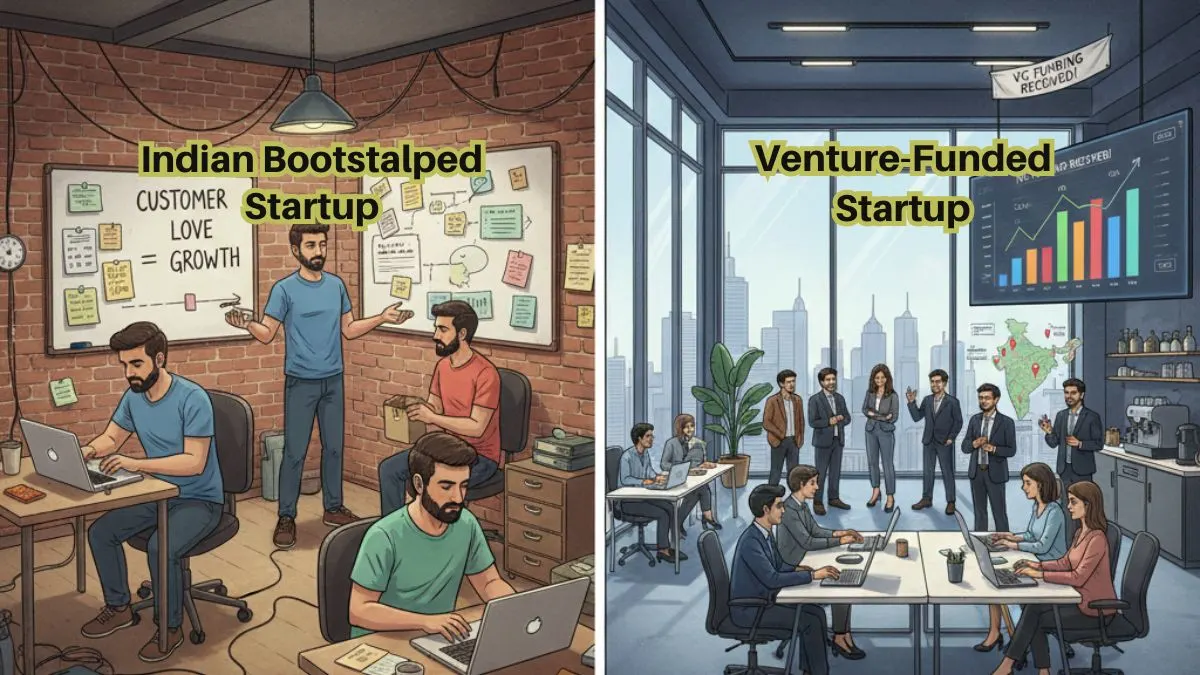
Two Starting Lines, Not Two Labels
“Bootstrapped” and “venture-funded” are frequently used as terms used after the fact.
And, in reality, they are beginning lines that influence everything that follows.

A startup bootstrapped in the beginning of the company, starts with:
- Personal savings OR operating cash flow
- Immediate revenue pressure
- Founder-controlled decision-making
- Incremental expectations for growth
A venture funded startup starts with:
- External capital
- Predefined growth narratives
- Investor accountability
- Time-bound milestones
From day one these startups are living in different economic universes.
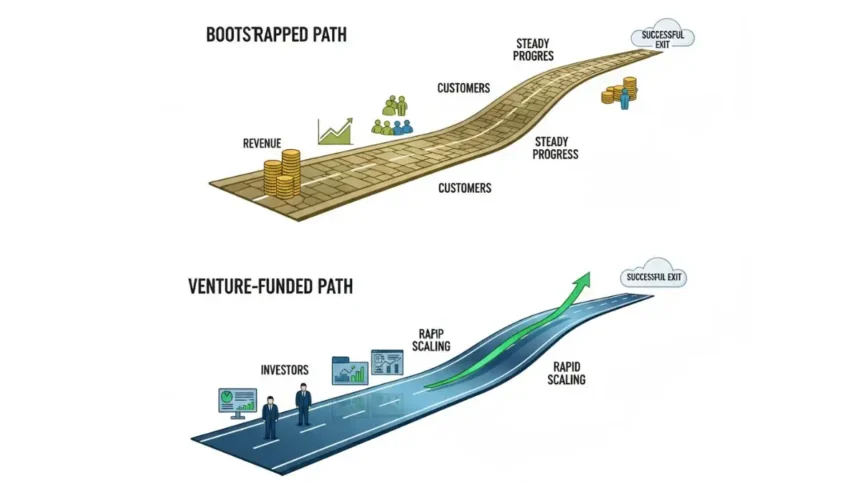
The Bootstrapped Founder’s Mentality: Get your Company to Survive, not Scale
Capital as a Scarcity Not as a Weapon
Indian bootstrapped founders do not “choose” frugality as a philosophy.
They get in the way and exercise it as a constraint.

Typical early questions are:
- Can this be a revenue-generating feature now?
- With this hire, will the burn of cash decrease immediately?
- Can the founder play this role instead?
Every expense is considered not in terms of elegance, but on a cash basis.
This creates a mindset where:
- Revenue is validation
- Customers are the most important feedback loop
- Failure is individual, not remotely
The Psychological Burden of Ownership
Bootstrapped founders are likely to carry:
- Personal debt exposure
- Family expectations
- Reputation Risk in Intimate Networks
This leads to:
- Slower decision-making
- Conservative expansion
- Reluctance to pivot drastically
But it also creates:
- Deep customer intimacy
- High accountability
- Strict operational discipline
In India bootstrapping is less of an independence, more a risk containment.
The Venture Funded Founder’s Mindset: Momentum Before Margin
Capital as a Strategic Tool
For venture funded startups, capital is not just funding; it is the product being leveraged.
Early questions are different sounding:
- How fast can we acquire users?
- What story supports the next round?
- Which Metric WillInvestors Tracking This Quarter?
This mindset prioritizes:
- Speed over certainty
- Scale over efficiency
- Market positioning Vs. profitability
Psychological Separation from Failure
Venture funding provides for shared risk.
Although there is still pressure on founders, failure is often:
- Financially distributed
- Socially normalized
- Professionally recoverable
This allows for:
- Aggressive experimentation
- Frequent pivots
- Risky market bets
In the ecosystem of India, while this can bring innovation, it can also have the opposite effect of camouflaging weak fundamentals.
How Ideas are Chosen Differently
Bootstrapped Idea Selection: Revenue-Proximate Problems
Bootstrapped founders prefer to pick:
- Problems that they understand personally
- Markets with Immediate Paying Customers
- Solutions that can be sold early
Common traits:
- B2B services turning into products
- Niche SaaS
- Localized platforms
- Operational tools
These sorts of ideas rarely are “headline-grabbing” but are cash-aligned.
Venture Backed Idea Selection: Market Narratives
Venture-backed notions can often be found coming from:
- Global trend replication
- Market-size storytelling
- Platform or ecosystem logic
The emphasis is on:
- TAM (Total addressable market)
- Category creation
- Scalability potential
In India, this can mean:
- Importing models without local fit
- Overstating willingness to pay
- Underestimating execution friction
The concept may have to be validated by investors before customers.
Hiring: Capability vs Optics
Bootstrapped Hiring: The Utility Over Credentials
Existing boot startups hire for:
- Immediate execution
- Multi-role capability
- Cost flexibility
Degrees, brands and titles play less of a role than:
- Problem-solving ability
- Willingness to adapt
- Long-term commitment
Founders themselves are very operational – often putting off senior hires.
Venture-Funded Hiring: Signalling and Scale
Venture backed startups recruiting early to:
- Signal seriousness
- Build teams rapidly
- Prepare for scale
This can lead to:
- High fixed costs
- Role redundancy
- Cultural fragmentation
In India, where hiring talent at scale is iffy, there are hidden risks in this approach.

Product Development: Push or Pull
Bootstrapped Products Being Towed by Customers
Bootstrapped startups:
- Build incrementally
- Prioritize paid features
- Respond closely to the feedback of users
Roadaps are flexible based on:
- Sales conversations
- Support tickets
- Churn reasons
The product changes as a commercial instrument.
Venture Funded Products Are Forced Into Markets
Venture-funded startups:
- Build towards a long-term vision
- To invest massively in UX and branding
- Delay monetization
Product decisions are determined by:
- Investor expectations
- Competitive positioning
- Growth narratives
This can result in innovation, but also feature bloat and low depth of use.
Growth: Organic Constraining vs Artificial Accelerating
Bootstrapped Growth: Is Earned Uneven
Growth in bootstrapped Startups =:
- Slower
- Regionally concentrated
- Operationally grounded
It depends on:
- Word of mouth
- Repeat customers
- Sales efficiency
This growth is often durable, but not so visible.
Venture Funded Growth: Bought and Measured
Venture backed-growth : this often involves:
- Paid acquisition
- Discounts and incentives
- Aggressive expansion
Metrics are more important than margins.
Where price is sensitive in the Indian markets, this can:
- Inflate user numbers
- Distort product-market fit
- Delay sustainability
Governance and Control
Bootstrapped Governance: Reality of the Founder Led
Bootstrapped startups do business with:
- Minimal formal governance
- High founder autonomy
- Informal processes of decision making
This allows speed but risks:
- Blind spots
- Over-centralization
- Burnout
Venture Governance: Organizational Accountability
Venture funding introduces:
- Board oversight
- Reporting discipline
- Pressure for strategic alignment
This can improve:
- Transparency
- Strategic clarity
But it can also:
- Reduce founder flexibility
- Favor exits over endurance
Exit Thinking: Optional or Mandatory
Bootstrapped Exit Logic
BootStrapped founders tend to think in terms of:
- Cash flow
- Long-term ownership
- Sustainable income
Exits are an option not an assumption.
Venture Exit Logic
Venture funded startups need to:
- Target liquidity events
- Fit fund timelines
- Optimize the outcomes of valuations
This influences choices from at the beginning stages and often happens unconsciously.
Hybrid Paths: The Reality of the Indians
Many Indian startups start out with bootstrapping and then go on to raise money.
This transition does not occur without problems.
Common friction points:
- Cultural shift
- Loss of control
- Metric redefinition
Founders with the highest success here know:
- Why they are raising
- What they are trading
- What they refuse to lose
What Should Be Understood by Serious Founders, Students
This is not a moral debate.
It is a structural analysis.
Bootstrapping rewards:
- Discipline
- Patience
- Deep market understanding
Venture funding rewards:
- Speed
- Narrative control
- Risk tolerance
Neither guarantees success.
Both have costs – financial, psychological, and strategic.
Adam here asks an analysis question to help the group make an embedded grounded conclusion.
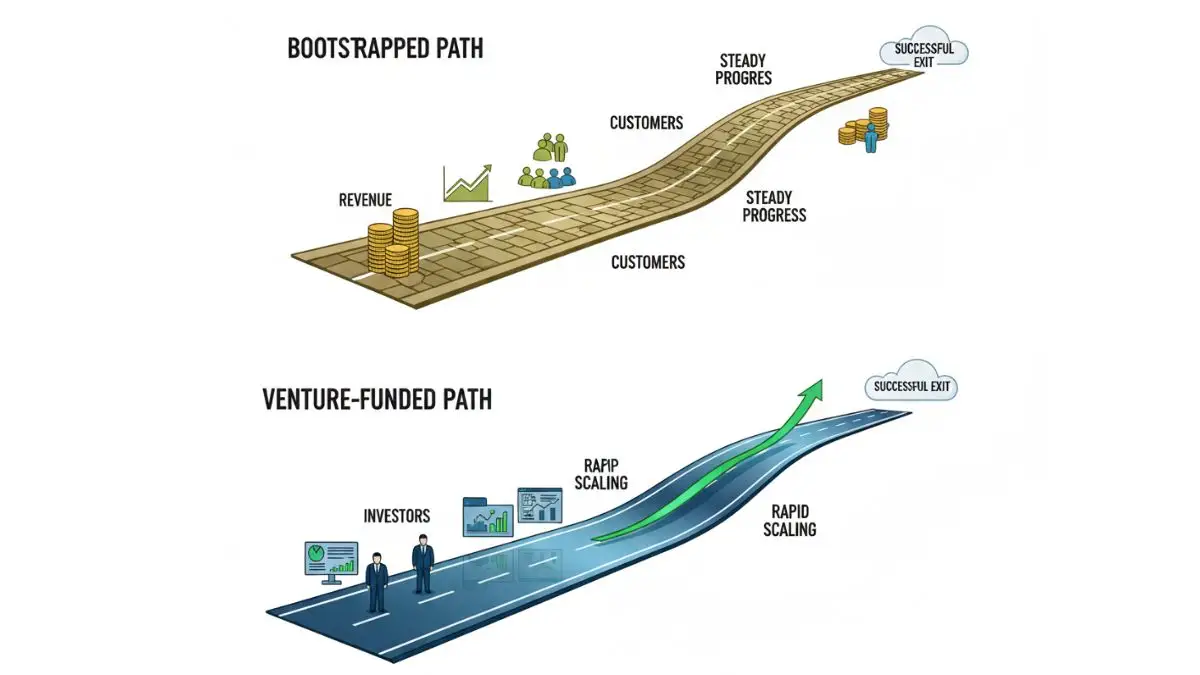
In India, the startups have not failed because they opted for bootstrapping or venture funding.
They fail because the founders misjudge the constraint into which they are being placed.
Bootstrapping constrains:
- Speed
- Visibility
- Optionality
Venture funding constrains:
- Autonomy
- Profit timelines
- Strategic freedom
The critical question is not:
“Which path is better?”
But:
“Based on my thinking, deciding, and enduring, which set of pressures do I”
At The Vue Times, we don’t look at startups as inspirational tales but rather as economic systems that are affected by incentives.
Understanding how they actually get started is the first step to understanding why so many don’t do well and why a few simply go silently.
Part of the Ongoing Series
How Startups Are Getting Started in India
A business intelligence perspective from The Vue Times
Frequently Asked Questions
1: Is bootstrapping more realistic than venture funding of Indian startups?
Yes– bootstrapping will be structurally realistic at the start with most Indian start ups. The shortage of access to early-stage capital, extended sales cycles, and price-sensitive clients typically require the company to grow revenue first before the external funding can be raised. The financing of the venture is open to a small group of startups that meet particular scale and story criteria.
2: Are venture funded startups in India more likely to fail than bootstrapped ones?
Both models have high rates of failure yet venture-funded startups fail in different ways. They usually overstep the scale prematurely, they overestimate the readiness of a market, or they burn money without attaining unit economic sustainability. Bootstrapped startups fail in less notorious ways, typically because of slow growth or founder burnout, as opposed to implosion.
3: Is it possible to have a bootstrapped company raise venture capital in India at a later date?
No, and several of them do–but change does not come naturally. There is a difference between how investors will view bootstrapped startups, and they look at the quality of the revenue, prices, and repeatability of the startups as opposed to growth alone. Including the raise of capital, founders should be ready to change the governance of changes in the expectation of growth and control.
4: What model will provide founders with more control in the Indian ecosystem?
Bootstrapping establishes the highest level of operational and strategic control, particularly during their first couple of years. Venture financing brings in common control in terms of boards, reporting and rights of the investor. This loss of flexibility can have a significant impact in India where markets can tend to change in unforeseen ways.
5: What is the best choice between bootstrapping and funding by first-time founders in India?
The move and course of action should be evidenced by the individual risk tolerance, market forces, and type of business rather than trends. There may be a need to fund capital-intensive, winner-take-most markets. Niche or operational types of businesses which are revenue driven are usually better to bootstrap. The attempt to make the wrong decision tends to increase the pressure instead of diffusing the problems.