
There’s a familiar scene across India that rarely makes headlines. A newly built road ends abruptly before reaching the village it was meant to connect. A health center stands complete on paper but operates without staff. A digital service portal exists—but only for those who already know how to navigate it.
These aren’t failures of intent. They are failures of execution.
At the heart of this contradiction lies a recurring tension within National Development Policies—a gap between what is envisioned at the policy level and what is delivered on the ground. It is a problem that cuts across sectors, from infrastructure and education to healthcare and digital governance. And it raises an uncomfortable question: why do well-designed policies so often struggle to translate into real outcomes?
The Promise Built Into National Development Policies
National development frameworks are rarely short on ambition. Over the past decade, governments have invested significant political capital into policies aimed at economic growth, social inclusion, and infrastructure expansion.

From rural electrification drives to digital inclusion programs, these policies are designed with a layered understanding of national priorities. They combine economic logic with social goals, attempting to balance growth with equity.
At their core, National Development Policies operate on a simple assumption: that centralized planning, supported by funding and institutional frameworks, can guide large-scale transformation. The logic is sound. The intention is clear.
But policy design is only half the story.
Execution is where complexity begins to unfold.
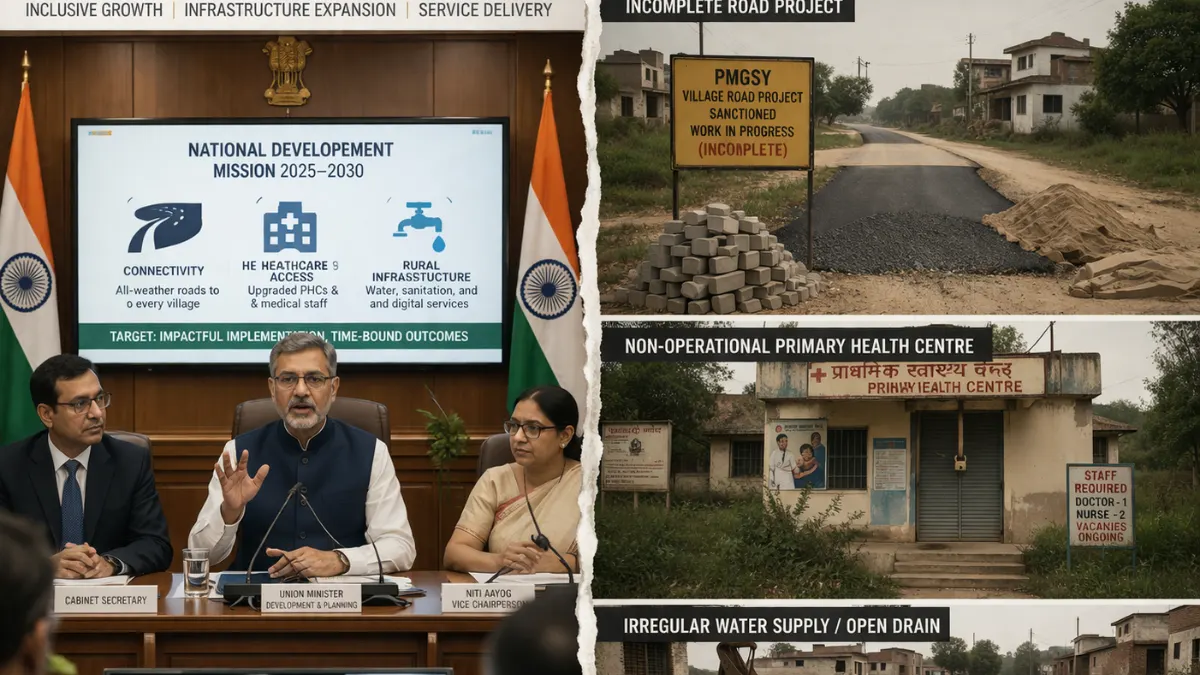
National Development Policies and the Reality of Ground-Level Governance
There’s a tendency to assume that once funds are allocated and schemes are launched, outcomes will follow naturally. But ground-level governance rarely operates with such linear clarity.

Consider a rural infrastructure project. Beyond funding, it depends on land availability, local contractor capacity, bureaucratic approvals, and community cooperation. Each of these variables introduces uncertainty.
Now multiply that across thousands of projects.
This is where the gap between policy and implementation becomes visible. Not because the policy itself is flawed, but because it interacts with a system that is uneven in capacity.

In some districts, execution is efficient and responsive. In others, the same policy struggles to gain traction.
The difference lies not in the policy, but in the administrative ecosystem surrounding it.
The Psychology Behind Policy Failure
There’s another layer to this issue—one that is less discussed but equally significant.
Policy-making often operates in a high-visibility environment. Announcements are public. Targets are ambitious. Timelines are politically sensitive. This creates an incentive structure where the focus shifts toward launch rather than longevity.
Execution, on the other hand, is slow, technical, and often invisible.
This imbalance shapes behavior within the system. Officials may prioritize meeting short-term targets over building sustainable systems. Data reporting can become performance-oriented rather than reality-oriented.
Over time, this creates a disconnect between reported success and lived experience.
The policy appears to work. The ground tells a different story.
Data, Metrics, and the Illusion of Progress
Modern governance relies heavily on data dashboards, performance indicators, and real-time monitoring systems. In theory, this should strengthen accountability.
In practice, it often creates a new kind of challenge.
When success is measured through predefined metrics, there is a tendency to optimize for those metrics rather than for actual outcomes. A school may report increased enrollment numbers without addressing learning quality. A sanitation program may record toilet construction without ensuring usage.
This phenomenon is not unique to India. It reflects a broader challenge in public policy—how to measure what truly matters.
Without meaningful feedback loops, National Development Policies risk becoming exercises in statistical achievement rather than substantive change.
The Business Lens: Efficiency vs. Scale
From a business perspective, the implementation gap resembles a scaling problem.
In the private sector, scaling operations requires standardization, quality control, and feedback mechanisms. Any inconsistency directly affects performance and revenue.
Public policy operates at a much larger scale, often without the same level of operational flexibility.
The challenge is not just scale—it is diversity. Policies must function across regions with different socio-economic conditions, infrastructure levels, and institutional capacities.
This makes uniform execution inherently difficult.
What works in one state may not work in another. Yet policies are often designed with a degree of uniformity that doesn’t fully account for these variations.
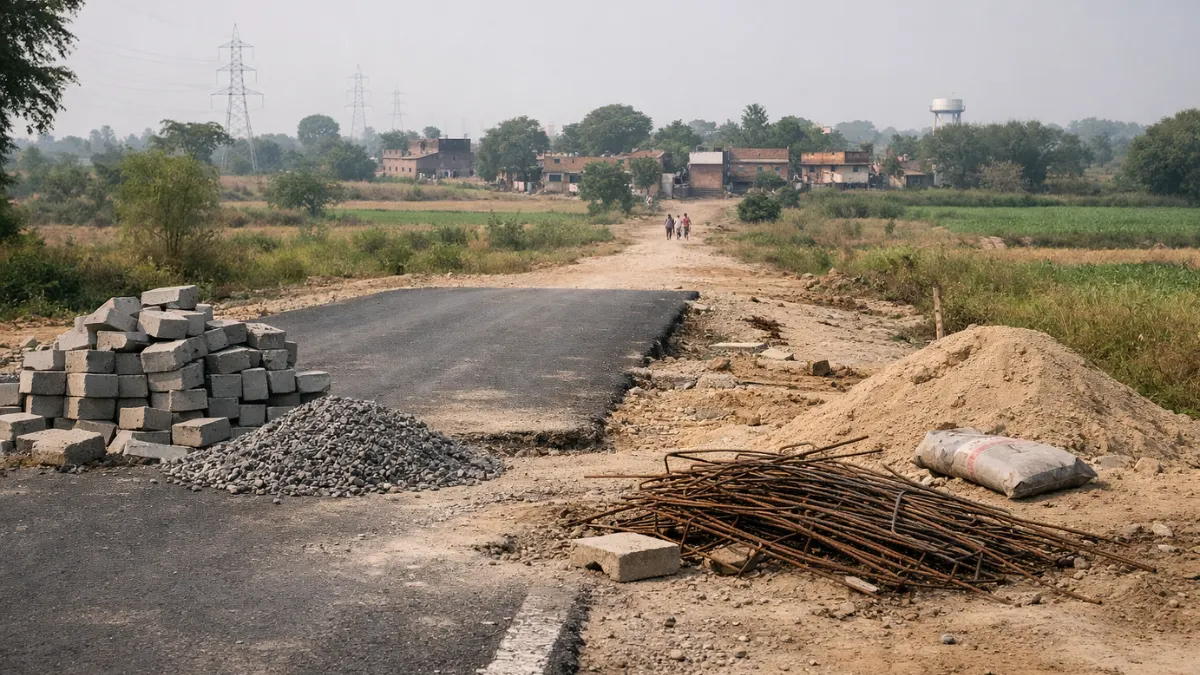
Why the Gap Persists
The persistence of implementation gaps is not accidental. It is structural.
Several factors reinforce it:
- Capacity constraints at local administrative levels
- Over-centralization of decision-making
- Limited accountability mechanisms beyond reporting structures
- Inadequate feedback integration from ground realities
- Political emphasis on announcements over outcomes
These factors interact in ways that make reform difficult.
Fixing one aspect—say, increasing funding—does not automatically resolve other issues like administrative capacity or accountability.
The problem is interconnected.
Rethinking How National Development Policies Are Designed
If implementation gaps are structural, then solutions must also be systemic.
One emerging approach is decentralization—not just in execution, but in design. Policies that allow for local adaptation tend to perform better because they account for regional realities.
Another shift involves strengthening feedback loops. Instead of relying solely on top-down monitoring, integrating bottom-up insights can provide a more accurate picture of what is working and what isn’t.
Technology can play a role here, but only if it is used to enhance transparency rather than merely to generate data.
There is also growing recognition of the need to invest in administrative capacity. Training, resources, and institutional support at the local level are critical for effective implementation.
Without this, even the best-designed policies will struggle.
The Cost of Getting It Wrong
Implementation gaps are not just technical issues—they have real consequences.
They affect how citizens experience governance. They shape public trust. They influence economic outcomes.
A policy that fails to deliver creates more than inefficiency. It creates skepticism.
Over time, this skepticism can become a barrier to future reforms. Citizens become less willing to engage with new initiatives. Administrators become cautious. Political momentum weakens.
In this sense, the cost of poor implementation extends beyond individual policies.
It affects the credibility of the system itself.
Looking Ahead: From Policy Announcements to Policy Outcomes
There are signs of change.
Governments are increasingly aware of the importance of implementation. There is a growing focus on outcome-based governance, real-time monitoring, and citizen feedback mechanisms.
But awareness alone is not enough.
The real shift will come when execution is treated with the same importance as policy design. When administrative capacity is seen as an investment rather than a constraint. When success is defined not by announcements, but by outcomes.
This requires a change in mindset—within institutions, within political systems, and within public discourse.
Because ultimately, National Development Policies are not judged by their intent.
They are judged by their impact.
More Read

Conclusion
The gap between policy and implementation is not a flaw in the system—it is a reflection of its complexity.
But complexity cannot be an excuse.
If development policies are meant to improve lives, then their success must be measured where it matters most—on the ground, in everyday experiences, in outcomes that are visible and lasting.
Until then, the quiet crisis of implementation will continue to shape the story of development—often in ways that remain unseen, but deeply felt.
Final Insight
Policy success is not decided at the moment of announcement—it is decided in the slow, often invisible process of execution. That is where governance either earns trust or quietly loses it. Stay Informed Stay Updated-The Vue Times
Frequently Asked Questions
What are National Development Policies?
→ These are government strategies aimed at improving economic growth, infrastructure, and social welfare at a national level through structured planning and programs.
Why do implementation gaps occur in development policies?
→ Gaps arise due to administrative inefficiencies, lack of coordination, limited local capacity, and differences between policy design and ground realities.
How do implementation gaps affect citizens?
→ They lead to incomplete services, delays, and reduced effectiveness of government schemes, directly impacting quality of life and trust in governance.
Can better technology solve implementation issues?
→ Technology helps in monitoring and transparency, but it cannot replace strong administrative systems and local capacity.
What is the biggest challenge in policy implementation?
→ Ensuring coordination across multiple governance levels while adapting policies to diverse regional conditions remains the core challenge.