Problem Statement
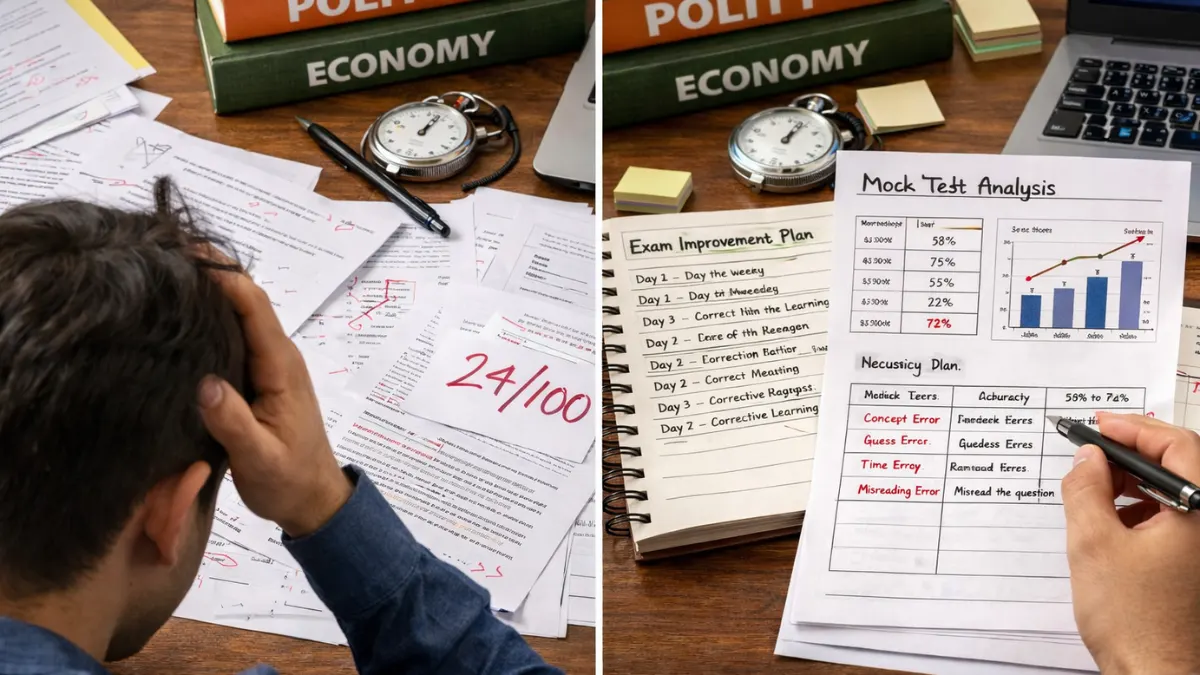
Many government exam aspirants regularly attempt mock tests but fail to convert those attempts into score improvements. They take a mock test, check the marks, and then immediately move to the next test without structured analysis. This creates a cycle where performance stagnates despite consistent effort.
The real issue is not the lack of mock practice but the absence of a Mock Test Recovery Strategy. Without a systematic approach to analyzing mistakes, identifying patterns, and correcting weak areas, mock tests become mere score indicators instead of learning tools.
Typical problems aspirants face include:
- Repeating the same mistakes in multiple mocks
- Poor time allocation during the exam
- Weak answer structure in descriptive papers
- Lack of question prioritization in objective tests
- No structured exam improvement plan
For competitive examinations such as UPSC, SSC, Banking, or State PCS exams, improvement depends not on the number of mocks attempted but on how effectively mistakes are recovered and corrected. A structured recovery process converts each mock into a diagnostic tool for performance enhancement.

Concept Clarity
A Mock Test Recovery Strategy is a structured post-test analysis method that identifies mistakes, categorizes them, and converts them into targeted improvements before the next test.
Instead of focusing only on the score, the strategy focuses on three analytical dimensions:
- Accuracy
- Conceptual understanding
- Time efficiency
A mock test should produce three outputs:
- Error identification
- Weak topic detection
- Tactical improvement plan
Most aspirants evaluate mock tests incorrectly by asking:
- “How many marks did I get?”
A proper recovery strategy asks:

- “Why did I lose marks?”
The focus shifts from performance measurement to performance correction.
For example:
| Analysis Method | Focus |
| Typical Approach | Marks scored |
| Recovery Strategy | Marks lost and why |
This shift is critical in creating a real exam improvement plan.

Practical Framework
Step-by-Step Mock Recovery System
A structured recovery process should follow these five steps.
Immediate Post-Test Reflection
Right after completing the mock test, note the following:
- Questions guessed
- Questions skipped
- Questions answered with confusion
- Sections where time pressure occurred
This reflection must happen before checking the answer key.
Example observation sheet:
| Category | Questions |
| Confident Answers | 45 |
| Guessed Answers | 10 |
| Skipped Questions | 20 |
| Time Pressure Area | Polity |
This initial assessment reveals time management and confidence patterns.
Error Categorization
Once answers are checked, categorize every mistake into one of four categories.
| Error Type | Meaning |
| Concept Error | Lack of subject understanding |
| Misreading Error | Misinterpreted question |
| Guessing Error | Risky attempt without elimination |
| Time Error | Could not reach question |
Example classification:
| Question | Error Type | Reason |
| Q12 | Concept | Weak in Federalism |
| Q19 | Misreading | Ignored “NOT correct” |
| Q24 | Guess | No elimination applied |
| Q38 | Time | Ran out of time |
This classification is the core of the Mock Test Recovery Strategy.
Weak Topic Mapping
Next, connect mistakes to specific syllabus areas.
Example:
| Topic | Mistakes |
| Polity – Fundamental Rights | 3 |
| Economy – Inflation | 2 |
| Environment – Biodiversity | 4 |
Instead of revising entire subjects, aspirants now focus on targeted micro-topics.
This prevents inefficient revision cycles.
Corrective Learning
After identifying weak topics, apply corrective learning.
Example structure:
Topic: Fundamental Rights
Corrective steps:
- Revise core concept from standard source
- Solve 15 practice questions
- Write 2 short answers if descriptive exam
Recovery should always combine:
- Concept revision
- Practice questions
- Active recall
Strategy Adjustment
Mock tests also reveal strategy flaws such as:
- Wrong question selection order
- Time misallocation
- Excessive guessing
Adjust the strategy for the next test.
Example:
| Issue | Adjustment |
| Attempted difficult questions early | Start with moderate questions |
| Lost time in Polity | Set 12-minute section limit |
| Excess guessing | Use elimination rule |
This converts mock tests into performance laboratories.
Model Answer Snippet (Descriptive Exam)
Question: Explain the importance of federalism in India.
Introduction
Federalism divides power between central and state governments to ensure administrative efficiency and regional autonomy.
Body
- Administrative efficiency
- Regional representation
- Conflict management
- Policy flexibility
Conclusion
Federalism ensures balanced governance in a diverse country like India.
This structure improves evaluation clarity and reduces answer-writing errors.
Mistake vs Correct Approach
| Mistake | Correct Approach |
| Checking score immediately | Perform reflection before checking answers |
| Revising entire subject | Revise only weak micro-topics |
| Ignoring time patterns | Track section-wise time |
| Random next mock attempt | Implement corrective learning first |
This comparison clarifies how the Mock Test Recovery Strategy improves exam readiness.
Common Errors
Several mistakes prevent aspirants from benefiting from mock tests.
Score Obsession
Many students track marks but ignore mistake patterns.
Marks alone do not indicate learning progress.
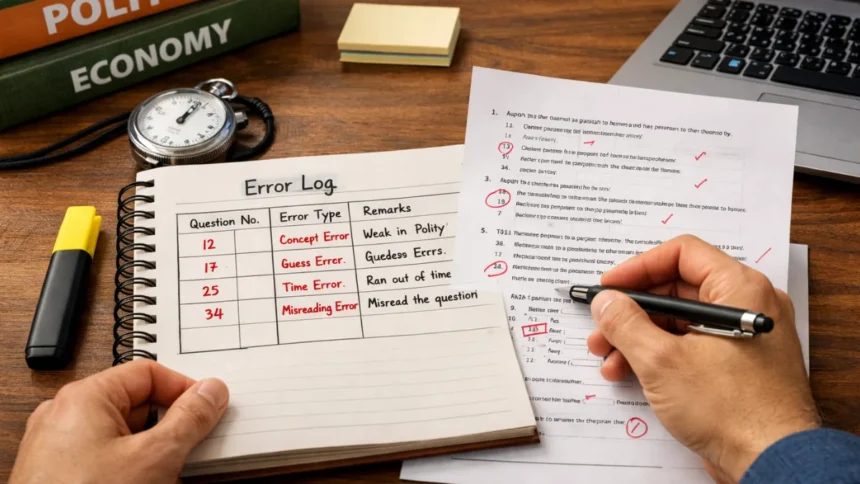
No Error Log
Without maintaining an error log, mistakes repeat across multiple tests.
Example error log:
| Mock | Error Type | Topic |
| Mock 1 | Concept | Inflation |
| Mock 2 | Concept | Inflation |
This clearly shows conceptual gaps.
Skipping Weak Topics
Some aspirants repeatedly avoid difficult areas instead of fixing them.
This leads to predictable score ceilings.
Over-Attempting Questions
Excess guessing reduces accuracy.
Example:
| Attempt | Accuracy |
| 95 questions | 58% |
| 80 questions | 72% |
Higher accuracy usually increases final scores.
Ignoring Time Analysis
Mock tests are not only knowledge tests but also time management simulations.
Students who ignore section timing often struggle in the real exam.
Tactical Application
Implementing a Mock Test Recovery Strategy improves exam performance in three direct ways.
Accuracy Improvement
Error categorization eliminates repeated mistakes.
Example:
| Mock | Accuracy |
| Mock 1 | 61% |
| Mock 4 | 73% |
Better Time Allocation
Tracking section performance improves pacing.
Example time allocation:
| Section | Time Limit |
| Polity | 12 minutes |
| Economy | 10 minutes |
| Environment | 8 minutes |
Structured pacing prevents time collapse near the end of the paper.
Stronger Answer Structure
Descriptive exam mocks improve writing clarity through structured responses.
Evaluators reward:
- Clear headings
- Logical sequencing
- Direct answers
Mock analysis reveals where answers lack structure.
Improvement Plan
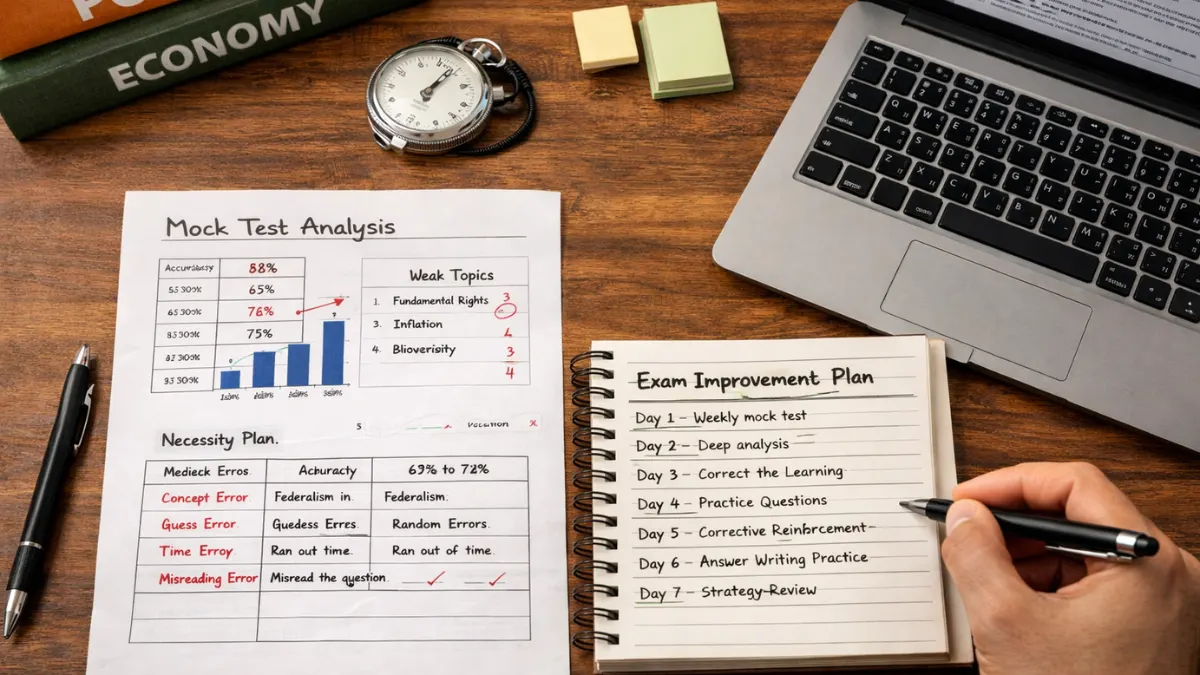
A systematic exam improvement plan converts mock test analysis into weekly progress.
Weekly Mock Cycle
Day 1 — Full Mock Test
- Simulate exam conditions
- Follow strict time limit
Day 2 — Deep Analysis
Tasks:
- Categorize errors
- Update error log
- Identify weak topics
Day 3 — Concept Recovery
Activities:
- Revise weak areas
- Solve topic-specific MCQs
Day 4 — Practice Reinforcement
Solve 30–40 targeted questions from weak topics.
Day 5 — Mini Mock Test
Attempt a sectional mock to test improvements.
Day 6 — Answer Writing Practice
Write 3–5 descriptive answers.
Day 7 — Strategy Review
Evaluate:
- Accuracy change
- Time efficiency
- Weak areas remaining
This weekly cycle ensures mock tests continuously produce measurable improvement.

Conclusion
Mock tests are one of the most powerful preparation tools for government exams, but their effectiveness depends entirely on how they are analyzed. Without a structured system for identifying mistakes and correcting them, repeated mock attempts produce limited improvement.
A well-defined Mock Test Recovery Strategy transforms mock tests from simple score indicators into performance diagnostics. By categorizing errors, mapping weak topics, and applying targeted corrections, aspirants can steadily increase accuracy, improve time management, and refine answer structures.
When integrated into a disciplined weekly cycle, this strategy becomes a practical exam improvement plan that converts every mock test into a measurable step toward higher exam scores.
Internal Linking (Placeholders)