Problem Statement
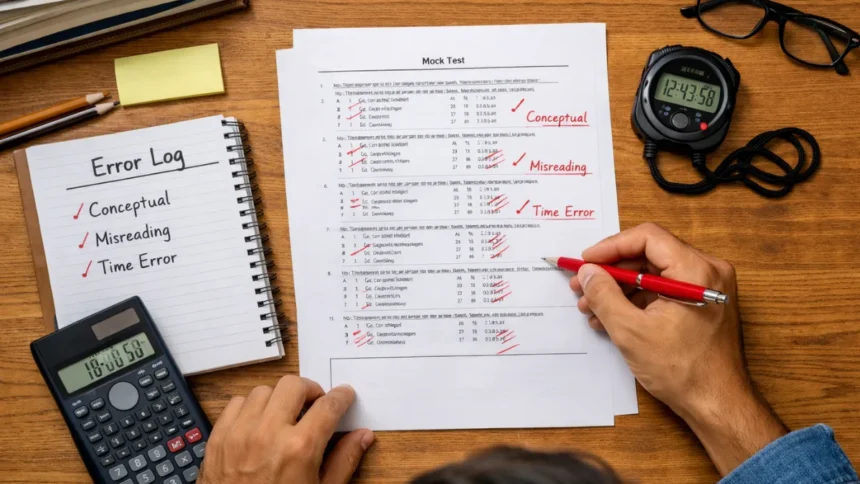
One of the biggest reasons serious aspirants fail to improve despite months of preparation is the absence of a structured Self Evaluation Government Exams system. Students attempt mocks, check scores, feel satisfied or disappointed, and move on. The cycle repeats without measurable correction.
Common patterns observed:
- Mocks attempted without deep review
- Wrong answers marked but not classified
- No tracking of recurring conceptual gaps
- Descriptive answers evaluated emotionally instead of analytically
- Improvement assumed instead of measured
The issue is not lack of hard work. The issue is the absence of structured mock analysis. Without a framework, preparation becomes repetitive rather than progressive.
In competitive exams where margins are narrow, unstructured preparation leads to stagnant scores.

Concept Clarity
What Is Self Evaluation Government Exams Strategy?
Self-evaluation is not checking answers against a solution key.
It is a data-based review system where every mistake is classified, tracked, and converted into corrective action.
A structured Self Evaluation Government Exams system includes:
- Error categorization
- Time management review
- Concept weakness mapping
- Answer structure evaluation (for descriptive papers)
- Pattern tracking across multiple tests
Self-evaluation must answer three questions:
- Why did I lose marks?
- Is this mistake recurring?
- What system change will prevent repetition?
If these questions are not answered after every mock, improvement remains random.

Practical Framework
Step-by-Step Self Evaluation Framework
Step 1: Categorize Every Wrong Question
Do not write “wrong” and move on.
Create 5 error categories:
- Conceptual gap
- Misreading question
- Time pressure guess
- Overconfidence error
- Calculation/technical mistake
After every mock:

- Create a table
- Place each wrong question into one category
Example:
| Question No | Topic | Error Type | Corrective Action |
| Q12 | Polity | Conceptual | Revise Article 32 |
| Q25 | Economy | Misread | Practice question framing |
Patterns appear within 3–4 mocks.
Track Accuracy by Topic
Instead of looking at overall score:
Break it by subject.
Example:
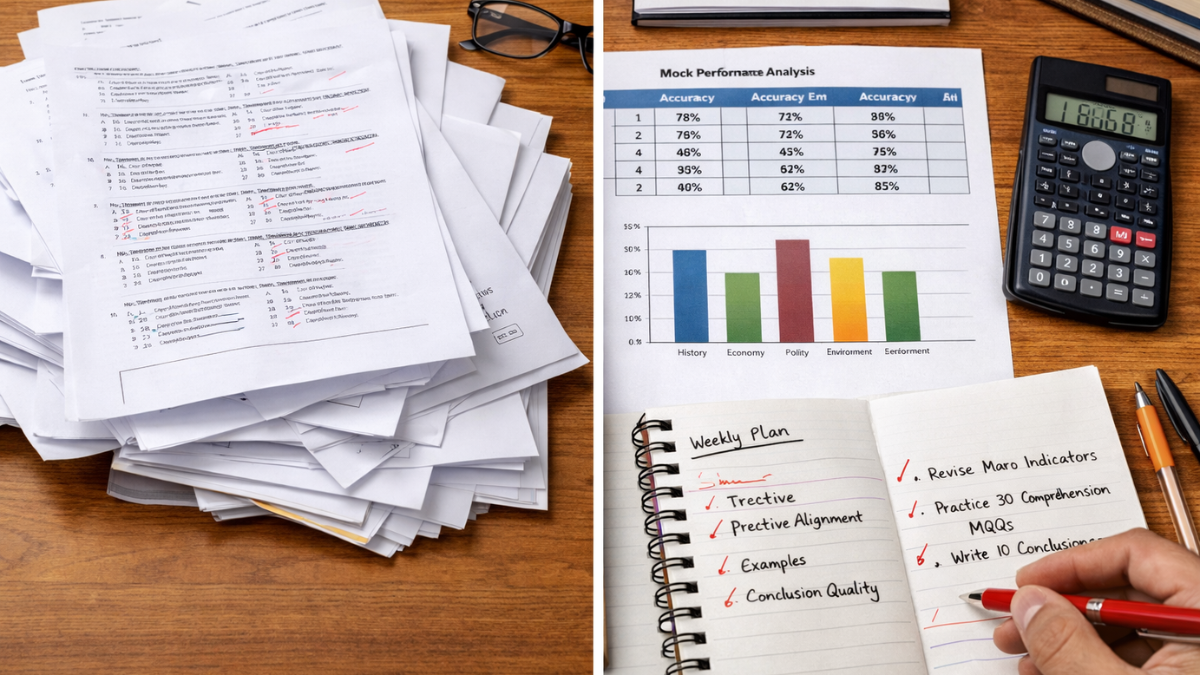
- Polity: 85%
- Economy: 62%
- History: 70%
- Environment: 55%
The weak zone becomes visible immediately.
This is effective mock analysis, not emotional reaction.
Time Audit
After finishing the test:
- Mark time spent per section
- Identify slow areas
Check if easy questions were skipped
- Time audit often reveals:
- Spending 4 minutes on one 2-mark question
- Over-attempting doubtful questions
Improvement in time distribution alone can increase marks by 5–10%.
Descriptive Answer Evaluation Framework
For mains or descriptive exams:
Evaluate answers on 5 fixed parameters:
- Introduction clarity
- Directive word alignment (discuss/analyse/explain)
- Structure (headings/subheadings)
- Use of examples/data
- Conclusion relevance
Score each out of 2. Total out of 10.
This creates measurable evaluation.
Mistake vs Correct Approach Comparison
| Mistake | Correct Approach |
| “I lost marks in polity.” | “I lost 6 marks due to Fundamental Rights confusion.” |
| Checking answer key once | Writing explanation for every wrong answer |
| Ignoring repeated errors | Maintaining error notebook |
| Emotional reaction to score | Data-based improvement plan |
This distinction defines serious aspirants.
Model Answer Snippet (Short Format)
Question: Analyse the role of local self-government in strengthening democracy.
Model Snippet:
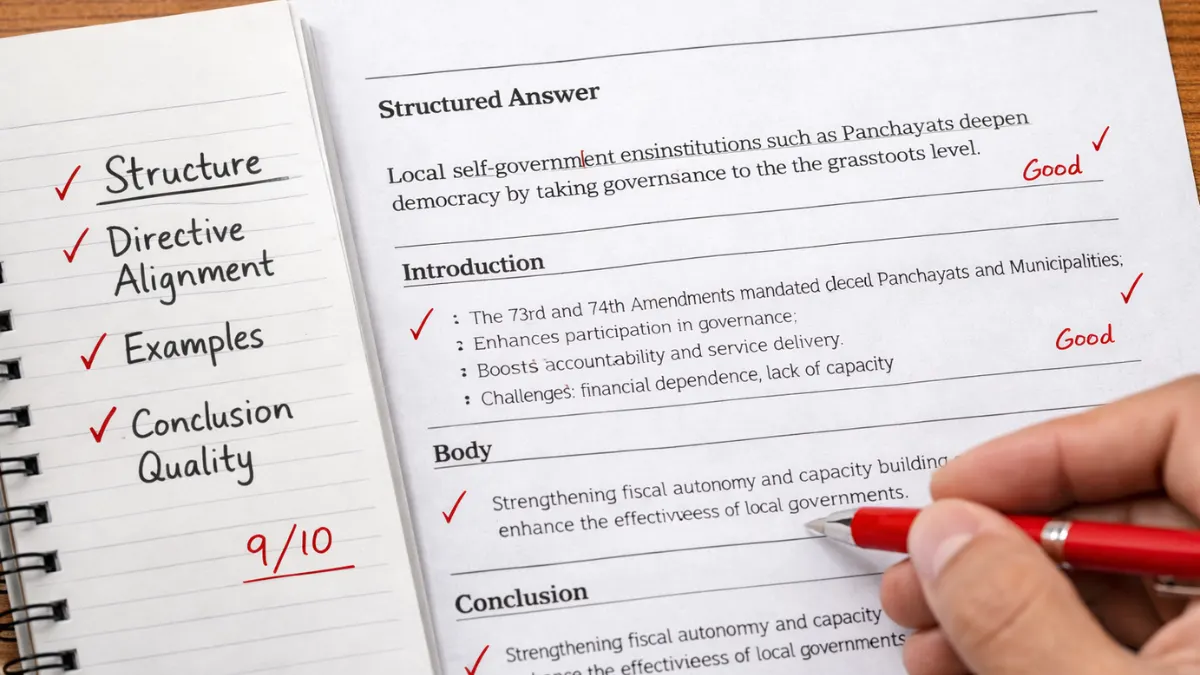
Introduction: Local self-government institutions such as Panchayats and Municipalities deepen participatory democracy at the grassroots level.
Body:
- Enhances decentralization through the 73rd and 74th Constitutional Amendments
- Improves accountability via direct citizen interaction
- Strengthens service delivery in health, sanitation, and education
- Challenges: financial dependence and capacity gaps
Conclusion: Strengthening fiscal autonomy and training mechanisms can make local bodies more effective democratic units.
Self-evaluation checklist for this answer:
- Directive word “Analyse” addressed? Yes (benefits + challenges)
- Structure present? Yes
- Constitutional reference included? Yes
- Data/examples added? Could improve
This is structured self-evaluation.
Common Errors in Self Evaluation Government Exams
Reviewing Only Wrong Answers
Correct answers guessed under pressure must also be reviewed.
A guessed correct answer is a hidden weakness.
Not Maintaining an Error Log
Without written tracking, patterns remain invisible.
A simple notebook divided into subjects is sufficient.
Repeating Mocks Without Revisiting Mistakes
Attempting 30 mocks without deep analysis is ineffective.
One mock + detailed analysis is more valuable than three careless attempts.
Ignoring Descriptive Structure Errors
Many aspirants focus only on content, not structure.
Examiners reward clarity and organization.
[Avoiding Generic Answers in Government Exams]
[Directive Words Strategy Guide]
No Weekly Pattern Review
Daily review is tactical.
Weekly review is strategic.
Without weekly pattern review, recurring weaknesses remain uncorrected.
Tactical Application: How This Improves Marks
A structured Self Evaluation Government Exams system improves marks in measurable ways.
Reduces Negative Marking
By identifying guess-based errors, you reduce random attempts.
Increases Accuracy Stability
Instead of fluctuating between 65–85 marks, performance stabilizes.
Consistency is more valuable than peak scores.
Improves Question Selection Strategy
Time audit reveals:
- Which sections to attempt first
- Which topics to avoid guessing
- Where to take calculated risks
Enhances Descriptive Scoring
Structured evaluation ensures:
- Introduction relevance
- Directive alignment
- Balanced arguments
This can increase 10–20 marks in mains-type papers.
Builds Predictable Improvement Curve
Without evaluation:
Score graph = Random spikes
With structured evaluation:
Score graph = Gradual upward trend
This difference determines final selection margins.
Improvement Plan (Daily & Weekly Execution)
Daily Plan (During Mock Phase)
After every mock:
- Spend 2–3 hours on analysis
- Categorize errors
- Update error notebook
- Revise weak topics immediately
- Rewrite 2 descriptive answers
Time distribution example:
- 2 hours mock
- 3 hours analysis
- 1 hour focused revision
Analysis time must exceed test time.
Weekly Plan
Every 7 days:
- Review error notebook
- Identify top 3 recurring error categories
- Identify weakest subject
- Create corrective micro-plan
Example Weekly Correction:
- Misreading questions high → Practice 50 comprehension-based MCQs
- Economy weak → Revise macroeconomic indicators
- Weak conclusions in answers → Write 10 conclusion-only practice drill
Monthly Performance Audit
After 4 weeks:
- Compare accuracy %
- Compare negative marking reduction
- Compare descriptive score trends
If no measurable improvement is visible, the evaluation system needs adjustment.
Structured Self Evaluation Template
You can maintain this template:
Mock No:
Score:
Accuracy %:
Highest Scoring Section:
Lowest Scoring Section:
Top 3 Error Types:
1.
2.
3.
Action Plan Before Next Mock:
This converts preparation into a system.
Integration With Full Preparation Strategy
Self-evaluation should connect with:
- [Internal Link: Time Management Government Exams Strategy Guide]
- Subject revision cycles
- Answer writing practice schedule
Without integration, analysis remains isolated.
Advanced Mock Analysis Layer
For serious aspirants:
Question Difficulty Mapping
Classify questions as:
- Easy
- Moderate
- Difficult
If easy questions are missed, conceptual clarity needs reinforcement.
If moderate questions are missed, application skill needs practice.
If difficult questions are missed, no major concern.
Attempt Quality Ratio
Attempt Quality Ratio = (Correct – Wrong) / Total Attempted
Track this across mocks.
Improvement here predicts final performance more accurately than raw score.
Section Order Experimentation
Try different section sequences.
Example:
- Polity → Economy → History
- Economy → Environment → Polity
Check which sequence produces higher accuracy.
This is controlled experimentation within mock analysis.
Why Most Aspirants Fail at Self Evaluation
- They treat analysis as optional
- They focus on number of mocks, not depth
- They avoid confronting repeated weaknesses
- They do not document mistakes
Competitive exams reward discipline, not volume.

Conclusion
A structured Self Evaluation Government Exams system transforms preparation from repetitive practice into measurable performance improvement. Through disciplined mock analysis, categorized error tracking, time audits, and structured answer review, aspirants convert every test into a data source for strategic correction.
Without self-evaluation, preparation becomes guesswork.
With a structured Self Evaluation Government Exams framework, improvement becomes predictable, controlled, and performance-driven.
The difference between stagnant scores and selection often lies not in knowledge acquisition, but in how effectively an aspirant analyses and corrects their own mistakes.