Understanding Directive Words in Government Exams
A large percentage of marks lost in descriptive papers is not due to lack of knowledge but due to misinterpretation of directive words in government exams. Aspirants often read the topic but ignore the instruction embedded in the question. Words such as discuss, explain, and analyse define the structure, depth, and approach expected by the examiner.
In competitive examinations like UPSC Civil Services Examination, SSC CGL, and State PSC Exams, directive words determine whether your answer is evaluated as structured and relevant — or generic and unfocused.
This article breaks down how to decode and apply directive words in government exams using a practical, scoring-oriented framework.
Problem Statement
The Core Mistake
Students often:

- Write everything they know about the topic.
- Ignore the specific instruction word.
- Use the same structure for every 10- or 20-mark question.
- Provide descriptive content when analytical depth is required.
For example:
Question: “Discuss the impact of urbanization on agricultural patterns.”
Common student response:
- Defines urbanization.
- Lists 4–5 random impacts.
- Concludes vaguely.
The mistake: The student writes a generic essay instead of balancing dimensions, examining both positive and negative aspects, and organizing arguments systematically.
Directive words are not ornamental. They are operational instructions.

Concept Clarity
What Are Directive Words in Government Exams?
Directive words in government exams are instruction terms embedded in questions that specify:
- The depth required
- The structure expected
- The analytical level
- The balance of arguments
The most common directive words include:
- Discuss
- Explain
- Analyze
- Examine
- Critically evaluate
- Comment
- Elucidate
This article focuses on the most frequently misused trio: discuss, explain, analyze.

A. “Discuss”
What it demands:
- Multiple dimensions
- Balanced arguments
- Structured presentation
- Often pros + cons or causes + effects
It does not demand a rigid conclusion but expects a reasoned summary.
B. “Explain”
What it demands:
- Clear conceptual breakdown
- Logical flow
- Cause-effect clarity
- Simplicity without oversimplification
It does not require heavy criticism or multiple viewpoints unless specified.
C. “Analyze”
What it demands:
- Break into components
- Identify relationships
- Show cause-effect chains
- Highlight implications
Analysis goes beyond description. It requires depth and structural clarity.
Practical Framework
This section provides a structured method to approach directive words in government exams.
Decode the Directive Word First
Before writing, ask:
- Is this asking for explanation?
- Is balance required?
- Is deeper breakdown needed?
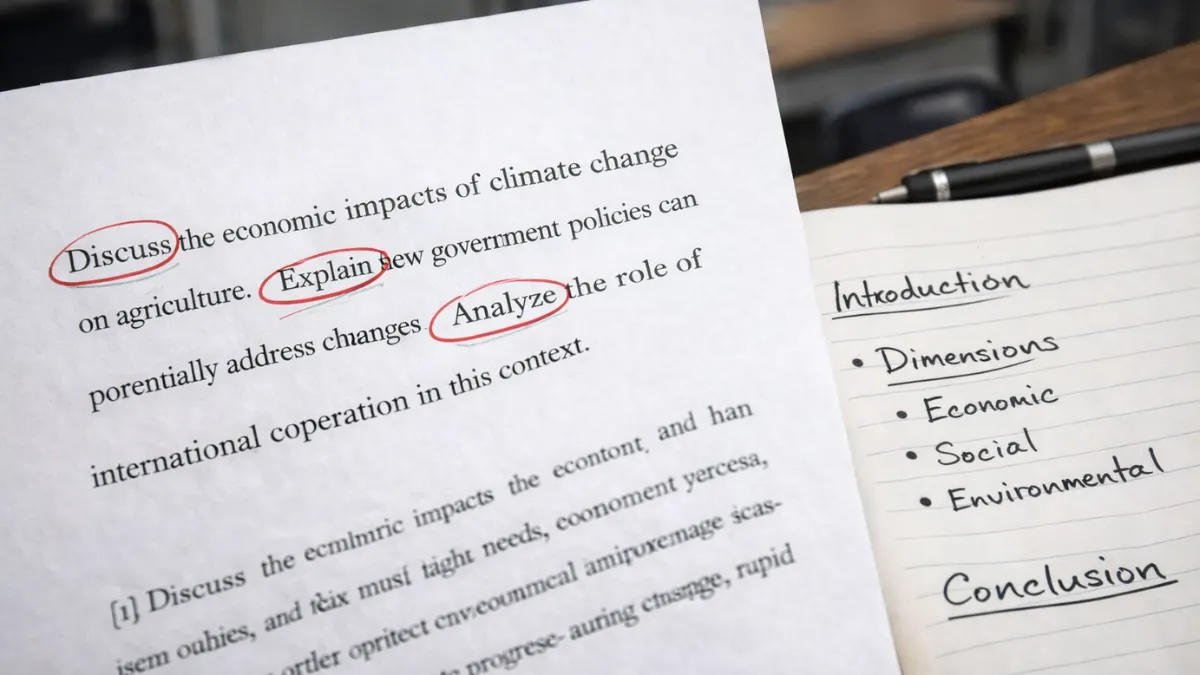
Circle the directive word in the question paper.
Adjust Structure Accordingly
Below is a tactical structure model.
Structure for “Discuss”
Introduction (2–3 lines)
Define or contextualize.
Body:
- Dimension 1
- Dimension 2
- Dimension 3
- Counter-argument or limitation (if relevant)
Conclusion:
Balanced summary or way forward.
Structure for “Explain”
Introduction:
Define the concept.
Body:
- Cause 1 → Effect
- Cause 2 → Effect
- Supporting example
Conclusion:
Brief reinforcement.
Structure for “Analyze”
Introduction:
Contextual framing.
Body:
- Component A
- Component B
- Interlinkages
- Consequences
Conclusion:
Insight-based synthesis.
Mistake vs Correct Approach Comparison
| Directive | Common Mistake | Correct Approach |
| Discuss | One-sided opinion | Multi-dimensional coverage |
| Explain | Vague description | Logical step-by-step clarity |
| Analyze | Listing points | Breaking into components with relationships |
Model Answer Snippet (Short Format)
Question: Analyze the role of technology in improving governance.
Model Structure (150-word sample):
Technology has significantly reshaped governance by improving transparency, efficiency, and accessibility.
First, digital platforms reduce bureaucratic delays by automating service delivery. Second, data analytics enhances evidence-based policymaking. Third, e-governance tools improve citizen participation through grievance portals.
However, digital divide and cybersecurity risks limit inclusive access. Therefore, while technology strengthens governance frameworks, its impact depends on infrastructure and regulatory safeguards.
Notice:
- Clear component breakdown
- Interlinkages shown
- Balanced analytical closure
This aligns with the directive word “analyze.”
Common Errors in Using Directive Words
1. Writing Pre-Prepared Templates
Students memorize answer structures and apply them blindly. This reduces directive sensitivity.
2. Ignoring Depth Requirement
A 20-mark “analyze” question cannot be answered with 4 superficial bullet points.
3. Over-Criticism in “Explain”
“Explain” does not mean evaluate or criticize unless asked.
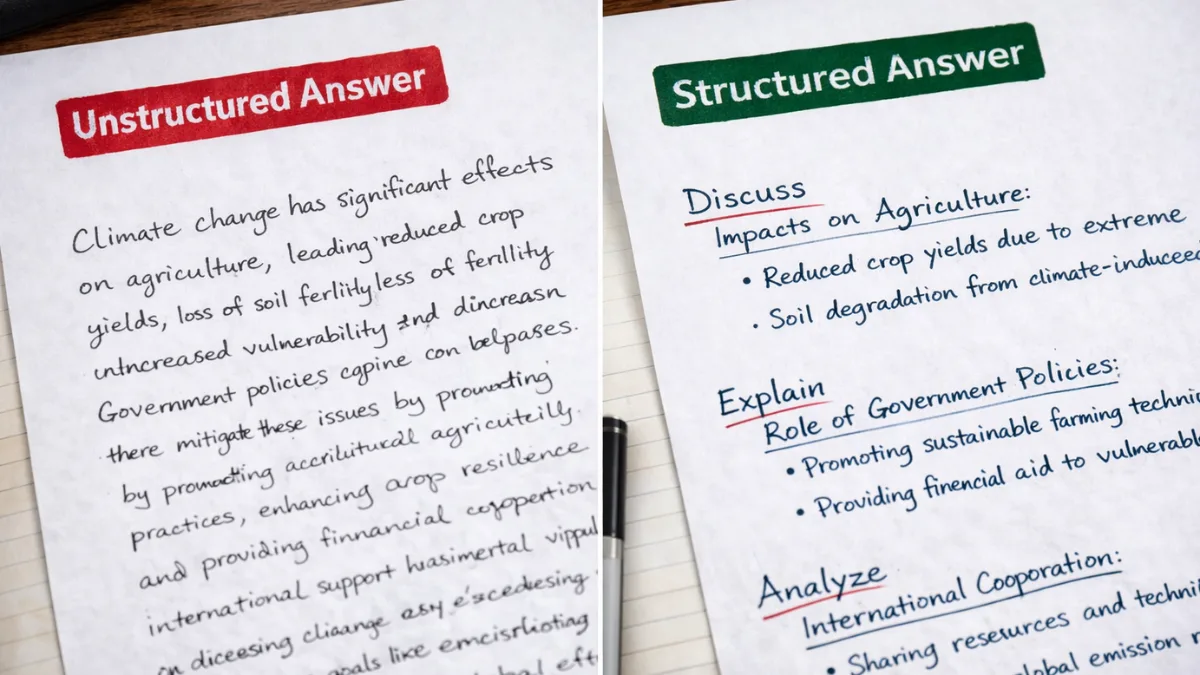
4. Lack of Structural Markers
No headings, no segmentation, no clarity of dimensions.
5. Conclusion Mismatch
Writing a reform-heavy conclusion for a neutral explanation question.
Tactical Application: How It Improves Marks
Understanding directive words in government exams improves scoring through:
A. Examiner Alignment
Examiners assess whether:
- The instruction was followed.
- Depth matches marks.
- Argument is structured.
Correct interpretation reduces negative marking in subjective assessment.
B. Structured Presentation
Directive-based structuring:
- Improves readability.
- Makes arguments visible.
- Enhances answer flow.
[20 Mark Answer Structure Guide]
[Why Students Lose Marks in Government Exams]
[Time Management in Mains Examination]
C. Better Time Allocation
When you know structure beforehand:
- You avoid rewriting.
- You reduce overelaboration.
- You maintain proportional depth.
Improvement Plan
A tactical execution method for mastering directive words.
Daily Exercise (30 Minutes)
- Pick 3 previous year questions.
- Identify directive words.
- Write only the outline (not full answer).
- Compare structure with official topper copies (if available).
Weekly Drill
- Day 1–2: Practice “Discuss” questions.
- Day 3–4: Practice “Explain.”
- Day 5–6: Practice “Analyze.”
- Day 7: Self-review and rewrite weak answers.
Evaluation Checklist
Before finalizing answer, ask:
- Did I follow the directive word?
- Is structure visible?
- Does depth match marks?
- Is conclusion aligned?
Advanced Technique: Directive Mapping Sheet
Create a one-page sheet:
| Directive | Meaning | Structure Pattern | Depth Level |
Revise this weekly.
Directive Words Across Exam Types
In exams like UPSC Civil Services Examination, directive precision is critical in General Studies Mains.
In SSC CGL descriptive papers, “explain” and “discuss” dominate.
In State PSC Exams, directive misuse is a common evaluation issue.
Understanding variation across exams ensures adaptability.
Practical Answer Flow Template
Below is a universal response grid.
- Directive Word
- Topic
- Core Demand
- Dimensions Required
- Depth Required
- Word Limit
- Balanced Closure (if needed)
This pre-writing checklist prevents structural drift.

Conclusion
Marks in descriptive government exams are determined not just by knowledge but by instruction compliance. Directive words in government exams define how knowledge must be presented. Words like discuss, explain, and analyze are operational signals — not decorative phrasing.
When aspirants align structure, depth, and argument with the directive word, answer quality improves immediately. The ability to decode and execute directive words in government exams transforms writing from descriptive narration to structured evaluation.
Mastering directive words is not optional. It is a scoring mechanism embedded inside the question itself.