
Onam is one of those festivals in India that you might be familiar with but know the story only after hearing it.
You might have noticed colourful designs at your homes, pictures of a huge vegetarian feast on banana leaves, people wearing traditional clothes or social media posts stating “Happy Onam.” If you’re not born and brought up in Kerala, you’d probably wonder the same question: What is Onam? Why is it so significant? Who is Mahabali? What’s unique about this festival?
When I’m introduced to Onam for the first time I find it so much more than a festival of flowers, food and celebrations. It’s a tale of a cherished king, of a harvest, of family, generosity, equality and of coming home.
So, this Onam 2026, let’s get to know about Onam from the beginning.
What Is Onam?
Onam is a major harvest festival as well as culture festival in Kerala. It is celebrated in the Malayalam month of Chingam which is August or September.
Thiruvonam is the tenth and most significant day in the ten-day traditional Onam festival. Thiruvonam 2026 is on August 26, 2026.
There are two aspects of Onam.
One is its association with King Mahabali, who is the main figure in the traditional story, which is about his annual return.
The other is its association with the harvest season, when Kerala’s farmers used to celebrate the bountiful and prosperous.
Onam is thus a cultural celebration as well as a festival engrained in the history and way of life of Kerala.
The epic of King Mahabali
Onam would not be understood without the understanding of Mahabali or Maveli.
Traditional legend has it that Mahabali was a powerful king who ruled an affluent kingdom. It wasn’t just his strength that made him different. He was remembered as generous, fair and was loved by his people.
The traditional story tells of his kingdom people living prosperously and equal.
The devas were afraid of Mahabali’s increasing popularity. They went to Lord Vishnu for help.
Vishnu then came in the form of Vamana and a dwarf Brahmin, Mahabali to him.
Mahabali gave Vamana only 3 steps of his land.
Mahabali agreed.
However, the seemingly simple request was extraordinary. Vamana increased in size up to cosmic size. He walked on the earth in his first step. His second, he covered the heavens.
The third step could not be taken anywhere.
Mahabali knew the identity of Vamana. He did not go back on his word, but gave his own head for the last step.
Vishnu was happy with Mahabali’s devotion and generosity. Mahabali was taken to the netherworld, but was allowed to come back each year to visit his precious people.
The annual homecoming is an important Onam event.
Then, the flowers, food and festivities start to make sense.
There’s no one just dancing for a king that’s a story. They are commemorating the memory of a ruler whose people loved so much that his return is welcomed by their people every year.
Why do people celebrate Onam?
Onam can initially be confused as a colourful harvest festival. Its meaning is deeper, though.
To Welcome Mahabali
According to the most popular custom, during Onam, Mahabali comes back to see his people.
During his visit, houses are cleaned and decorated, flowers are laid out and families come together to welcome him.
It’s similar to “preparing your home for a loved one’s return”.
To Celebrate the Harvest
Onam is also associated with India’s agricultural heritage of Kerala.
Chingam is a month of prosperity, harvest. The festival is a time of hope, happiness, abundance and new beginnings after the hardships of the monsoon season.
To Bring People Together
One of the most beautiful aspects of Onam is that there’s no single activity for the celebration.
Families eat together. Cultural activities are held in communities. Individuals perform games, dances and traditional celebrations.
Onam is, according to Kerala Tourism, a festival of unity, joy and communities.
What do you do in the 10 Days of Onam?
The celebration of Onam is the 10-day celebration, starting with Atham and culminating on Thiruvonam.
Every day is unique with its own meaning and customs.
Celebrations start with the first Pookalam (floral decoration). The floral designs increase in size and intricacy as the days go by.
Other activities these days include preparing for the traditional feast, getting new clothes, cultural activities and community celebrations.
The preparations for Thiruvonam are at their peak by the 9th day, Uthradom.
Now is the day of Thiruvonam, the most important day.
People decorate their homes, get together with their families, and the grand Onam feast is the highlight of the celebration.
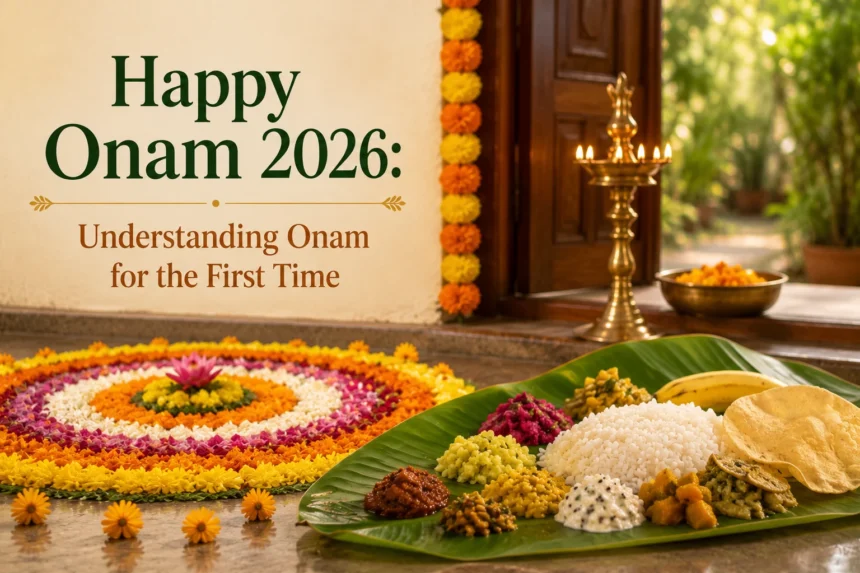
What Is a Pookalam?
The first thing that might strike a non-onamite observer is the beautiful flower design outside the houses in the form of a circle.
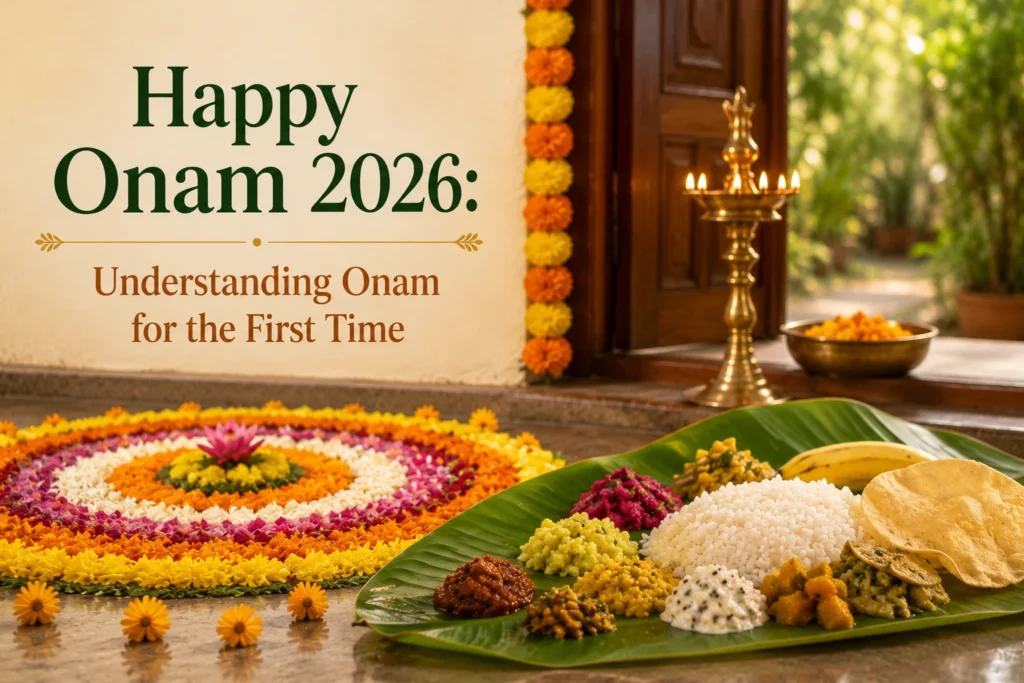
A Pookalam is this.
It’s a floral carpet made using fresh flowers. Pookalams are traditionally started as a simple design, and gradually grow in size and complexity as the days of Onam go on.
It is linked to the welcoming of Mahabali.
This tradition is quite beautiful as it does not need to be adorned with costly decoration. The entrance of a house can be transformed into a festival by flowers, creativity and time.
And Then There Is Onam Sadya
Onam Sadya is likely to be the most mouth-watering symbol of Onam, while Pookalam is probably the picture of Onam.
A traditional vegetarian feast served on a banana leaf is Sadya.
It may be made with rice, curries, vegetables, pickles, chutneys, side dishes or sweets like payasam. The specific dishes may differ from home to home and place to place.
Sadya is more than just a big meal.
It is about sitting together, sharing food.
Everyone is served various dishes on the banana leaf, which becomes a familiar table. According to Kerala Tourism, Sadya is an important means of expression of abundance and togetherness in Onam.
If you’re first timing Onam, this might be the best explanation for its spirit: There is plenty to share, so there is a seat at the table.
Onam is More Than Food and flowers
The party’s not over at home!
Onam is celebrated in Kerala with traditional performances, music, dance, games and in public places.
Vallamkali is one of the popular traditions where the long boats are raced in the form of snake boats with people rowing in a team which chants together.
Pulikali, also known as the “tiger dance,” is another, which is characterized by the performers’ bodies being painted and the dancing to traditional music.
The festive ambiance is accompanied by traditional art and cultural activities.
These practices demonstrate that Onam is not an observance that is done by the people. Rather, it is an action that people engage in.
What is Onam Like Today?
This is the aspect of Onam that is particularly intriguing.
As the festival evolves so does Onam.
Nowadays Onam is also celebrated in various areas of the Indian subcontinent as well as in the outside world.
There are methods through which the Malayali communities living outside of Kerala have found a way to retain the traditions. Sadya can be prepared in the home of a family. A Pookalam could be organised by friends as a competition. Traditional clothes and food are allowed for offices to celebrate. Cultural programmes can be organised within the community.
Some traditions may even be simplified due to living in an urban environment, the lack of time or the difficulty to gather all the traditional ingredients and flowers.
However, there is a central theme.
Come together. Share. Celebrate. Keep in mind where you are from.
The conversations surrounding Onam also have touched upon its role in binding together various generations, with elders who are accustomed to traditional Onam rituals, and the younger generation, who are in search of ways to celebrate it in their own unique manner.
It may be one of the reasons that traditions don’t get stuck in time. They develop and still maintain their original meaning.
What can I learn from Onam, if I am a little man?
This can be the most intriguing question.
It doesn’t matter if you aren’t from Kerala, there’s something you can learn from Onam.
Generosity Matters
Generosity is the theme of Mahabali’s story.
He was great, not in that he had more than others, but that he was ready to give.
Onam is a time to remind us in a world where success is measured by what we accumulate, what we share can be just as important.
Equality Matters
Mahabali’s kingdom has been in the tradition where people have a sense of wealth and equality.
So Onam is more than just a celebration of the past. It provides us with a vision of what kind of society people would prefer to live in – a society in which they are respected and included.
Home is more than a place.
Onam has an emotional value as Mahabali is supposed to go back to his people annually.
Home is more than just a house or a place.
It can be the people who remember you, and welcome you and wait for you.
It’s a message that anybody can comprehend.
Food is a connection to others, to culture, to family.
With today’s lifestyle, the food we eat can turn into a rushed meal.
Onam Sadya has a different notion.
Food can be a time for sitting together, conversation, sharing and celebrating.
A meal doesn’t always have to be a meal. It’s an expression of the sentiment: “You’re welcome here.”
Traditions Need People
Traditions are perpetuated by a will to continue.
Parents teach children. Grandparents tell stories. Young people take part in old practices and make them a part of modern life.
That is, traditions don’t live just in the past. They are a part of each generation that may carry them forward.
Understanding Onam as an Outsider
Since Onam is a festival celebrated by outsiders, it is important to have an understanding of it.
Perhaps the most important thing for somebody who has never celebrated Onam to learn is that they don’t have to be a grown man or woman to appreciate Onam.
There are hundreds of festivals, languages, foods and cultural traditions in India.
We don’t know them all.
Let’s be curious, though.
We can ask ‘why do people celebrate?’.
We can hear what they have to say.
We’ll try their food.
We can learn what their traditions are and what their meanings are.
Sometimes, too, when we learn about another community’s festival we find something new about ourselves as well.
Happy Onam 2026
It’s not just another “Happy Onam” that I now hear when I visit someone this year, it is a festive greeting that is meaningful to me.
I know of Mahabali, and his annual return.
I understand the reason for making Pookalams.
I get the significance of the Sadya to the celebration.
I know all this is related to Kerala’s harvest tradition, culture and community, which brings me to Onam.
Most of all, I know what it means, and I understand it.
Welcome home. Give, give and give some more. Celebrate together. Be mindful of the values of a good society.
Perhaps it is because of this that Onam has not lost its significance over the years.
And, perhaps, this is the best way to celebrate it for a first-time experience.
Rather than pretending that it is our tradition, it is important to understand, respect and appreciate someone else’s.
Happy Onam 2026!
May Onam be a source of happiness, prosperity, unity and a bit more kindness to our homes and communities.