From UPI scams to delivery fraud, what to do when you’ve been cheated online, and how to actually get help.
A True Story, This has Happened to a Person like you
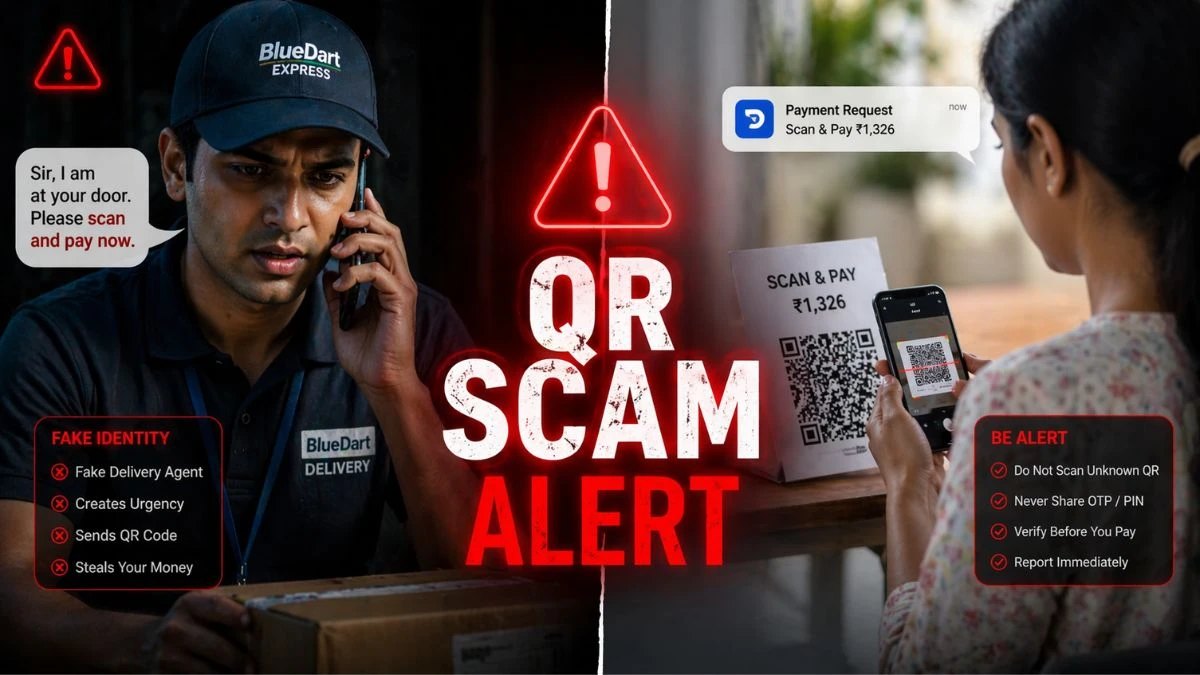
She had skincare products ordered at Foxtale. She received a call after 4 days. A man claimed to be of BlueDart, and was standing right outside her house. You can pay through the Internet, I will send you a scanner. It felt urgent. Legitimate. She scanned, paid, and transferred a screenshot. He said she entered the wrong amount, you need to send 1326 rupees, you send again and I’ll return the difference amount. Her mind wakes-up suddenly. Then silence. No delivery. No message from BlueDart. No refund. Only 1,360 lost, and the gutted rope of knowing what has just happened.
She isn’t alone. This is the same scam: fake delivery agent + QR code panic that is reported hundreds of times per day in India.
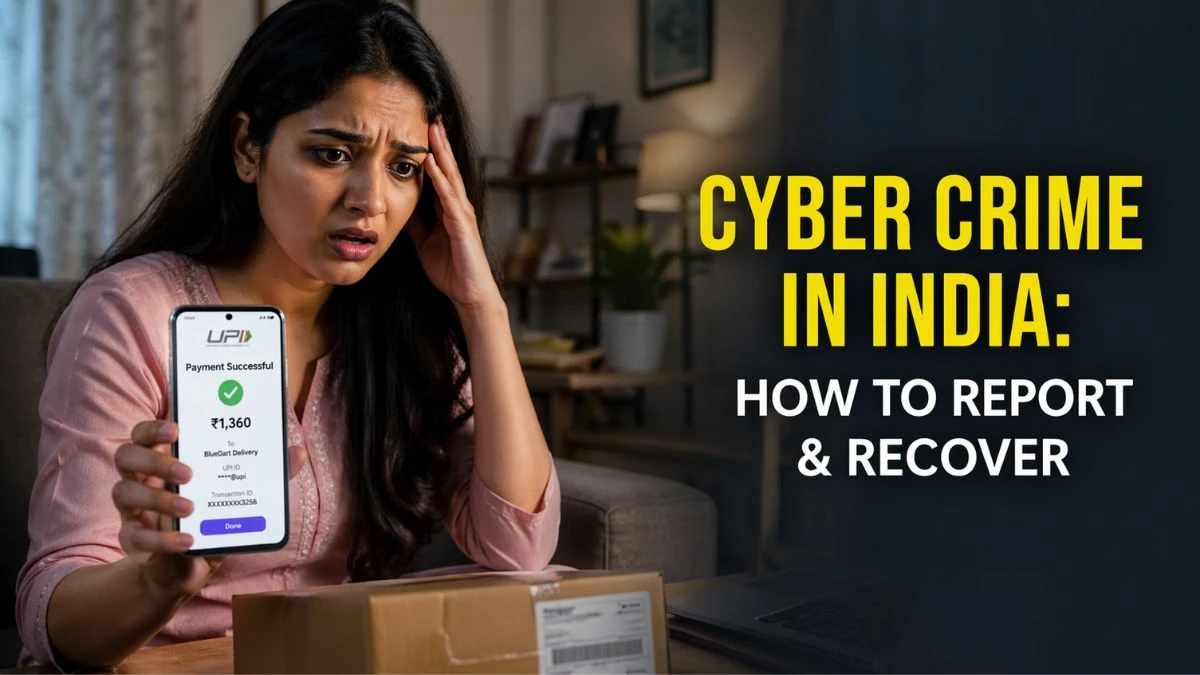
In the event that you are reading this because something like that has already happened to you, first: it is not your fault. These cheaters are businessmen. They investigate the functioning of the delivery systems. They understand precisely how to get you to do it, without pondering. Nevertheless, what you do today is important. Walk us through it, step by step.
What Does Cyber Crime Mean? (And Why India Needs to Take It Seriously)
Cyber crime is any crime that involves the use of a computer, smartphone and/or internet connection to cheat, threaten, steal and/or harm a person. The main law that regulates these crimes in India is the IT Act 2000 and Amendment Act 2008.

However, this is the awkward reality of the matter: the majority of victims do not report. This may be due to embarrassment, they think nothing will occur or simply, they are not sure of where to go. It is precisely that silence which scammers will rely on.
Typical forms of cyber crime in India.
- Delivery / QR Code Scam
Fraudulent courier agents forward a payment QR and coerce you to scan. Similar to the Foxtale story above. - UPI Fraud
Scammers send you a “payment request” rather than paying you and you mistakenly accept it. - OTP Fraud
Somebody calls in the guise of a bank officer, and deceives you to provide your OTP. - Cyber Bullying
Social media, WhatsApp or email harassment, threats, or humiliation. - Romance / Sextortion
Fraudulent relationships on the Internet to raise funds or blackmail photos. - Job / Loan Fraud
False employment opportunities or loan applications that rob their personal information or preliminary funds.
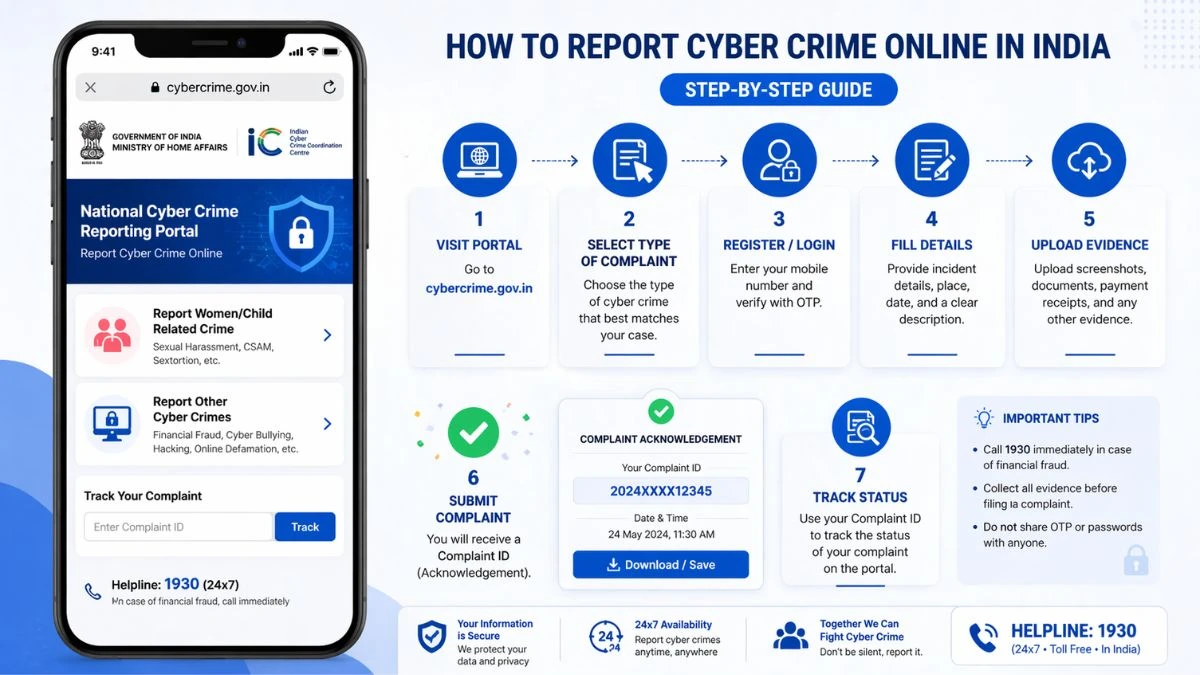
How to Report Cyber Crime Online in India Step-by-Step
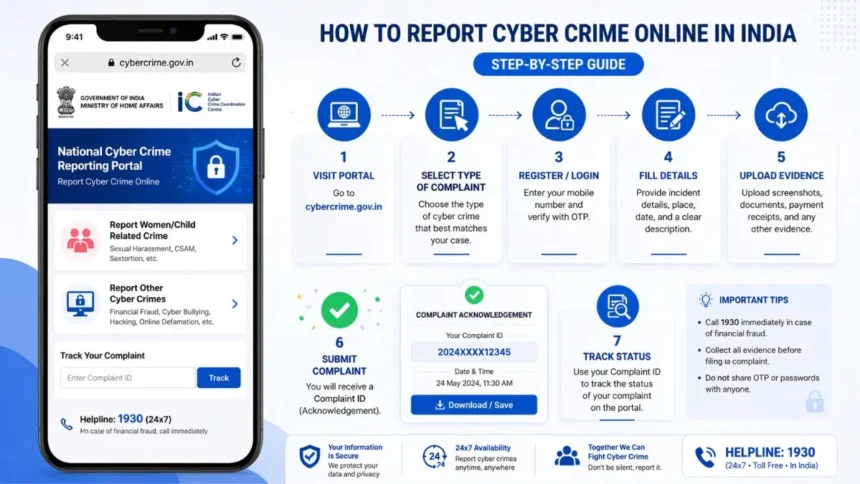
The Government of India has an official portal where cyber crimes can be reported: cybercrime.gov.in. It is free, 24/7 and you can report even when you do not know who the scammer is.
1 Go to the official portal
Visit cybercrime.gov.in. It is the single cyber crime reporting site operated by the government. Do not use third-party complaint websites which can also be scams.
2 Select type of complaint.
You will have two choices: Report Women/Child Related Crime (sexual harassment, CSAM, sextortion) and Report Other Cyber Crimes (financial fraud, cyber bullying, hacking, and so on). In the case of delivery scams, UPI frauds and internet bullying – choose the second alternative.

3 Register or log in
Select “File a Complaint. You’ll be asked to log in or register with your mobile number. A one time password will be provided. Do this step, your complaint has to be associated with a verified identity.
4 Enter details of the incident.
This is the most important step. You will be questioned: When did it occur? What type of crime? Which state are you in? Then explain in your own words what happened- be specific. Add dates, value, what was mentioned, what you have clicked, what you have paid.
5 Upload your evidence
This is critical. Include photos of the chat, payment receipts, UPI transaction IDs, phone number of the scammer, photos of any QR codes or links provided. The portal allows uploading of images and PDF files.

6 Give suspect information (where available)
Insert the phone number, email address, social media account of the scammer or any other account information. Even incomplete information is beneficial to investigators.
7 Enter and store your acknowledgement.
Once you have submitted it, you will receive a complaint number (acknowledgement ID). Screenshot and save this. And that is your evidence that the complaint was made. This number will enable you to check the status subsequently on the same portal.
Pro tip – do this FIRST before filing.
You have to collect all the data in a single folder before opening the portal: screenshots of all messages, your UPI transaction history, the number of the scammer, timestamps of calls. There is a time limit per session in the portal – you would be saved time by being prepared.
What Will Your Next step be after Filing?
This is the question everybody would like to have an answer to and, frankly speaking, the answer it could have been, was determined by the thoroughness of your complaint and the quickness with which you responded to it.
Your complaint is forwarded to the cyber crime cell of the state that the crime has been committed (mostly your home state). Cases are allocated to a case officer. They can get in touch with you to seek further information. In case the scammer had a bank account to receive the money, the authorities could request a freeze, however, it is highly effective when reported in 2472 hours.
Important reality check
Complaining is not a sure way of refunding or being arrested. Small sums (less than ₹5,000) might not result in active investigation. But reporting does not go to waste – your report is one of a pattern that can assist in catching serial offenders, and it can also aid in bank dispute procedures.
Other Reporting Options-Do Not Use a single Channel
The first one is the National Cyber Crime Helpline.
Call 1930 – this is the special call center of cyber crimes in India, which can be called in different languages. Should you have been defrauded in a money sense, a call to 1930 as soon as possible will result in a golden hour freeze of the fraudster before they can grab the cash. Every minute counts.
2. Your Local Police Station
You may also submit an FIR at the nearest police station in terms of the IT Act and IPC (Indian Penal Code). Request the cyber crime division or officer. Be prepared with printouts of your evidence. In case the police are not ready to accept your complaint, demand a written acknowledgement – that is your right of law.
3. Bank / UPI App (Financial Fraud)
In case money was stolen with the help of UPI (Google Pay, PhonePe, Paytm), call your bank fraud helpline and inform them that they are dealing with unauthorized transactions. Open UPI app, locate the transaction, and tap the Report an issue option, as well. It is possible to undo actions of banks in some cases, however, you should do it within a short period of time.
4. Social Media Platforms
You were bullied, harassed, or scammed on Instagram, WhatsApp, Facebook, or Twitter/X – report the account on the platform. Indian users have a legal right to complain about the platforms (as stipulated in the IT Rules 2021 of India) and expect the platform to act upon the complaint within allotted timeframes.
What Evidence to Gather, Before It is Lost.
Fraudsters erase the accounts, switch numbers and hide their footprint. Once you know that something is amiss, begin to preserve evidence, even before you know all that has transpired.
- All messages and calls screenshots.
WhatsApp, SMS, Instagram DMs, emails – screen shot all. Include timestamps. - UPI transaction ID and payment receipts.
Go to your UPI application, locate the payment and take a screenshot of the entire transaction and UTR (Unique Transaction Reference) number. - The telephone number of the scammer.
Save it – do not block the number till you have reported it. Not erasing the record of it, but you should file it and then block. - Any QRs and links posted.
Take a screenshot of the QR code or the URL – do not need to click on it again, simply save the image. - Your initial order confirmation.
In delivery frauds particularly, demonstrate that you did make an order and what a legitimate state of delivery was.
The Delivery Scam – How It Works (So You Never Fall Again).
The Foxtale/BlueDart scam at the top of this blog is a 100% real story of a known person, the person aware of this cyber bullying or fraud but still the person fell for it, the cyber fraud of a so-called fake delivery agent scam. Herein the psychology of its success:
It feels 100% real. The telephone call is timely. The individual is aware of the brand name. They say they’re outside. It is with haste, I will be away unless you pay now. You are in confirmation mode, rather than suspicion mode.
The most important warning sign that you must never forget: the genuine delivering agents do not request you to scan a QR code to pay. None of them are implementing QR codes in COD (cash on delivery). When someone requests you to scan and pay online calls as a delivery person – hang up. Contact the brand by calling their official site.
In case you were Cyber Bullied- this is the section you
Cyber bullying is not all an online drama. To the extent of the IT Act, sending threatening or offensive messages, sharing personal information of a person without permission, as well as repeated harassment of a person through the Internet is a punishable offense – up to 3 years of a prison sentence and fines.
You don’t need to tolerate it. There is no need to work out how to deal with it quietly. Here’s what to do:
First, stop responding. Bullies are usually driven by involvement. Second, take notes on everything – take pictures before blocking. Third, report on the platform. Fourth, file on cybercrime.gov.in on “Cyber Bullying / Stalking / Sexting.” Fifth, in case of threats, visit your local police station and request an FIR under Section 507 IPC (criminal intimidation by anonymous communication).
In case you are a student or minor, your school or college is also bound by POCSO and UGC guidelines to act.,
Prevention of Small Habits That Save You Big Losses.
Prevention is preferable to reporting. Here are habits which require you only seconds, and can make you thousands:
- Never rely on the supplier to check out the delivery status.
Go to the official site or app of the brand and monitor the status there – not by clicking on the link provided by an unknown person. - Stay away from a QR code that someone sends you to pay.
A QR code scam is a reversed transaction – you believe you are getting something, but you are paying. - Make calls on official numbers.
In case of a suspicious call from BlueDart, hang up and dial the official number of BlueDart on their website. - Turn on UPI transactions.
The majority of UPI applications allow you to establish daily restrictions – set them low so that you can use them every day. - Share with family.
These scams target their victims who are least likely to discuss them. Please share this article with your parents, siblings or friends who do online shopping.

Notice to a person who is embarrassed.
You lost ₹1,360. Or ₹10,000. Or more. And it was not anger, maybe, that was your initial reaction: it was shame. How did I fool myself?
Listen to this: These fraudsters are armed robbers on script. This is the same call which they have made hundreds of times. Their knowledge is when you order, brand knowledge, how to sound real. To fall in love with it does not render one gullible, it only renders him a human being.
The thing now is: you make a complaint. You tell someone. You warn others. Since any report, even one that does not result in an arrest in your case, creates a database that apprehends these people one day.
You were not a fool. You were targeted.
Ready to report? Start here.
Go to cybercrime.gov.in ↗
Or call helpline: 1930 (24/7, free)
This blog is informative to enable the Indian citizens to go through the process of reporting cyber crimes. A cyber law lawyer should be consulted to provide you with legal advice concerning your case.
Sources: cybercrime.gov.in, MeitY, NPCI, IT Act 2000 & Amendment 2008.
Frequently Asked Questions (FAQs)
- What is the speed at which I should report a cyber crime in India?
An immediate report of a cyber crime should be made preferably within the first few hours. In cases of financial fraud, the early reporting, in particular through the 1930 helpline, can serve to enable the authorities to make an attempt to freeze the transaction prior to the money being withdrawn or transferred further.
- Does this mean that one has to visit a police station after making an online complaint?
No, it is not mandatory in all cases. To start the process, one has to file a complaint on cybercrime.gov.in. But in severe instances or cases as ordered by authority, you might have to go to a police station or cyber cell to take further steps.
- Can I report the cyber crime with incomplete information about the scammer?
Yes. Even the partial data like a phone number, UPI ID, or even screenshots may be helpful. Patterns and numerous complaints help authorities monitor offenders, thus, piecemeal data should not make you turn back.
- Am I likely to recover my money upon reporting cyber fraud?
There is no certainty, and recovery. The odds are determined by how promptly you report the incident and whether the money can be tracked down or frozen before it is recovered. Early intervention will go a long way in enhancing chances of recovery.
- Does India have free reporting of cyber crime?
Yes. Cyber crime reporting in the official portal or helpline is absolutely free of charge. Watch out on third party services or agents who charge to make complaints as they too can be fraudsters.
About The Vue Times
The Vue Times is an online platform that aims at making complex issues in the areas of technology, finance, public policy and daily matters in India easier. We aim to provide simple, practical and research based information to facilitate comprehension of real life issues and good choices by the readers.
Editorial Note
This article has been reviewed and vetted by the editorial team of The Vue Times to guarantee that it is accurate, clear and can be used in practice. The data is informed by publicly available data, formal guidelines and real-world user scenarios in India.
Disclaimer
The aim of this article is informational. Although all possible efforts have been taken to be accurate, policies, banking procedures and regulations are subject to change with time. It is recommended that the readers should check the information with the official sources or their concerned banks before making any action.