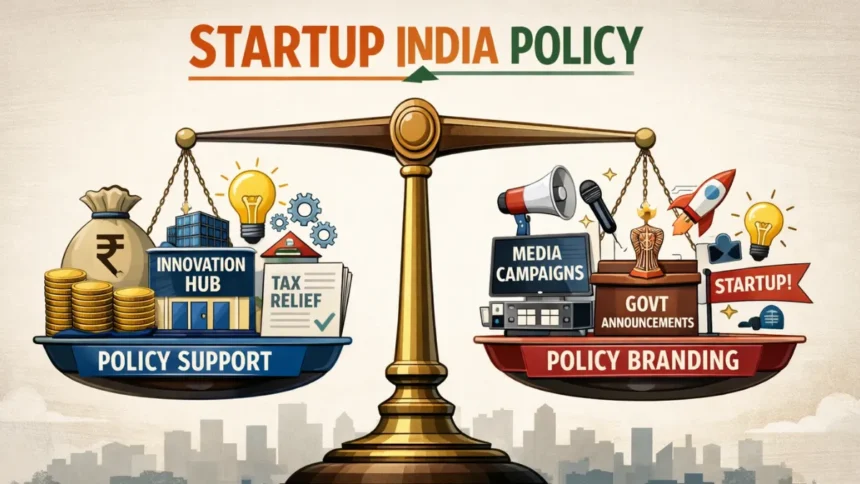
For serious government exam aspirants, Startup India Policy is not just an economy-topic headline. It is a recurring policy theme that can appear in GS answers, essay papers, interview discussions, and state PCS mains questions in multiple forms: entrepreneurship, employment generation, ease of doing business, innovation ecosystem, regulatory reform, and public policy evaluation. The real problem is that many students prepare it like a current affairs note, not like an examinable policy issue.
That creates a predictable mistake. Aspirants either write a one-sided appreciation piece praising startup growth, or they write a cynical answer calling it only a publicity campaign. Both approaches lose marks because examiners usually reward balanced policy analysis, not reaction. A better answer asks a sharper question: has the Startup India Policy created meaningful institutional support, or has it remained stronger in visibility than in structural reform?
This framing matters because it allows a student to move beyond slogans and into evaluation. It also connects directly with the broader issue of startup regulation India, which is where many answers become stronger. A high-scoring answer should examine what the policy intended, what support mechanisms were created, where regulatory bottlenecks remain, and whether branding has outpaced implementation. That is the difference between a descriptive answer and an analytical one.
Problem Statement
Students usually face three specific difficulties with this topic.

First, they confuse scheme summary with policy analysis. They list points such as tax benefits, self-certification, Fund of Funds, and startup recognition, but they do not assess whether these instruments have changed the business environment in practice.
Second, they ignore administrative friction. Any answer on entrepreneurship policy in India becomes incomplete if it overlooks compliance burdens, state-level variation, delayed approvals, sector-specific restrictions, and the gap between policy announcement and field execution. In exam language, this is where the theme of startup regulation India becomes central.
Third, many aspirants fail to structure the answer around a judgement. The title itself — “Policy Support or Policy Branding?” — demands evaluation. If a student only describes the policy, the answer stays average. If the student compares intent, instruments, implementation, and outcomes, the answer becomes much more mature.
The challenge, then, is not lack of information. It is lack of answer architecture.

Concept Clarity
To write well on Startup India Policy, students need to understand the difference between policy support and policy branding.

Policy support means actual institutional help that lowers barriers and improves startup survival and growth. This includes easier registration, simpler compliance, faster patent processing, access to funding channels, tax incentives, incubation support, procurement access, and reduced inspector burden.
Policy branding means the state successfully creates a narrative of reform and innovation, but delivery is uneven, selective, or exaggerated relative to the claims. Branding is not automatically bad. In public policy, branding can attract investment, encourage entrepreneurship, and signal intent. But from an exam perspective, branding alone does not amount to deep reform.
So the right conceptual lens is this:

- Policy support asks: what changed on the ground?
- Policy branding asks: what changed in perception and messaging?
- Policy evaluation asks: how far do these two overlap?
A strong answer should show that the Startup India Policy has elements of both. It has undeniably improved visibility of entrepreneurship and created some support structures. At the same time, the broader field of startup regulation India still includes many constraints that limit the transformative potential of the policy.
This balanced framework helps in GS papers because it demonstrates nuanced thinking. It also helps in essays because it provides a central argument: Startup India is best understood as a mixed policy — symbolically powerful, partially substantive, but uneven in regulatory depth.
Practical Framework
Here is a clean exam-writing framework you can use for any mains answer on this topic.
Define the policy in one line
Start with a compact definition:
Startup India Policy is a government-led initiative aimed at promoting entrepreneurship, innovation, and job creation through regulatory easing, funding support, and institutional recognition.
This opening gives scope, purpose, and policy domain in one sentence.
Mention the major support pillars
In the next 3–4 lines, identify the key support mechanisms:
- startup recognition framework
- tax incentives and exemptions
- self-certification for certain labour and environmental laws
- faster intellectual property support
- Fund of Funds and incubation ecosystem
- public procurement relaxation
Do not over-explain each point unless the question is purely descriptive.
Shift to evaluation
This is where many students fail. Use a pivot line:
However, the real test of Startup India Policy lies in whether these measures have significantly reduced entry and operating barriers across sectors and states.
That sentence moves the answer from summary to analysis.
Evaluate through four parameters
Use four parameters for assessment:
1. Regulatory ease
Has compliance actually become easier for founders?
2. Financial access
Have early-stage and growth-stage funding gaps been reduced?
3. Institutional reach
Is support concentrated in major urban ecosystems or spread widely?
4. Outcome quality
Has the policy improved innovation depth, employment, and enterprise survival?
This is a very exam-friendly framework because it gives order to your body paragraphs.
Deliver a balanced judgement
End with a line like:
Thus, Startup India Policy represents genuine policy support in selected areas, but in the wider ecosystem of startup regulation India, branding has often run ahead of deep structural reform.
That is the kind of sentence that gets remembered by examiners.
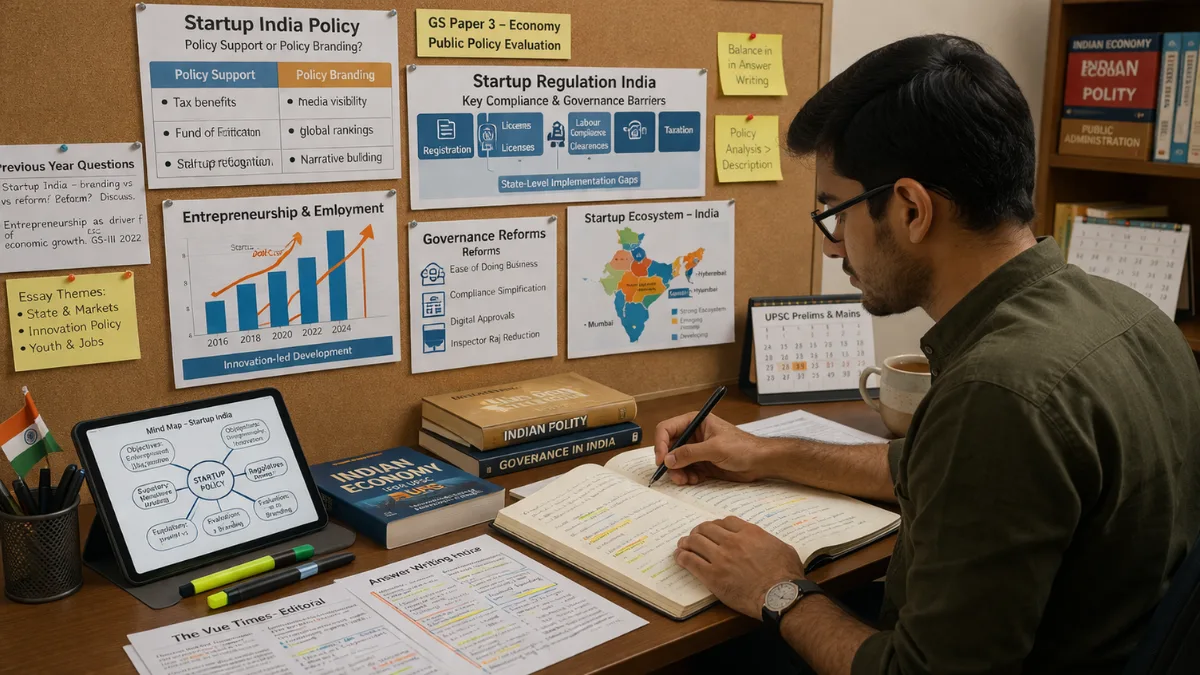
Example Answer Structure
For a 150-word mains answer, use this pattern:
Intro: Define Startup India Policy and mention objective.
Body Para 1: Mention major support measures.
Body Para 2: Evaluate implementation limits and regulatory bottlenecks.
Body Para 3: Balanced judgement on support versus branding.
Conclusion: Suggest deeper reforms for better policy outcomes.
Mistake vs Correct Approach Comparison
Mistake:
“Startup India has helped many startups by giving tax benefits and making India an innovation hub.”
Why it is weak: too generic, no evaluation, no policy language, no regulatory depth.
Correct approach:
“Startup India Policy has strengthened the visibility and recognition of entrepreneurship through tax incentives, self-certification, and institutional support. However, persistent compliance burdens, uneven access to funding, and state-level implementation gaps suggest that policy branding has moved faster than comprehensive regulatory reform.”
Why it scores better: balanced, specific, analytical, and linked to actual governance issues.
Model Answer Snippet
Question: Startup India Policy has been more successful as a branding exercise than as a structural reform. Discuss.
Model snippet:
Startup India Policy has had a significant signalling effect by making entrepreneurship a recognised policy priority in India. It introduced support mechanisms such as startup recognition, tax exemptions, easier patent filing, and self-certification under selected laws. However, the broader environment of startup regulation India continues to be shaped by compliance complexity, funding concentration, and uneven state capacity. Therefore, while the policy has delivered visible support in ecosystem-building, its structural impact remains partial and uneven. A stronger second-generation reform agenda would require deeper regulatory simplification, wider regional inclusion, and more predictable implementation.
Common Errors
1. Writing a current affairs summary instead of an answer
Many students prepare from newspaper notes and reproduce scheme facts without building an argument. That may work in prelims revision, but not in mains.
2. Ignoring the word “discuss” or “critically examine”
If the question asks for evaluation, then both positives and limitations must appear. A one-sided answer signals weak interpretation of directive words.
3. Mixing startups with MSMEs without distinction
Startups are not simply small businesses. They are typically linked to innovation, scalability, technology, or new business models. Confusing them with the entire MSME sector reduces conceptual accuracy.
4. Overusing vague phrases
Phrases like “boosted the economy,” “encouraged youth,” and “made India better” do not carry marks unless backed by policy reasoning.
5. Ignoring implementation heterogeneity
The impact of startup support is not identical across states, sectors, or stages of enterprise growth. Students who mention this variation usually write better answers.
6. Missing the regulation angle
Because the secondary keyword is startup regulation India, answers should explicitly mention compliance burden, approvals, taxation uncertainty, labour rules, sectoral permissions, or other governance barriers.
Tactical Application
This topic improves marks because it helps students demonstrate three high-value exam skills.
First, it shows policy evaluation. Examiners prefer answers that do more than list features. When a student distinguishes between intent, instrument, and outcome, the answer immediately looks mature.
Second, it improves interdisciplinary writing. Startup India Policy can be used in questions related to economy, governance, employment, innovation, urbanisation, digital economy, and cooperative federalism.
Third, it strengthens essay quality. In essay papers, this topic can support arguments about the state and markets, the role of regulation in innovation, and whether modern governance increasingly relies on narrative-building alongside institutional reform.
Aspirants can also use this topic in interviews. A balanced line such as “India has improved startup visibility, but regulatory consistency still needs work” is much more credible than a simplistic yes-or-no position.
From a marks perspective, this topic is useful because it rewards structured judgement. Students who write with calibrated language — “partial success,” “mixed implementation,” “signalling value,” “institutional limits” — usually appear more serious than those who write in absolute terms.
Improvement Plan
To master this topic for exams, use a weekly execution plan instead of passive reading.
Daily Method
Day 1: Core Concept Note
Write a one-page note covering objectives, instruments, and implementation concerns of Startup India Policy.
Day 2: Regulation Lens
Make a separate note titled startup regulation India. Under it, list the main barriers:
- compliance burden
- licensing and approvals
- funding asymmetry
- state-level differences
- tax uncertainty
- sector-specific restrictions
Day 3: Answer Practice
Write one 150-word answer and one 250-word answer on the same topic. Focus on balance, not information overload.
Day 4: Mistake Audit
Check whether your answer:
- defined the policy clearly
- included both support and branding angles
- used at least one evaluative sentence
- ended with a reasoned conclusion
Day 5: Value Addition
Prepare 5–6 strong phrases you can reuse:
- signalling effect of policy
- ecosystem-based support
- implementation asymmetry
- compliance simplification gap
- branding versus structural reform
- innovation-led entrepreneurship
Day 6: Model Paragraph Rewrite
Take a weak paragraph and rewrite it into a sharper policy paragraph. This builds answer maturity faster than reading more material.
Day 7: Revision Drill
Speak the topic aloud in two minutes. Then write a 50-word summary. This improves recall under exam pressure.
Weekly Execution Strategy
Each week, do three things:
- One concept revision
- Two answer-writing drills
- One policy comparison
For comparison practice, compare Startup India with:
- Make in India
- Digital India
- MSME support measures
- Ease of Doing Business reforms
This helps build analytical depth and prevents isolated preparation.
Internal Link Placeholders
- [Read more: How to Write Balanced Public Policy Answers for UPSC Mains]
- [Read more: Difference Between Scheme, Mission, and Policy in Government Exam Answers]
- [Read more: GS Paper 3 Economy Answer-Writing Framework for High Scores]
Final Insight
Public policy questions are rarely scored well through memorised definitions alone. The scoring edge comes from knowing how to evaluate intent, design, implementation, and outcomes in a compact answer format. That is where serious aspirants lose marks without realising it. Follow The Vue Times for exam-focused policy breakdowns that convert current affairs into answer-ready frameworks, issue-based comparisons, and practical writing structures built for actual mains performance.
FAQs
1. What is the Startup India Policy in simple terms?
Startup India Policy is a government initiative designed to support entrepreneurship through recognition, tax incentives, regulatory easing, funding facilitation, and innovation support measures.
2. Why is Startup India Policy important for government exam preparation?
It is important because it connects with economy, governance, employment, innovation, public policy evaluation, and regulatory reform — all common themes in GS and essay papers.
3. How should students write on Startup India Policy in mains answers?
Students should avoid simple feature-listing and instead assess both policy support and implementation gaps, especially the issue of startup regulation India.
4. Is Startup India Policy more branding than reform?
A balanced answer is that it has been effective as a branding and signalling exercise, while its structural reform impact remains real but uneven.
5. What mistakes reduce marks in this topic?
The main mistakes are writing one-sided answers, ignoring regulatory bottlenecks, confusing startups with MSMEs, and failing to give a balanced conclusion.

Conclusion
The best way to approach Startup India Policy in exams is neither celebration nor dismissal. It should be treated as a serious policy case study in which state-led entrepreneurship support has produced visible ecosystem gains, but deeper questions remain about execution, reach, and regulatory simplification. In that sense, the real debate is not whether the policy matters, but how far it has moved from symbolic encouragement to durable institutional reform. For aspirants, this makes Startup India Policy a high-value topic: it allows demonstration of balance, policy reasoning, and analytical writing grounded in the realities of startup regulation India.