
AI Is Moving Beyond Chatbots: What Gemini 4 Neon Tells Us About the Future
Artificial intelligence is moving beyond simple conversations. Google's Gemini 4 Neon highlights how AI agents could transform research, coding, business operations and everyday work.

AI Is Moving Beyond Chatbots: What Gemini 4 Neon Tells Us About the Future
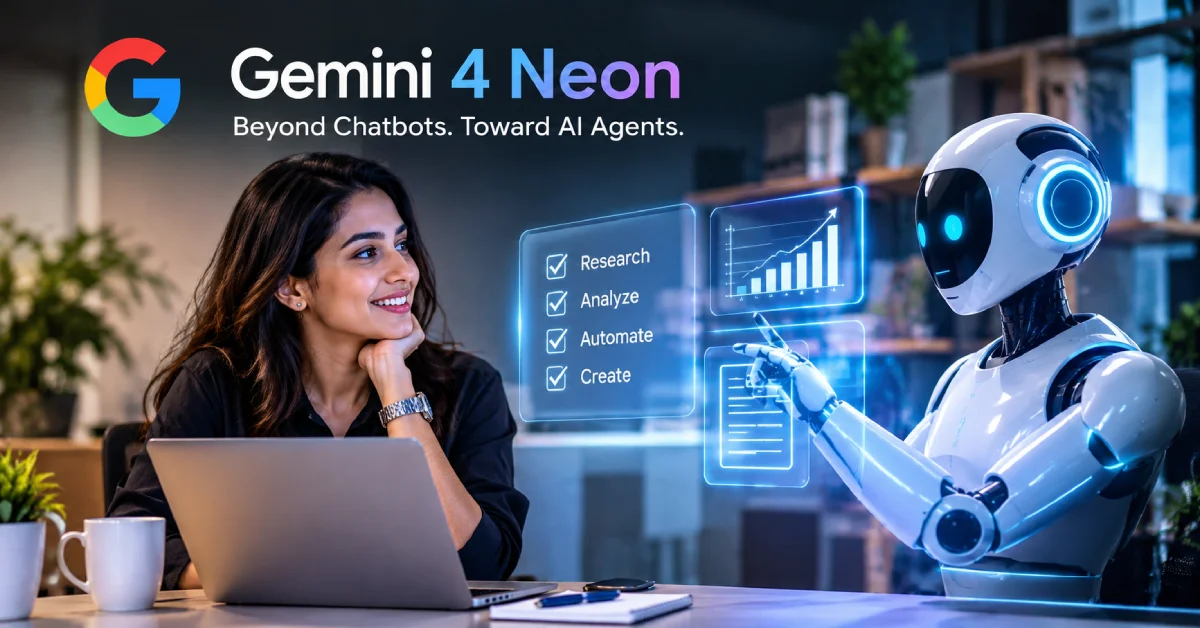
Suppose you gave an AI tool five competing companies, you asked it to find the price of each one, you asked it to make a spreadsheet and you asked it to write a report on the market and what opportunities you may have found. Rather than providing you with a list of suggestions, the AI goes through the various steps and creates the results.
This is the way artificial intelligence is going. Over the years, numerous individuals have interacted with AI chatbots for questions, content creation, language translation, or everyday issues. The next big thing in AI, however, is systems that can interpret instructions, employ tools and accomplish tasks with minimal human interaction.
Google's latest launch, Gemini 4 Neon is another important step in this direction. The model will be announced on 18.11.2026, it is used for complex software engineering, research, business analysis and multi-step workflow.
However, what does that imply? Could AI assistants soon be more of a digital worker than just another chatbot?
Let's understand.
How AI is Transforming from Answering Questions to Completing Tasks
Consider the existing applications of AI. A person could instruct a chatbot to create an e-mail, clarify an intricate issue or generate concepts for a marketing campaign. AI produces a response and the user does the rest.
For instance, when the owner of a business would like to compare others, he or she may have to ask some questions, gather information, arrange the data and make a final report.
An AI agent seeks to make this more connected.
An agent can decompose a more complex request into smaller steps and access tools that are available, analyze information and act on it to accomplish the task.
This is an important difference between traditional chatbot interactions and agentic AI.
But it is not to say that AI can take over all the real-world tasks. These still rely on available tools, permissions and reliable information and human supervision.
What is the difference of Gemini 4 Neon?
Google developed Gemini 4 Neon, a model that harmonizes with high reasoning, speed, cost-efficiency.
Unlike the AI models that are targeted at more generic conversations, Neon is targeted at heavy work that can involve multiple steps, various types of information, and longer working sessions.
It has several key features, such as:
1. Handling complex research
Research can include reading multiple documents, comparing and looking for useful connections. For every type of format, such as PDFs, spreadsheets, charts, audio and video, Gemini 4 Neon can be used.
2. Supporting software development
AI is not just for creating brief code snippets! Gemini 4 Neon is designed to handle multi-file debugging, code refactoring and complex software engineering workflows.
3. Analysing business information
There is a constant need for businesses to deal with financial papers, reports, spreadsheets and huge data. Neon is an AI tool that helps simplify the analysis of these data and generate helpful reports.
4. Completing multi-step workflows
The most interesting is perhaps the ability to manage longer tasks. Neon is able to act as an orchestrator in Google's Antigravity environment, this allows it to control numerous smaller AIs to accomplish distinct aspects of a project.
The abilities reflect the transition towards AI systems that perform tasks, rather than just provide answers.
Why Google Is Focusing on AI Agents
AI competition is now more than just about the most impressive response by the chatbot.
In addition, technology firms are striving to make AI more beneficial in daily life, job routines and business actions.
A business might consider using AI to sift through customer reviews, create reports, sort information and assist staff with routine jobs. When creating an AI system, developers might wish to have an understanding of the whole codebase as opposed to just programming questions.
This is why there's a need for models that can follow instructions, remember the relevant context while carrying out a task and interact with various tools.
Google's Gemini 4 Neon takes this approach. It sits between its more intensive long-running tasks of Gemini 4 Carbon and the more speedy execution of everyday tasks of Gemini 4 Hydrogen.
The concept is to provide a balance between intelligence, speed and cost of operation and to not utilize the most powerful model for all tasks.
The impact of AI Agents on everyday work
As AI agents become more common, they may impact various industries. Here are a few examples of potential application areas.
-
Customer data: AI can help business owners manage and store customer information.
-
Product prices: AI can also help compare product prices.
-
Digital marketing: AI can help marketing teams by analysing campaign performance, feedback from customers, content research and campaign reporting.
-
Software development: Builders can delegate repetitive coding duties, audit mistakes, test code adjustments and comprehend massive software projects with the support of AI.
-
Education and research: AI can be used to organize study materials, summarize lengthy documents, and compare information from different sources, benefiting both students and researchers.
Document analysis, spreadsheet preparation, report writing and other repetitive tasks may be time-consuming in the office, but these are tasks that employees could save time in.
These are not necessarily applications that will automatically occur, but merely potential applications, which means that not every task can be completed today without human intervention.
Will AI replace human workers in the future in the field of gemstone cutting?
With the rise of AI in handling more complex tasks, one can only imagine that people will be worried about losing their jobs.
People tend to wonder if businesses will need less people, when a tool is able to analyse the documents, compile reports, write code and organise information.
The influence will probably not be felt in the same way in all occupations.
While AI can help with repetitive tasks, human judgments are necessary in situations where decisions carry business responsibility, deal with Customers, are creative or involve ethical issues and real-world understanding.
For instance, an AI system can create a marketing report, but a marketing expert is still required to ensure they know the company's customers, what is best for the company and what is the most appropriate recommendations.
Likewise while AI can aid in bug detection, code review, comprehending product demands and securing its safety are also essential tasks.
Perhaps the larger transformation is in the ways of working. With the effective understanding of AI tools, the employees may acquire an edge in accomplishing specific tasks faster.
What Human Control and AI safety?
Tasks that involve several actions present new challenges when the tasks are given to AI systems.
An incorrect answer is one problem. An AI agent that accesses documents, websites, business systems and makes a mistake in his or her interaction can cause a much larger problem.
That's why the importance of safety, permissions and human oversight is crucial as AI gets more powerful.
Google says that Gemini 4 Neon has “defenses against misuse and indirect prompt injection attacks,” in which malicious instructions could be embedded in a website, document or other content that the AI system is fed.
However, the safety testing does not imply absolute correctness or security of the AI model.
When engaging AI agents with critical systems, businesses need to be mindful of permissions, safeguard sensitive data and confirm critical actions before granting access.
The future of AI may be about getting work done!
One of the key shifts in artificial intelligence that Gemini 4 Neon has introduced is its ability to feed on data and streamline workflows. The emphasis is shifting away from improving conversations and more towards developing systems that can effectively accomplish tasks.
However, this doesn't imply that the chatbots are going away. Instead they are getting integrated into a larger AI ecosystem where they can research, analyse, write, code and interact with various tools.
This could lead to a wider range of applications for AI in business, development, and user interactions, beyond just answering questions.
The true challenge, however, will be the ability to develop an AI model that performs well in the actual application. It will be if it provides accurate, reliable and useful results in real world scenarios.
One such transformative shift is with its new offering, Gemini 4 Neon. Although AI agents are still evolving, the next major technology change could be the focus on how well they can get people to do things, rather than how clever they can be.












Comments (0)