

What Are Isolated Coach Brakes? Understanding the Vande Bharat Train Incident
An empty Vande Bharat train travelled around 463 km with isolated coach brakes. Understand what brake isolation means, how train braking systems work and why the incident has raised railway safety concerns.

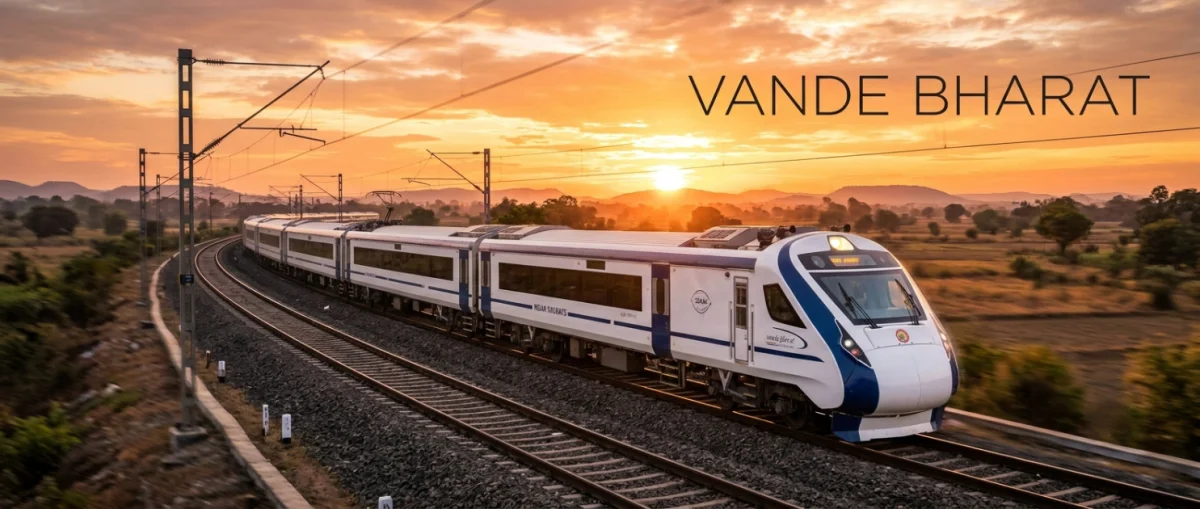
What Are Isolated Coach Brakes? Understanding the Vande Bharat Train Incident
An empty Vande Bharat train reportedly travelled around 463 kilometres despite problems with its braking system. The incident has raised questions about railway safety, maintenance inspections and the importance of properly functioning train brakes.
According to reports, the incident occurred on October 24, 2026, when an empty Vande Bharat chair car rake was being moved from Hatia in Jharkhand towards Jhansi in Uttar Pradesh using a freight locomotive. During the journey, two loco pilots reportedly raised concerns about poor braking performance. However, the train was allowed to continue.
A subsequent inspection at Deen Dayal Upadhyaya (DDU) station found that the braking systems of all the coaches had been isolated. Following the incident, South Eastern Railway ordered an investigation on November 7 to examine the lapses and identify the reasons behind the incident.
What Was the Reason Behind the 'Vande Bharat Train Brake Incident'?
The incident took place on October 24, when the railway officials were asked to shift an empty Vande Bharat train from Hatia to Jhansi with a freight locomotive, the reports said.
Usually, if one locomotive is to be used to draw a group of coaches, all of the braking systems must be correctly coupled and coordinated for the purpose. This enables the train to be braked as a whole by the driver of the locomotive.
But, the necessary integration of the locomotive and Vande Bharat coaches' braking system was reportedly not performed correctly.
Both the warnings were issued by the loco pilots after they had done a brake feel and brake power test between Hatia and Ranchi. The pilot also observed the train's braking performance was extremely poor and reported the same in writing to railway officials in Ranchi.
In spite of this warning, the train went ahead.
Another loco pilot, who assumed control at Muri station, also said that the brakes weren't functioning effectively. Reportedly, the brake pipe pressure was not activating the coach's brakes.
Eventually, the train arrived at DDU station where it was discovered that all of the coaches' brakes were isolated.
The rake had covered some 463 kilometres when coach braking systems were not working as they should be. It was reported to have used the brakes and regenerative braking of the freight locomotive.
On November 7, South Eastern Railway issued an order to the Ranchi Divisional Railway Manager to take up the investigation and find out the lapses in the staff.
What Are Isolated Coach Brakes?
Knowing what brake isolation is, is essential when it comes to understanding the incident.
Each coach of a train is fitted with a brake mechanism which aids the slowing down or stopping of the train. These brakes are intended to be used in conjunction with the locomotive's braking system.
However, at times, a coach's braking system may be isolated or disconnected for a technical reason, maintenance requirement or other operational reason.
The process is called "brake isolation".
In simple terms, if a coach's brakes are “isolated,” its braking system is unable to react to the normal braking input.
Brake isolation doesn't necessarily mean that the physical brake parts have been taken away. The braking operation, rather, is not possible because of the lack of the connection or control, by which the braking operation is possible.
A failed brake system could likely cause other equipment to malfunction, and should be isolated by railway personnel. But an isolated brake-equipped coach cannot be considered a normal coach equipped with all four brakes. It has to be evaluated and the railway should adhere to the necessary safety precautions before it can be moved.
In the Vande Bharat incident, it was reported that brakes were isolated on all the coaches, that is, the train was supposed to be provided with the required braking support from the coaches.
How Do Train Brakes Work?
Air-braking arrangements are adopted in most of the conventional Indian Railway passenger coaches. The compressed air systems are used to apply and release brakes.
A simple description of their operation:
1. Compressed air is stored in the system
The air-brake arrangement of a train is based on a system of compressed air in the various components of the braking system. The train is equipped with a brake pipe which aids in brake control.
2. The driver is in charge of braking
The pressure of the brake pipe will vary when the loco pilot applies the brakes. It is a signal for the braking system of the coaches to activate the brakes.
3. Brakes are applied to slow down the train
The braking equipment automatically works on the brake cylinders, which push the braking elements. This will generate friction or braking force, which will slow down the wheels and assist in braking the train.
4. Brakes are released as necessary
The system is able to return the air pressure required for the brakes to release when the driver releases the brakes.
The train simply needs to be able to work together, slowing down safely and in a controlled manner.
The type of braking technology and control systems could vary depending on the type of train, including modern trainsets like Vande Bharat.
Isolated Coach Brakes: What Makes Them a Big Problem for Safety?
A train can be several hundreds of tonnes, particularly if it is carrying passengers. To stop a heavy vehicle, a suitable braking system is needed.
When one or more coaches' brakes fail to work, the braking of the train may be affected.
Here are some of the key safety issues to consider:
1. Longer stopping distance: The train could take longer to stop since all coaches are not expected to provide a braking force.
2. Less braking control: The locomotive driver may not feel the braking action on the entire train.
3. Emergency situations: If an unforeseen obstacle or another emergency in the train's operation arises, there is less braking power available and it is more difficult to stop the train safely.
A train operating on a heavily used railway without a braking system can cause other railway operations to be at risk.
That is why it is important for railway employees to test a train's braking system prior to the train's movement.
How Did the Vande Bharat Train Travel 463 Km Without Coach Brakes?
One common question following the incident is how the train could travel such a long distance if its coach brakes were not working.
The answer is that the empty Vande Bharat rake was being pulled by a freight locomotive.
According to media reports, the train relied on the locomotive's braking system and regenerative braking instead of the expected combined braking arrangement.
Regenerative braking is a technology in which an electric motor works as a generator during braking. It converts some of the vehicle's movement energy into electrical energy, helping slow it down.
However, locomotive braking and regenerative braking should not be considered a replacement for the required braking arrangement across all coaches.
The reported journey highlights why proper brake integration and mandatory brake power checks are important before moving a train.
What Did the Railway Investigation Highlight?
The preliminary findings reported by the media pointed towards multiple failures rather than a single technical problem.
Some of the major concerns included:
-
Maintenance staff allegedly failed to physically verify whether the coach brakes were working before departure.
-
The first loco pilot reported poor braking performance at Ranchi, but the train was allowed to proceed.
-
A second loco pilot also raised concerns at Muri.
-
Railway controllers reportedly failed to take appropriate action despite receiving warnings.
-
The investigation also highlighted a lack of familiarity among the operating crew with the Vande Bharat braking system.
South Eastern Railway described operating a train without adequate brake power as a serious safety concern.
The detailed investigation was directed to identify the lapses and recommend corrective and preventive measures to avoid similar incidents.
What Does This Incident Mean for Indian Railway Safety?
Vande Bharat trains are among India's modern semi-high-speed train services. They feature advanced technology and are designed to offer faster and more comfortable journeys.
However, modern technology alone cannot guarantee railway safety. Proper maintenance, technical inspections, trained staff and timely action are equally important.
The incident is particularly concerning because the loco pilots reportedly identified the braking problem during the journey, but their warnings did not lead to an immediate resolution.
It also highlights an important lesson: even when a train is empty, it must meet the required safety standards before being moved on an operational railway route.
The focus of the investigation will therefore be not just on how the brakes became isolated, but also on why the train was allowed to continue despite repeated warnings.
Conclusion
The Vande Bharat isolated coach brakes incident has brought attention to an important but often overlooked part of railway safety: the braking system.
Brake isolation can be a necessary technical procedure in certain situations, but moving a train without adequate braking capacity creates serious risks. The reported 463-kilometre journey highlights the importance of proper inspections, communication between railway staff and strict safety checks.
As Indian Railways continues to modernise its services, ensuring that every train is technically fit before departure remains just as important as introducing new technology.













Comments (0)