

Delhi's Air After Diwali: What Really Causes the November Spike
Delhi's air often becomes harder to breathe after Diwali, but firecrackers are only one part of the problem. Understand how stubble burning, winter weather, traffic and local emissions combine to create the November pollution spike, what GRAP restrictions mean and how to protect yourself.

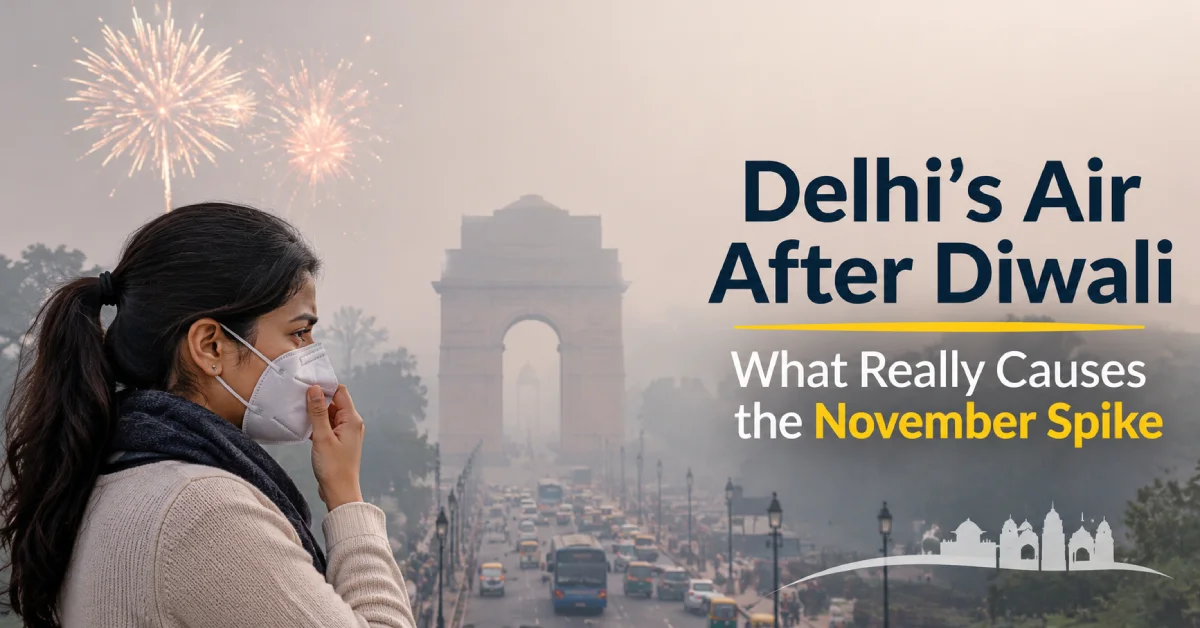
Delhi's Air After Diwali: What Really Causes the November Spike
As Diwali celebrations wind down, each year Delhi people start to observe a familiar change. The morning sky is dull, far buildings fade out into a haze and it is uncomfortable to walk outdoors a short distance.
People are told the first thing that comes to mind is firecrackers. November pollution in Delhi has a much bigger story behind it, as fireworks do release smoke and harmful particles.
The problem is exacerbated by the burning of stubble in neighbouring states, emissions from cars and trucks, dust from construction sites, pollution from industry, and weather conditions during the winter months. The effects of the two together can lead to a significant increase in pollution levels and this can still be high well after midnight.
The extent of the problem is shown in the IQAir 2025 World Air Quality Report. In the capital city comparison, New Delhi had an average PM2.5 concentration of 82.2 micrograms per cubic metre per day (µg/m³/day) for the whole year, making it the most polluted capital in the world.
So, what triggers the spike in pollution in November, in Delhi? Let's take a look at the big factors.
Delhi AQI After Diwali: November 9 Update
The current AQI of Delhi on 09th November 2026 is [insert latest AQI] which has classified the city under the [insert latest AQI category] category. The average concentration of PM2.5 for 24 hours was [insert reading] µg/m³.
Include reading time, reporting stations and official source prior to publication. Refer to CPCB or Delhi government's air-quality dashboard and make it clear if the number is an average for the city or a particular monitoring station.
The Indian National Air Quality Index (AQI) uses six categories: Good (0–50), Satisfactory (51–100), Moderate (101–200), Poor (201–300), Very Poor (301–400) and Severe (401–500).
An AQI value gives us information about the pollution level of the air at that time. It alone does not designate the source of the pollution.
1. Stubble Burning: Smoke That Travels From Neighbouring States
Particularly, in the areas of Punjab and Haryana, farmers may have little time after the paddy harvest to ready the fields for the next crop. Governments are encouraging other methods of disposing of crop residues, but one way to quickly clear fields is to burn the surplus residue.
The emission of fine particles (PM2.5) by these fires may be capable of crossing state lines depending on wind direction and velocity.
These pollutants, which are already present in the city, are then contributed to when winds blow these pollutants towards the city of Delhi. The contribution of farm fires may vary greatly from one day to the next. This is related to the number of fires, wind direction and weather factors.
That's why stubble burning should not be considered as a single culprit of pollution in Delhi. It is an important contributor and each day has a variable contribution.
2. Pollution Can Become Trapped in the Air During the Winter Season
The amount of low-level pollution depends heavily on the weather.
In the summer months, when there is more mixing in the air and stronger winds, pollutants can be dispersed. The months of November and December can be unpredictable! When the weather is cooler, winds are weaker, and the mixing height is lower, polluted air will not be able to rise and disperse.
The situation can get worse when there is a temperature inversion. Usually, air close to the surface of the Earth warms up and climbs. An inversion occurs when the warm high-level air layer is overlying the cooler ground-level air layer, inhibiting vertical mixing and confining air pollutants to the polluted air layer near the ground where people breathe.
This is a problematic scenario; it is challenging because emissions are still being released from cars, factories, building and other anthropogenic activities, while the atmosphere is less effective at spreading the emissions.
Put simply, when weather conditions do not disperse the amount of pollution can become more significant in terms of air quality.
3. The Everyday Sources: Traffic, Construction and Industrial Emissions
Although stubble burning and firecrackers are talked about a lot in November, the other regular pollutants that plague Delhi don't disappear after the festival.
Delhi and the entire NCR have thousands of vehicles running every day. Pollutants are emitted in the exhaust gases and tyre/brake wear contributes to particulate pollution.
This is exacerbated by construction activity, road dust and industrial emissions from diesel generators and open burning of waste. They are in action all year long, but may be more noticeable during the winter months when pollutants are confined to the surface.
This is the reason why it is not enough to just do something about pollution around Diwali for a day or two. Cleaner transport, dust management, industrial compliance and improved waste management are crucial all year round.
4. Red Chalk: A Sharp Spike Around Diwali
Firecrackers are a real cause of short duration air pollution. They emit smoke and fine particles and gases that may lead to an immediate degradation in air quality.
The impact of the effect can be seen during, and after, Diwali night when fireworks are set off in various neighbourhoods. It is possible that levels of pollution could increase significantly at nearby monitoring stations.
But the effects of firecrackers need to be considered in context. These can result in a dramatic surge in the short term, but they do not account for Delhi's poor air quality for weeks following the festivities.
The effect of local emissions and regional pollution and unfavourable weather conditions on the November pollution episode is significant.
5. What Are GRAP Stages and Why Are They Important?
Authorities put into place restrictions and pollution control measures in Delhi-NCR through the Graded Response Action Plan (GRAP) when the air quality level suffers.
GRAP has four stages depending on the severity of the Delhi AQI:
| GRAP Stage | AQI Range | Air Quality |
|---|---|---|
| Stage I | 201–300 | Poor |
| Stage II | 301–400 | Very Poor |
| Stage III | 401–450 | Severe |
| Stage IV | Above 450 | Severe+ |
Each stage adds measures to those already introduced at lower stages.
Stage I: Focuses on dust control, road cleaning, water sprinkling and preventing open waste burning.
Stage II: Adds stronger restrictions, including measures to reduce private vehicle use and control emissions from diesel generator sets.
Stage III: Brings stricter action, including restrictions on certain construction activities and additional measures affecting vehicles and schools.
Stage IV: Introduces the strongest emergency restrictions, which may include further limits on vehicle movement and construction activity.
These measures are not simply activated after the AQI crosses a number. Authorities can take forecasts and expected pollution trends into account and introduce restrictions in advance.
The exact restrictions depend on the official CAQM order in force, so residents should check the latest announcements rather than rely on an old GRAP list.
6. How Can You Protect Your Lungs During High Pollution?
People cannot control every pollution source, but they can take practical steps to reduce their exposure.
Check AQI before going outside. Follow the CPCB or Delhi government's official air-quality updates. Avoid relying only on a general weather forecast.
Reduce outdoor exercise when pollution is high. Long walks, running and strenuous workouts can increase the amount of polluted air you breathe. Move outdoor activities indoors when AQI levels are poor or worse.
Consider a well-fitting N95 mask. A genuine, properly fitted N95 respirator can reduce exposure to fine particles. A loose-fitting cloth or surgical mask does not offer equivalent protection.
Improve indoor air quality. Keep windows and doors closed when outdoor pollution is high, where practical. A correctly sized air purifier with a HEPA filter can help reduce indoor particles. Check the room size, clean-air delivery rate and filter replacement requirements before buying one.
Take extra care of vulnerable people. Children, older adults, pregnant people and those with asthma or heart and lung conditions may be more affected by polluted air. Follow medical advice and seek help if breathing symptoms worsen.
These steps can reduce exposure, but they cannot make polluted air completely safe. Long-term improvement depends on reducing emissions at their source.
Delhi's Pollution Problem Needs More Than a Post-Diwali Solution
Delhi's November air-quality crisis is not caused by one festival, one state or one pollution source. Firecrackers can worsen the air around Diwali, stubble burning can add regional smoke, everyday emissions continue throughout the year, and winter weather can trap all these pollutants close to the ground.
That is why the solution must go beyond temporary restrictions. Better public transport, cleaner industrial practices, alternatives to crop-residue burning, construction dust control and consistent enforcement are all part of the answer.
For residents, checking AQI and reducing outdoor exposure can help make safer daily decisions. But the bigger goal should be to ensure that breathing clean air does not become a seasonal privilege.
Delhi's air should not become a public health concern only after Diwali. It deserves attention throughout the year.









Comments (0)