

Muhurat Trading 2026: Date, Time (2:20–3:30 PM) Explained
Muhurat Trading 2026 will take place on Sunday, 8 November, from 2:20 PM to 3:30 PM. Learn about the NSE and BSE schedule, the new Closing Auction Session, settlement rules and how the Sensex and Nifty performed in previous Diwali sessions.

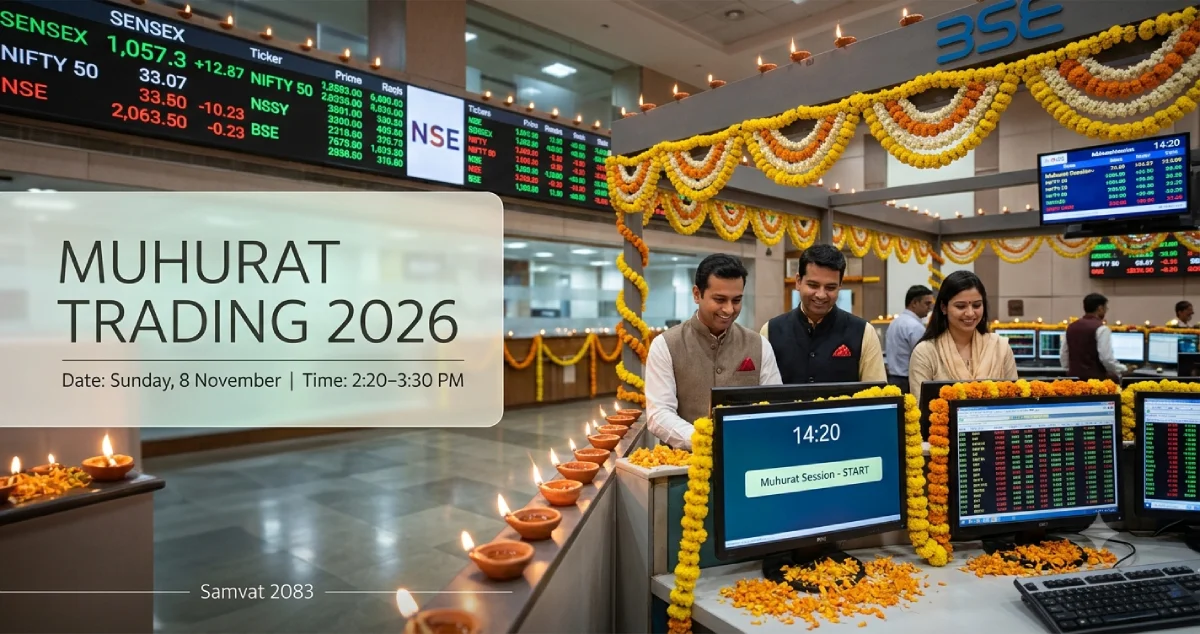
Every Diwali, as families prepare for Lakshmi Puja and the new Samvat year, India's stock market follows a tradition of its own. The trading screens light up for a special session, investors place symbolic orders, and market participants welcome the new year with hopes of prosperity.
This is known as Muhurat Trading.
In 2026, the tradition comes with an important market change. The National Stock Exchange (NSE) and Bombay Stock Exchange (BSE) will hold the special session on Sunday, 8 November 2026, and it will be the first Muhurat session to operate with the new Closing Auction Session (CAS) mechanism.
For investors, this means understanding not just the familiar trading window but also how eligible stocks will move into the closing auction. Here's what to know about the schedule, settlement, and what the Sensex and Nifty have returned in previous sessions.
Muhurat Trading 2026: Date and Timings
NSE and BSE have confirmed Sunday, 8 November 2026, for the Diwali Laxmi Pujan trading session. The main equity trading window will run from 2:20 PM to 3:30 PM IST, giving investors a 70-minute continuous trading period.
The pre-opening session will take place before regular trading begins.
|
Market activity |
Timings (IST) |
|
Block deal window |
1:50 PM – 2:05 PM |
|
Pre-open session |
2:05 PM – 2:20 PM |
|
Continuous trading begins |
2:20 PM |
|
Continuous trading for CAS-eligible stocks |
2:20 PM – 3:15 PM |
|
Closing Auction Session (CAS) |
3:20 PM – 3:35 PM |
|
Continuous trading for non-CAS stocks |
2:20 PM – 3:30 PM |
|
Post-close session |
3:50 PM – 4:00 PM |
The schedule includes separate arrangements for different securities and market segments. Equity derivatives, currency and commodity markets may follow different closing times. Investors should check their broker's schedule before placing orders.
What Is Muhurat Trading and Why Is It Important?
The word Muhurat refers to an auspicious time. In the Indian stock market, Muhurat Trading is a special session organised on Diwali to mark the beginning of a new Samvat, the traditional Hindu calendar year.
Many investors consider it an auspicious occasion to begin investments, purchase shares or make a symbolic first trade for the year ahead.
However, the session is not just a cultural tradition. It is also a live market session in which actual orders are placed and executed. Prices can move, and trades carry financial obligations just like regular trading days.
For some investors, the occasion is about starting the year with a disciplined investment habit rather than trying to make a quick profit.
What Is the New Closing Auction Session (CAS)?
The biggest market-related development to understand this year is the Closing Auction Session (CAS).
Introduced in 2026, CAS is a separate mechanism designed to improve the way closing prices are discovered for eligible stocks. It applies in the first phase to cash-market stocks that have derivative contracts available.
Earlier, investors were familiar with the regular continuous trading session ending at 3:30 PM. Under the new mechanism, eligible stocks move into a separate closing auction after their continuous trading ends.
Here's how it works during Muhurat Trading 2026:
1. Continuous trading ends at 3:15 PM
For CAS-eligible stocks, continuous trading will stop at 3:15 PM. A reference price calculation and transition period will follow.
2. Orders are collected from 3:20 PM
During the first five minutes, investors can enter, modify or cancel both market and limit orders.
3. Limit orders continue until 3:30 PM
During the next five minutes, only limit orders can be entered, modified or cancelled. Market orders are not permitted during this period. The system may close order entry randomly in the final two minutes.
4. Orders are matched from 3:30 PM to 3:35 PM
The exchange matches eligible buy and sell orders and confirms the trades.
In simple terms, a closing auction collects orders and matches them through an auction process instead of relying only on the final moments of continuous trading. The aim is to support a more orderly closing-price discovery process.
It is important to remember that CAS does not apply to every listed stock in its first phase. Non-CAS stocks will continue trading until 3:30 PM during the special session.
How Did Sensex and Nifty Perform During Previous Muhurat Sessions?
Muhurat Trading is often associated with optimism, but what do the numbers actually show?
Looking at the last ten sessions from 2016 to 2025, both benchmark indices closed higher in eight years and lower in two years.
Here is a comparison of their session-day performance:
|
Year |
Nifty 50 return |
Sensex return |
|
2016 |
-0.14% |
-0.04% |
|
2017 |
-0.63% |
-0.59% |
|
2018 |
+0.65% |
+0.70% |
|
2019 |
+0.37% |
+0.49% |
|
2020 |
+0.47% |
+0.45% |
|
2021 |
+0.49% |
+0.49% |
|
2022 |
+0.87% |
+0.87% |
|
2023 |
+0.51% |
+0.54% |
|
2024 |
+0.40% |
+0.42% |
|
2025 |
+0.10% |
+0.07% |
Source: Published historical index data compiled by market research sources. Returns represent the percentage change from the previous regular trading day's close to the Muhurat session close. They are not full-year investment returns.
What Do These Numbers Tell Us?
There are three useful observations from the table.
First, positive sessions have been more common. Both indices ended higher in eight of the ten sessions between 2016 and 2025. However, the two negative years show that a festive occasion does not guarantee market gains.
Second, the gains have generally been modest. In 2025, the Nifty gained 0.10%, while the Sensex advanced just 0.07%. The strongest session in this ten-year comparison was 2022, when both indices gained 0.87%.
Third, one session cannot predict the next Samvat year. A positive Muhurat close does not mean the market will continue rising over the following months. Corporate earnings, interest rates, inflation, global developments and investor sentiment remain important.
What Should Investors Keep in Mind Before Muhurat Trading?
For a first-time investor, Muhurat Trading can be an opportunity to understand how the market works. But it is still important to approach the session with a plan.
Keep these points in mind:
-
Decide your investment objective: Know whether you are making a long-term investment or a short-term trade.
-
Research before buying: Understand a company's business, financial performance and valuation instead of purchasing shares simply because it is Diwali.
-
Avoid impulsive decisions: A short trading window and festive excitement can encourage rushed orders.
-
Understand settlement: Trades executed during the session create normal settlement obligations. They are not symbolic transactions without financial consequences.
-
Check order types and timings: The closing auction has different order-entry rules from continuous trading. Check the latest exchange and broker instructions.
Investors should also avoid treating historical Muhurat returns as a list of stocks to buy. Past index performance does not establish which individual shares will perform well.
Conclusion: A New Samvat, a New Market Mechanism
Muhurat Trading 2026 brings together an old Indian market tradition and an important change in the way eligible stocks close.
On Sunday, 8 November, NSE and BSE will open for the special session, with the main equity trading window beginning at 2:20 PM. But this year, investors also need to understand the Closing Auction Session, which changes the closing process for eligible stocks.
Historical data shows that the Sensex and Nifty have finished higher in most of the last ten Muhurat sessions, although the gains have usually been small. That is a useful reminder that optimism and market performance are two different things.
Whether you are making your first symbolic investment or reviewing your portfolio for Samvat 2083, the best approach remains the same: understand what you are buying, manage risk and make decisions based on research rather than excitement.
Happy Samvat 2083!

















Comments (0)