

SpaceX Starship Rocket Launch: What Happened During the Latest Test Flight?
SpaceX's latest Starship test flight achieved a major milestone with the spacecraft's first successful tower catch after an orbital mission. Here's what happened and why it matters.

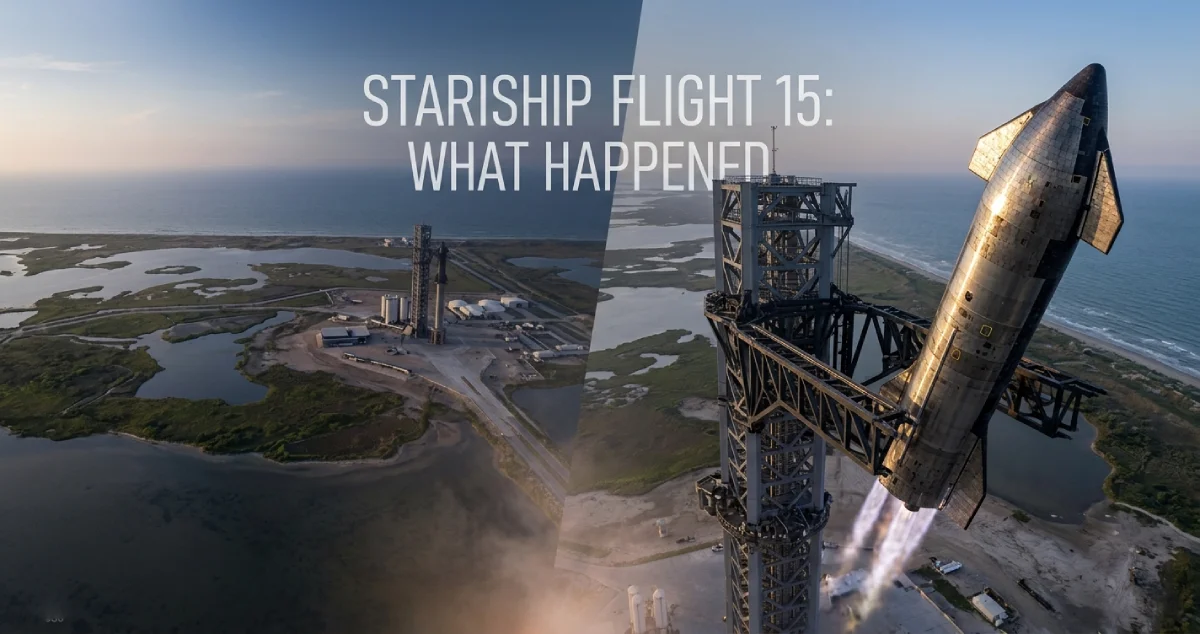
The recent SpaceX rocket launch called Starship has captured the interest of space fans and individuals throughout the world. This isn't another rocket going into space. This test flight marked an important step towards making rockets and spacecraft reusable, potentially changing how humans travel to space in the future.
On its last flight, Starship managed to achieve a trip to space, deploy Starlink satellites and return to Earth. The most interesting part was when the spacecraft was grabbed by the huge mechanical arms of the spacecraft launch tower in Texas. The mission, however, was not entirely successful as the Super Heavy booster was not recovered as planned.
So, what went wrong during the SpaceX Starship launch and why is this test flight significant? Let's put it in simple terms.
What Was The Recent SpaceX Starship Rocket Launch?
On November 13, 2026, SpaceX sent its Starship Flight 15 mission to the heavens from the Starbase in Texas. The mission aimed to prove out the company's next steps on becoming the entire Starship system reusable.
The rocket launched successfully and took the Starship spacecraft on a journey towards orbit. In the mission, the spacecraft released 26 Starlink satellites and kept the spacecraft operating around the Earth.
But the recovery of the booster failed to go as planned. The Super Heavy booster could not come back to the launch pad for the planned catch. It was deflected away to the Gulf of Mexico where it detonated before coming to the ocean.
The spacecraft orbited on its own. It spent about 22.5 hours in space and made about 14 orbits of the Earth before landing in Texas.
SpaceX had managed a significant milestone, with the mechanical arms of the launch tower grasping the spacecraft in a significant achievement. This was the first orbital flight upper stage catch.
The achievement highlighted that SpaceX is closing in on the ability to recover and reuse both of its major components of the rocket system. The challenge of boosting recovery is still a problem, however.
So, What is SpaceX Starship?
SpaceX's next-generation spacecraft and rocket system is called Starship.
Supports space launches, can transport people and cargo into space, and can be used to transport astronauts to the Moon and Mars.
SpaceX aims for total reusability of Starship rockets, in contrast with most rockets that are discarded after their missions. That is, the corporation is trying to recover, inspect, refuel the rocket and reuse it instead of constructing an entirely new one for each mission.
There are basically two components to the Starship system.
1. Super Heavy Booster
The Super Heavy is the bottommost, powerful rocket stage. It gives the lift needed to get Starship off of Earth.
SpaceX will attempt to retrieve the booster following separation by giant mechanical arms on the launch tower, bringing it back to the launch facility.
2. Starship Spacecraft
The upper stage, which separates from the booster and goes into space, is called Starship. It is designed to transport astronauts, cargo and satellites.
It also must re-enter the Earth safely to be reused for future missions.
What is the working of the Starship Rocket Catch System?
The rocket-catching feature of SpaceX's Starship programme is one of its most interesting features.
SpaceX places two large mechanical arms on its launch tower instead of landing legs for the returning rocket. These arms are usually referred to as chopsticks.
During a planned recovery, the rocket returns towards the launch tower and positions itself between the mechanical arms. The arms are now used to capture or trap the vehicle.
The intention of this method is to retrieve rockets faster and require less landing gear.
The most recent test flight of the Starship was especially significant in that the Starship spacecraft was brought back from space in good condition. The spacecraft catch was another major milestone on the way to the company's goal of reusable rockets, though the booster itself was never recovered.
So why is SpaceX trying to be the first and only company to make a space vehicle fully reusable?
Making and flying rockets costs a lot of money. If big rocket parts are discarded after each flight, companies must create new hardware for future flights.
SpaceX is looking to lower this expense by recovering and reusing its rocket system.
Starship may have a number of benefits when it is fully reusable:
-
Reduction in launch expenses: With the ability to reuse their big parts, the cost of launching satellites, cargo and other equipment into space may be reduced.
-
Faster recovery and refurbishment: SpaceX could launch more often if it can recover and refurbish its rockets more quickly.
-
Satellite deployment: Starship is being developed to launch loads of satellites and other payloads into orbit.
-
NASA's plans for future Moonships: NASA is planning to use a version of Starship as part of its Artemis programme to support future astronaut landings on the Moon.
-
SpaceX: Mars exploration: SpaceX is also looking to Starship to play a major role in its long-term goals of sending people and materials to Mars.
But more testing will be needed to reach these objectives. The company has yet to prove reliable recovery, refurbishment, refuelling and repeated flights.
Where is NASA's Moon Mission headed with the newest launch of its Starship?
But the Starship initiative is not just significant to SpaceX. It's also linked to NASA's plans to take astronauts back to the Moon.
SpaceX's version of Starship has been chosen by NASA as a human landing system for its Artemis programme. The spacecraft will enable future missions to place astronauts in lunar orbit to the lunar surface.
To do this, Starship will have to navigate a number of difficult tasks, such as carrying astronauts, functioning in space, and fueling up other spacecraft.
It's a good test flight, as it showed the spacecraft could return from an orbital mission and be caught by the launch tower. But, it is not a sign that Starship is ready to transport astronauts to the Moon yet.
It will take more testing and technical demonstrations to do that.
What Happens Next for SpaceX Starship?
The latest flight has provided SpaceX with valuable information about its rocket recovery technology.
The successful spacecraft catch is a major milestone, but the failed booster recovery shows that the company still has engineering challenges to solve.
Future Starship flights will need to demonstrate more reliable booster recovery, successful spacecraft recovery and the ability to reuse both stages.
SpaceX will also need to continue improving the spacecraft's heat shield and demonstrate the technologies required for longer space missions.
The company ultimately wants Starship to become a reliable transportation system for Earth orbit, the Moon and potentially Mars.
Conclusion
The latest SpaceX Starship rocket launch was an important moment in the development of reusable space technology. While the Super Heavy booster could not be recovered as planned, the successful return and tower catch of the Starship spacecraft marked a significant achievement.
The test flight shows how rocket technology is moving beyond simply reaching space. Companies are now working towards recovering and reusing entire launch systems to make future space missions more practical.
For SpaceX, the next challenge is to turn these individual achievements into a reliable system that can fly repeatedly and support future missions to the Moon and beyond.














Comments (0)