
Problem Statement
A recurring issue in General Studies papers is not the lack of knowledge, but the inability to structure answers around evaluation. Topics like Centre-State Fiscal Relations Under GST Regime are often approached as static economy content—definitions, constitutional articles, GST features—without addressing the real demand of the question.
Students tend to:
- Describe GST structure without linking it to federalism
- Ignore institutional mechanisms like the GST Council
- Miss contemporary issues like compensation disputes
- Fail to balance Centre vs State perspectives
The result is predictable: answers become informational rather than analytical. Examiners are not looking for what GST is—they are evaluating whether you understand how it reshapes fiscal federalism in India.
Concept Clarity
Understanding Centre-State Fiscal Relations Under GST Regime requires shifting from “tax reform” to “federal restructuring.”

GST is not merely a tax. It is a structural redesign of fiscal power between the Union and States.
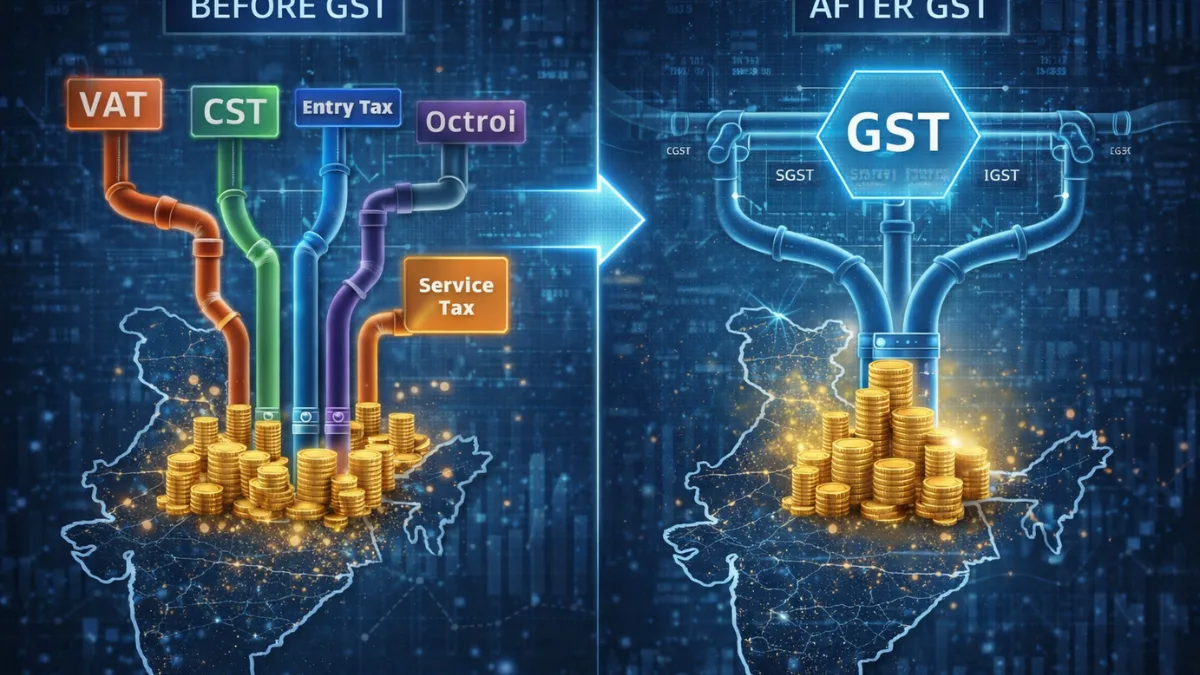
Pre-GST Context
Before GST:
- Centre controlled excise duty, service tax
- States controlled VAT, entry tax, luxury tax
- Overlapping taxation created inefficiencies
- Fiscal autonomy of states was visible but fragmented
Post-GST Reality
GST subsumed multiple taxes into a unified system:
- Both Centre and States tax the same base (CGST + SGST)
- Interstate transactions fall under IGST
- Decision-making shifted to a joint institutional body
This is where the nature of federalism changed.
Key Insight
GST introduced “pooled sovereignty” in taxation.

States gave up independent taxation powers in exchange for:
- Assured revenue (initially via compensation)
- Participation in decision-making through the GST Council
This creates a unique model—neither fully centralized nor purely federal.
Centre-State Fiscal Relations Under GST Regime: How to Approach the Topic
This is where most answers fail. The question is rarely asking “What is GST?” It is asking:

- Has GST strengthened or weakened federalism?
- What tensions exist between Centre and States?
- Is GST cooperative or coercive federalism?
Your approach must reflect this.
Practical Framework
Step-by-Step Approach
Define the Shift (2–3 lines)
Start by stating how GST transformed fiscal relations.
Institutional Mechanism (GST Council)
Explain how decisions are made jointly.
Federal Impact (Positive + Negative)
Balance cooperative vs centralizing aspects.
Contemporary Issues
Use examples like compensation delays.
Analytical Conclusion
Give a nuanced judgment—not absolute.
Example Answer Structure (10–15 Marker)
Introduction:
GST represents a major shift in Centre-State fiscal relations by creating a shared taxation framework.
Body:
1. Cooperative Federal Features:
- GST Council ensures joint decision-making
- Uniform tax structure improves efficiency
- States have voting power
2. Centralizing Tendencies:
- Limited fiscal autonomy of states
- Dependence on GST compensation
- Centre’s influence in rate-setting
3. Emerging Challenges:
- Compensation disputes post-2020
- Revenue uncertainty for states
- Political disagreements in GST Council
Conclusion:
GST reflects a hybrid model of fiscal federalism, combining cooperation with structural constraints.

Mistake vs Correct Approach
| Mistake | Correct Approach |
|---|---|
| Writing GST features only | Linking GST to federal power shift |
| Ignoring GST Council | Explaining decision-making dynamics |
| No current examples | Adding compensation issue |
| One-sided answer | Balanced analysis |
Model Answer Snippet (For Practice)
“GST has redefined Centre-State fiscal relations by introducing a system of shared taxation and institutionalized cooperation through the GST Council. While it enhances uniformity and efficiency, it also raises concerns regarding state fiscal autonomy and dependence on central transfers. Thus, GST reflects a model of cooperative yet constrained federalism.”
Common Errors
1. Treating GST as a Static Topic
Students write about tax slabs, components, and structure without connecting to federalism.
Correction: Always anchor GST within fiscal relations.
2. Ignoring the GST Council
Many answers miss the most critical institution.
Correction:
Mention:
- Article 279A
- Voting structure (Centre + States)
- Role in decision-making
3. No Mention of Compensation Issue
The GST compensation dispute is one of the most important developments.
Correction:
Briefly include:
- 14% revenue growth promise
- Compensation cess
- Delays post-pandemic
4. Lack of Balance
Either praising GST completely or criticizing it entirely.
Correction:
Use a dual framework:
- Cooperative federalism
- Centralizing tendencies
5. Weak Conclusion
Generic endings like “GST is important for the economy.”
Correction:
End with evaluation: hybrid federal model
Tactical Application
Applying this framework directly improves marks because:
- It aligns with examiner expectations (analysis over description)
- It demonstrates conceptual clarity
- It integrates current affairs into static topics
- It ensures structured answer presentation
In GS papers, especially GS-III, structured answers consistently score higher than content-heavy but unorganized ones.
This approach also helps in:
- Essay writing (federalism topics)
- Interview discussions (policy debates)
Improvement Plan
Daily Execution (20–30 minutes)
- Pick one topic (e.g., GST, Finance Commission, FRBM)
- Identify its core concept (not definition)
- Write a 150-word structured answer
Weekly Execution
- Practice 2–3 full-length answers
- Focus on:
- Introduction precision
- Balanced arguments
- Real examples
Self-Evaluation Checklist
After writing, check:
- Did I link GST to federalism?
- Did I mention GST Council?
- Did I include a current issue?
- Is my conclusion analytical?
Internal Link Placeholders
- [Understanding GST Structure in India – Complete Guide]
- [Fiscal Federalism in India: Concept and Challenges]
- [Role of Finance Commission in Centre-State Relations]
Conclusion
Centre-State Fiscal Relations Under GST Regime cannot be approached as a tax reform topic alone. It represents a deeper shift in India’s fiscal federalism—where autonomy is partially pooled, cooperation is institutionalized, and tensions are inevitable.
For exam writing, the difference lies in recognizing this shift. When answers move beyond definitions and reflect structural understanding, scoring improves significantly.
Final Insight
High-scoring answers on federal topics are not built on information—they are built on interpretation. GST is not just a policy change; it is a lens through which examiners assess whether you understand how power, finance, and governance intersect in India. Stay Updated with –The Vue Times
Frequently Asked Questions
What is Centre-State Fiscal Relations Under GST Regime?
It refers to how taxation powers and financial responsibilities are shared between the Centre and States after the implementation of GST.
How has GST affected federalism in India?
GST has introduced cooperative decision-making through the GST Council but also reduced independent taxation powers of states.
What is the role of the GST Council?
The GST Council is a constitutional body that decides tax rates, policies, and rules jointly between the Centre and States.
Why is GST compensation important for states?
It ensures revenue stability for states by compensating losses due to GST implementation, especially during initial years.
Is GST centralized or federal in nature?
GST represents a hybrid model—combining elements of cooperative federalism with certain centralizing features.