Introduction
Cinema has been perceived as a form of entertainment, narration, and art. However, there is a lot underneath the surface that the films can also convey powerful messages influencing opinion, potential beliefs and even the perception of the masses. Here comes the aspect of propaganda as a meaning in films.
In the age of digital media, and when the contents of films, streaming services, and social networks get viral, the boundary between the narration and the convocation is becoming more indistinct. Political dramas to patriotic movies, films are no longer passive entertainment, but could potentially affect the way the viewers think of the society, the past, and the ongoing events.
The interpretation of propaganda in movies does not consist of categorizing each moviemaking as prejudiced. Rather it is the realization of the construction of narratives, what are being told, and why some ideas are being accentuated rather than others. This paper examines the definition of propaganda in films, its origin, current usage, and its influence on the society at large.
Background and Context
To know what propaganda means in movies, one has to examine its origin.

In its simplistic definition, propaganda is information, which is usually biased or selective with respect to the information, that is used to advance a specific political, ideological or social agenda. Although propaganda has long existed in the form of speeches, posters, and literature, it is the cinema that became one of the most effective tools of propaganda in the 20th century.
Propaganda was used at an early age in movies.
The governments soon discovered the emotional and visual strength of films. Movies were utilized during significant international wars such as World War I and World War II to:
- Boost morale
- Promote nationalism
- Demonize enemies
- Be able to justify political decisions.
The movies of this era were not just films, but they represented a tool of influence.

Evolution Over Time
With the development of cinema, the propaganda became less obvious. Filmmakers started to introduce ideas into the plotlines, characters and to put them into the narrative instead of direct messaging.
This movement gave rise to what we currently refer to as film narrative manipulation whereby the storytelling techniques are employed to influence the audience perception without any apparent message.

What Is Happening Right Now
In recent years, debates of the meaning of propaganda in films have been heated particularly in nations with robust film industries such as India, the United States, and China.
Why It Is Trending
This resurgence of attention has been caused by a number of factors:
- The emergence of politically oriented movies.
- More popularization and criticism.
- Debates in social media boosting the reaction of the audience.
- Streaming networks with international popularity.
Current Trends
Today’s films often include:

- Historical reinterpretations
- Nationalistic themes
- Narratives that are motivated by social issues.
- Biopics that are selective in their narration.
In India, such as, propaganda cases India is a topic of discussion more often when films present historical events or political leaders in a specific image.
The most important change is the fact that the audiences are no longer passive; they are active in questioning and analyzing what they watch.
What Makes this Topic Controversial.
The debate on propaganda definition in films has remained a contentious issue to date due to the fact that it lies somewhere on a delicate cross over line between art and politics, and narrative and persuasion. Modern films do not make it easy to establish the intent unlike in the traditional forms of propaganda which is usually overt and clear. This vagueness is what causes controversy.
Cinema as an art form and a medium of mass communications is also a creative medium. Filmmakers narrate, and the narratives may affect the beliefs, reinforce ideologies, or may challenge the status quo. The instant when a film starts to shape the perception of viewers on reality, particularly in such fields as history, nationalism or politics, it moves to a grey territory.
Key Triggers of Controversy
The reasons of such controversy of propaganda in movies are several:
Representation of History
Historical films tend to oversimplify, dramatize or distort facts. Although this makes the story telling better it can also cause accusations of bias or revisionism. The viewers cannot distinguish the film version and the historical one.
Political Partisanship in narration.
Once the appearance of the films is perceived to promote a specific political ideology, party or view, it is easily branded propaganda. This is a very delicate matter in democratic societies where neutrality in the media is very appreciated.
Influence on Public Opinion
Cinema is emotional and has a great reach. The strong film narrative will have the power to define the discourse of the masses, shape the views, and even social attitudes in the long term.
Blurring of Fact and Fiction
Contemporary film making tends to incorporate realities and fictitious details. This complicates the task of the viewers to differentiate the facts and fictional narration, which raises the probability of misinformation.
Due to these provocations, viewers are segregated. There are those that perceive such films as cultural pride or identity whereas there are those that perceive them as a way of advancing a certain agenda.
After all, the issue is controversial, since storytelling and persuasion do not have an explicit line of distinction, merely interpretation.
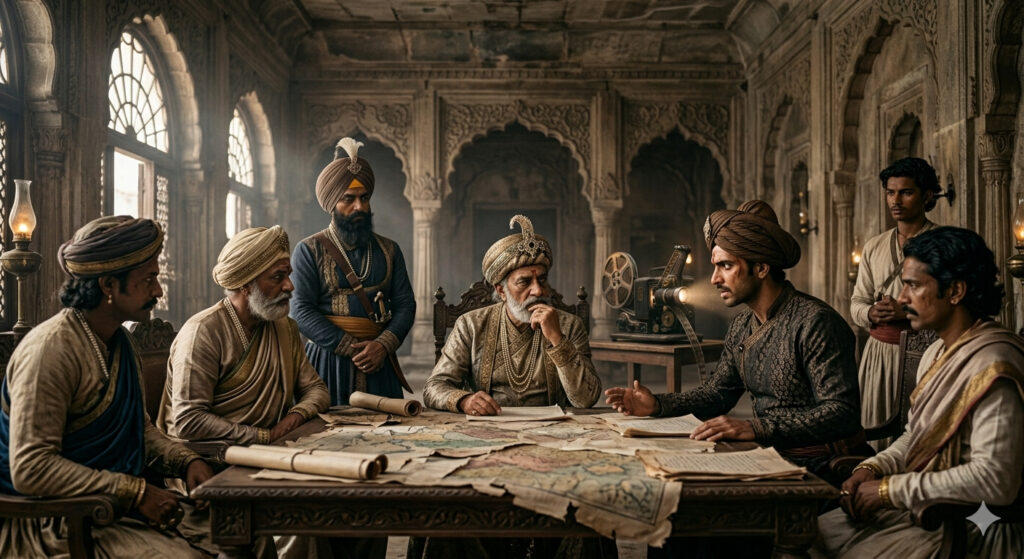
Different Perspectives
Supporters’ View
The proponents of the films that are criticized as being propagated argue that film telling is a subjective process. Any film director enters his/her worldview, experiences, and beliefs into the work. They believe that it is impractical to expect a total sense of neutrality.
Their view raises a number of important points:
Any story possesses a viewpoint.
None of the narratives is absolutely neutral. A viewpoint is even evident in the character of the main hero, the scene, or the struggle.
Positive values can be propagated through films.
There are numerous films that focus on such concepts as patriotism, unity, resilience, and social awareness. Advocates believe that cultivation of such values should not necessarily be termed as propaganda.
It is necessary to have freedom of creativity.
The filmmakers need to be allowed to share ideas without censorship or censure. Considering movies as propaganda prematurely is a way of deterring the courageous.
Audiences are not passive
Contemporary consumers are more enlightened and in a position to think critically. They are able to analyze and interpret content as opposed to being a mere blind consumer.
In this perspective, the term propaganda when applied to movies can be seen as overstating the simplicity of the narrative and compromising on art.
Critics’ View
Critics are more conservative and affirm that propaganda in films can be dangerous particularly when it is insidious and emotive.
Their concerns include:
Emotional manipulation
Movies employ music, images and character development to create solid emotions. This may cause the audiences to make judgments grounded on emotions rather than facts.
Normalization of bias
Constant exposure to some stories can render them normal or undisputed, despite their prejudice or incompleteness.
Distortion of history
Selective storytelling has the potential to create the revised way of remembering historical events and alter the collective memory.
Limited perspective
Films may create a distorted comprehension of complicated matters when they show just one side of the story.
Critics believe that since cinema is a widely spread medium, there is a certain level of responsibility on filmmakers to make sure that their storytelling does not misrepresent and manipulate people.
Facts vs Claims
Evidence-based facts should not be mixed with assumptions and narratives by ordinary people so as to have full knowledge of propaganda meaning in movies.
Verified Facts
- The historical application of films is as a means of political and ideological communication.
- Emotional narration influences perception and memory of the audience.
- One of the most powerful types of communication is visual media as this type of communication is considered immersive.
Public Claims
- Any film that deals with political themes is propaganda.
- In all situations, filmmakers strategically control people.
- Viewers are easily deceived and do not have critical thinking capabilities.
Reality Check
- The reality is more nuanced. Not every film, which bears political or social content, is propaganda. Simultaneously, numerous films do have some portion of persuasion, whether it is deliberate or not.
- The main difficulty is to detect the intent, context, and impact without making a conclusion. An equal compromise would mean that the viewers should doubt the story and at the same time admire the artistic side of the movie.
What People Might Be Missing
The subtlety of propaganda meaning in films is one of the most neglected factors. In contrast to the old style of propaganda which is simplistic and direct to the point, modern movies tend to be loaded with messages between narration lines.

Hidden Layers
- Empathy is influenced by the depiction of the characters: Viewers are inclined to follow heroes. The writing of the characters can determine who the viewers will sympathize with and why.
- Emotional prejudice is formed by music and graphics: Background scores, lighting, and camera angles may affect the perceptions of the scenes, which may not be apparent to the viewer.
- There is narrative structure leading to interpretation: The flow of events and information disclosed can covertly guide the audiences to a certain conclusion.
- Omission of facts: The thing that is not displayed may be as strong as displayed. Omission of certain vital facts may bring a one-sided story.
Common Misconceptions
- Propaganda never becomes disguised: As a matter of fact, the best propaganda is so subtle and is usually built in the narrative.
- The propaganda is only found in political films: Even the films, which are entertainment oriented, may have concealed messages about the culture, society or values.
- Entertainment movies are impartial: There is no totally neutral film. In each story, there are decisions which mirror some viewpoints.
To see these latent constituents, one needs to be aware of the techniques of film narrative like framing, symbolism, pacing, and selective storytelling.
To sum up, the propaganda issue in films is not only in how to determine bias but also in how stories can shape the perception. By understanding the obvious as well as the unspoken aspects of movie telling, viewers are able to watch the movie with a much more critical and philosophical approach.
Social, Economic, User Impact.
Propaganda in films is not just a source of entertainment.
Social Impact
- Shapes public opinion
- Affects cultural identity.
- Influences the recollection of history.
Psychological Impact
- Establishes emotional attachment to some notions.
- Strengthens the pre-existing beliefs.
- Thwarts critical thinking when taken in its passive form.
Economic Impact
- Pushes box office success by appeal to emotion.
- Funding influences around similar films.
- Influences the trend of the movie world.
Impact on Viewers
To individuals, recurrent exposure to some stories can:
- Change perspectives
- Influence political views
- Affect decision-making
This is the reason why media literacy is getting more and more significant.
Role of Media and Narrative
Media is instrumental in intensifying and decoding film narratives.
How Media Shapes Perception
- Reviews shape expectations of the audience.
- Trends are made in the social media discourse.
- The narrative is framed through news coverage.
Methods of Narrative in Motion Pictures.
Moviemakers employ the following devices to get the message across:
- Hero vs villain framing
- Selective storytelling
- Emotional storytelling
- Symbolism and metaphors
The techniques play a center stage in deciphering propaganda meaning in films.
Influence of Platforms
Films are even more globalized through the streaming sites, which have enhanced the spread of propaganda.
Greater Vision / Prospect.
The role of propaganda in movies can only be expected to become more complicated due to the changes in technology and media.
Future Trends
- AI-created content with implications on stories.
- Individualized content to influence individual beliefs.
- Distribution of films all over the world.
Challenges Ahead
- Being creative and responsible at the same time.
- Differentiating story telling and manipulation.
- Supporting media literacy to audiences.
Opportunities
- More informed audiences
- Balanced storytelling
- More openness in the filmmaking.
The future of cinema will be determined by how the creators and the viewers will manage to work in this changing environment.
Conclusion
Propaganda meaning in films is not a black and white concept. Films never have been only entertainment, films are reflections of society, culture and ideology.

On the one hand, certain films obviously tend to shape the views, on the other hand, some films can do it in a more hidden manner as narrative methods and emotional narratives. The issue is the fact that these aspects can be identified without disregarding the artistic value of cinema.
The seemingly growing awareness and criticality of the audience is likely to increase the discussion on propaganda in films. This is not to reduce the strength of movies, it only helps us to relate to them more intelligently.
Ultimately, it is not the question of whether there is propaganda in movies, but how we knowingly decide to perceive what we see.