
GST Structure in India: Reform or Compliance Burden?
The GST Structure in India is one of the most significant economic policy reforms in recent decades. Introduced to replace a complex system of indirect taxes, the Goods and Services Tax aimed to simplify taxation, create a unified national market, and improve compliance. However, from an exam perspective, students often struggle to analyze whether GST represents a transformative indirect tax reform or a system that creates new compliance burdens for businesses.
For government exam aspirants, questions on GST frequently appear in descriptive papers, economy sections, and interview discussions. The challenge is not simply explaining GST but presenting a balanced analysis that demonstrates conceptual clarity, policy understanding, and critical evaluation.
This guide explains the GST Structure in India in an exam-focused way and provides a practical framework to help aspirants write structured, high-scoring answers.


Problem Statement
A common mistake students make when writing answers about GST is treating it as a purely theoretical topic. Most answers only list GST features such as “one nation, one tax” or “destination-based tax” without addressing the practical debate: Has GST simplified taxation, or has it increased compliance requirements?
Typical problems seen in exam answers include:
- Listing GST components without explaining their policy purpose.
- Ignoring compliance challenges faced by businesses.
- Writing descriptive paragraphs without analytical evaluation.
- Missing the reform context within India’s broader indirect tax reform process.
For example, many students write:
GST replaced VAT, service tax, and excise duty and created a unified tax system.
While factually correct, such statements do not demonstrate analytical ability or policy understanding. Examiners expect candidates to evaluate the impact, structure, and challenges of GST.

Therefore, the challenge for aspirants is to move beyond description and develop an answer that combines structure, policy logic, and critical analysis.
Concept Clarity
GST Structure in India
The GST Structure in India is designed as a dual tax system, where both the central government and state governments have the authority to levy tax on goods and services.
The structure consists of four main components:

Central Goods and Services Tax (CGST)
CGST is collected by the central government on transactions occurring within a state.
Example:
If a product is sold within Haryana, the central government collects CGST.
State Goods and Services Tax (SGST)
SGST is collected by the state government on the same transaction within the state.
Example:
A purchase within Haryana attracts both CGST and SGST.
Integrated Goods and Services Tax (IGST)
IGST is applied to inter-state transactions and imports. It is collected by the central government and later distributed between states.
Example:
If a company in Maharashtra sells goods to a buyer in Delhi, IGST applies.
Union Territory GST (UTGST)
UTGST is applicable in union territories without legislatures.
Policy Objective of GST
The introduction of GST aimed to achieve several economic objectives:
- Eliminate cascading taxes (tax on tax)
- Simplify multiple indirect taxes
- Create a common national market
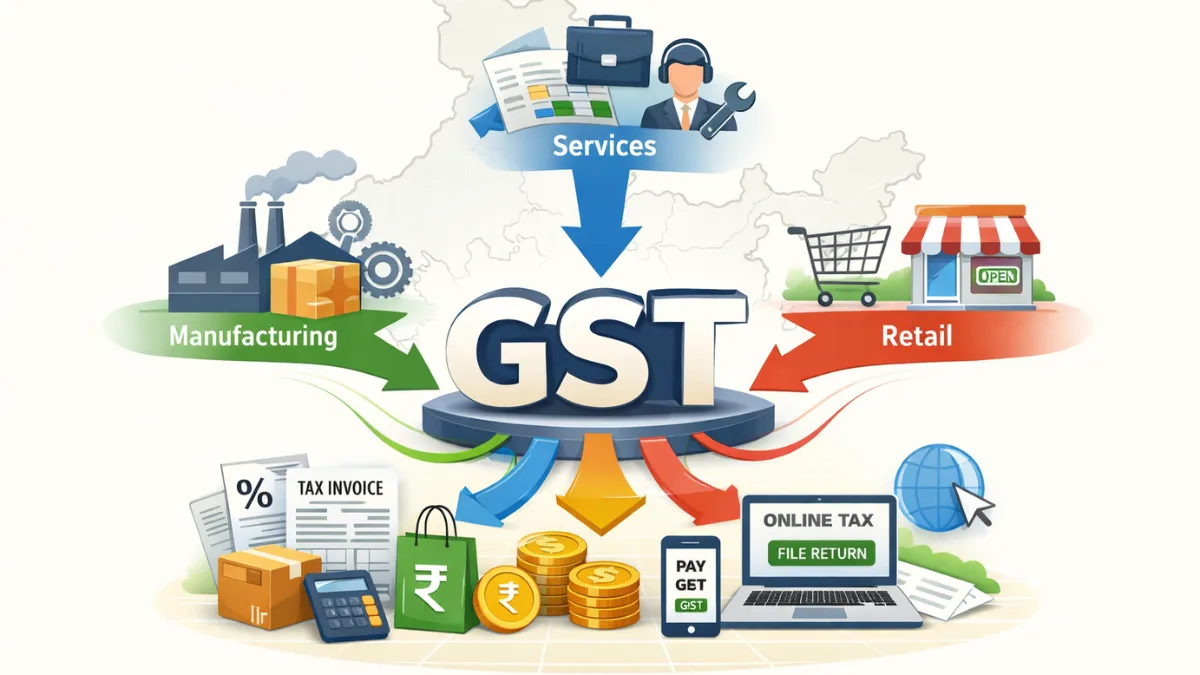
- Improve tax compliance using digital systems
Because of these goals, GST is often described as India’s largest indirect tax reform.
However, despite its reform intent, businesses have raised concerns about complex compliance requirements, including:
- Multiple return filings
- Invoice matching systems
- Digital reporting requirements
Understanding this dual perspective is essential for exam answers.
Practical Framework
To write an effective answer on GST in descriptive exams, aspirants should follow a three-part analytical framework.
Step 1: Start With Reform Context
Begin with a brief introduction explaining why GST was introduced.
Example approach:
- India earlier had fragmented indirect taxes.
- GST aimed to unify these taxes.
- It was implemented in 2017 to simplify the tax system.
Step 2: Explain the GST Structure
Next, briefly explain the dual structure:
- CGST
- SGST
- IGST
- UTGST
Use bullet points instead of long paragraphs.
Step 3: Evaluate Reform vs Compliance
This is the analytical part of the answer.
Explain both perspectives:
Reform Benefits
- Unified national market
- Input tax credit system
- Reduced cascading taxes
- Digital tax administration
Compliance Challenges
- Frequent rule changes
- Complex filing requirements
- Compliance cost for small businesses
- Technology dependency
Model Answer Snippet (Short Format)
Question:
Is GST a major indirect tax reform or a compliance burden for businesses?
Sample Answer Structure:
Introduction:
The Goods and Services Tax introduced in 2017 represents a major restructuring of the GST Structure in India, replacing multiple indirect taxes with a unified tax framework.
Body:
GST follows a dual model consisting of CGST, SGST, and IGST, ensuring both central and state governments share tax authority. The reform has improved tax transparency and reduced cascading taxes through the input tax credit system.
However, businesses often face compliance challenges due to complex return filing systems, digital reporting requirements, and frequent regulatory updates.
Conclusion:
Therefore, while GST is a landmark indirect tax reform, continuous simplification of compliance procedures is necessary to fully realize its economic benefits.
Mistake vs Correct Approach
| Mistake | Correct Approach |
| Listing GST types without analysis | Explain why the structure exists |
| Writing only advantages | Provide balanced evaluation |
| Long theoretical paragraphs | Use structured points |
| Ignoring compliance issues | Include real economic challenges |
Common Errors
Several recurring mistakes reduce the quality of answers on GST topics.
Confusing GST Components
Students sometimes mix up CGST, SGST, and IGST. Examiners expect clarity because these are foundational concepts.
Ignoring Federalism
GST involves cooperation between the central government and states through the GST Council. Answers that ignore this dimension appear incomplete.
Over-explaining History
Some students write lengthy explanations about pre-GST taxation systems. While context is useful, excessive history reduces answer efficiency.
Missing Analytical Balance
Writing only about benefits creates a biased answer. Examiners reward balanced evaluation
No Policy Suggestions
Good answers briefly suggest reforms such as:
- Simplifying return filing
- Reducing tax slabs
- Improving digital infrastructure
Tactical Application
Understanding the GST Structure in India improves exam performance in multiple ways.
Economy Answer Writing
GST is frequently asked in:
- UPSC Mains
- State PSC exams
- SSC descriptive papers
A clear framework helps produce structured answers quickly.
Interview Discussions
Candidates are often asked policy questions such as:
- Has GST improved tax compliance?
- What challenges do small businesses face under GST?
Candidates with conceptual clarity can answer confidently.
Current Affairs Integration
GST reforms frequently appear in economic news, including:
- Rate revisions
- GST Council decisions
- Compliance changes
This allows aspirants to link static economy concepts with current developments.
[Understanding Fiscal Policy in India]
[How to Write High-Scoring Economy Answers]
[Previous Year Economy Questions Analysis]
Improvement Plan
A structured preparation plan helps aspirants master economy topics like GST.
Daily Practice (20 Minutes)
- Read one economy concept.
- Write a 100-word summary.
- Identify one advantage and one challenge.
Weekly Practice
Choose one economic reform topic such as:
- GST
- Inflation control
- Fiscal deficit
Write a 250-word analytical answer.
Focus on:
- Introduction
- Structured body
- Balanced evaluation
- Policy suggestions
Monthly Revision
Create a one-page summary sheet including:
- Definition
- Key features
- Advantages
- Challenges
- Policy reforms
This helps retain important facts for exams.

Conclusion
The GST Structure in India represents a major transformation in the country’s taxation framework. By integrating multiple taxes into a unified system, GST has significantly advanced India’s broader indirect tax reform agenda and improved transparency in tax administration.
At the same time, businesses have faced compliance challenges related to complex filing systems, technological requirements, and evolving regulations. Therefore, evaluating GST requires a balanced perspective that recognizes both its reform achievements and its implementation difficulties.
For government exam aspirants, understanding the GST Structure in India is not only important for conceptual clarity but also for writing structured, analytical answers that demonstrate policy awareness and economic reasoning.