
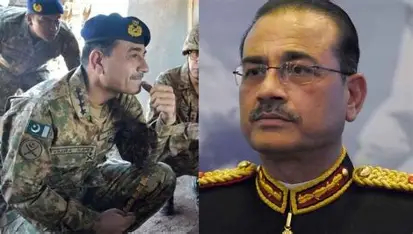
In Pakistan’s political-military landscape, the line between constitutional governance and military-institutional dominance has repeatedly blurred. The notion of a “constitutional coup”—where changes are effected via legal-constitutional instruments but with the net effect of centralising power in the hands of the military or military-backed actors—has become a recurring motif in Pakistani governance. The recent efforts attributed to Asim Munir through the suggested 27th Constitutional Amendment in Pakistan have been described by analysts as such a “silent coup”.
In this context, the legacy of Zia-ul-Haq looms large: his 1977 military takeover, subsequent constitutional manipulations, Islamisation drive and institutional embedding of military power established patterns that still influence Pakistani politics. This essay argues that Munir is seeking, in effect, to revive Zia’s legacy—though with a modern twist: replacing outright martial law by constitutional engineering, consolidating power via legal-amendment rather than a classic military coup, and reaching into domains (e.g., nuclear command structure) that were previously more distributed.
We will explore:
-
The historical backdrop of Zia’s rule and its institutional legacy.
-
The concept of a constitutional coup in Pakistan, and how Zia’s era exemplified it.
-
The new developments under Asim Munir: how they mirror, diverge from, and update Zia’s model.
-
The implications and risks for Pakistan’s democracy, constitutionalism, civil-military balance and regional security.
-
Concluding reflections on how this matters for Pakistan’s future.
Zia-ul-Haq’s Legacy: Institutionalising Military Dominance
To understand the present, it is necessary to recall how Zia initiated a deep transformation of Pakistan’s constitutional and institutional architecture.
The 1977 Coup and its Aftermath
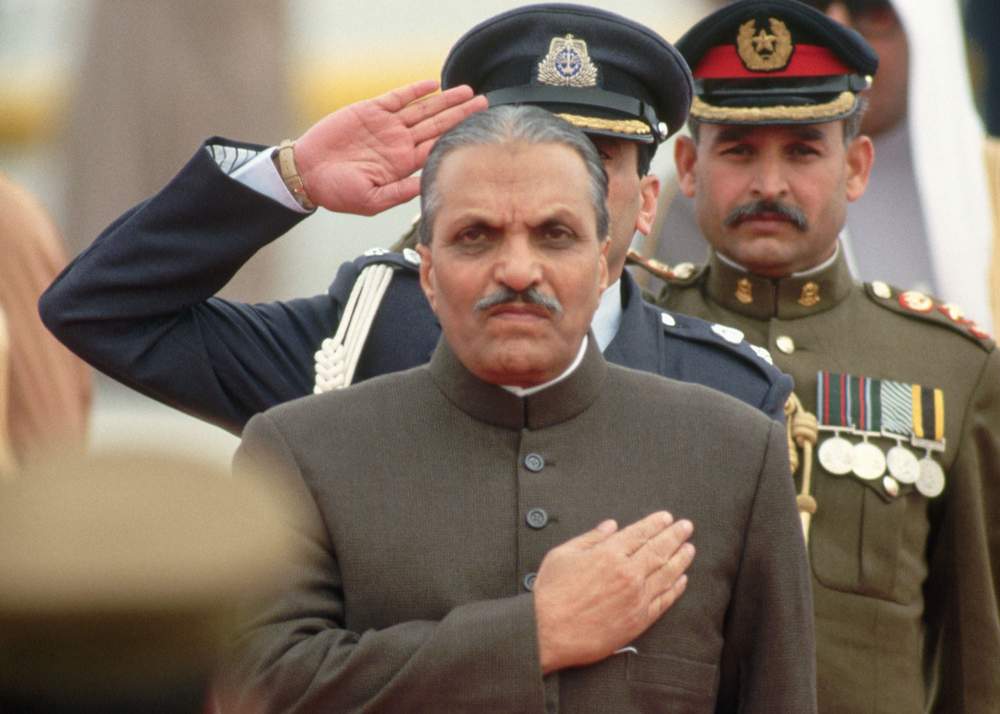
On 5 July 1977, General Zia-ul-Haq overthrew the elected government of Zulfikar Ali Bhutto in what has been described as a “black day” for Pakistani democracy. The constitution was suspended, assemblies dissolved, and martial law imposed — though initially under the rhetoric of restoring order and holding elections.
Legal and Constitutional Engineering
Rather than simply rule by brute force, Zia sought legal-constitutional legitimation of his regime. He introduced the Provisional Constitutional Order (PCO) and used the doctrine of necessity via supportive judiciary decisions. Key to his strategy was the Eighth Amendment to the 1973 Constitution in 1985, which strengthened the President’s power to dissolve the National Assembly (via Article 58(2)(b)) and generally shifted Pakistan from a pure parliamentary system toward a semi-presidential model.
Islamisation and Civil-Military Fusion
Zia’s era is also remembered for a broad Islamisation policy: laws like the Hudood Ordinances, Zina laws and Blasphemy laws were introduced; the state and armed forces reorganised to favour visible religious credentials. The military’s institutional role expanded beyond defence: officers were placed in civilian administration, economic institutions (defence welfare corps etc), and the army’s ideological alignment was strengthened.
Long-Term Impact
Zia’s legacy includes: a political culture in which the military sees itself as a guardian of the state; a constitutional architecture that enables extraparliamentary interventions (via presidential power to dismiss assemblies); and a civil-military imbalance entrenched. As one recent analysis puts it: “He banned political parties, suspended the 1973 Constitution, and ruled by presidential ordinances.”
Thus, Zia set the template: military takeover → constitutional re-engineering → embedding of military power within civilian institutional forms → ideological and structural changes to the state that outlast the dictator.
The Concept of a “Constitutional Coup” in Pakistan
The term “constitutional coup” refers to a situation where power is shifted or consolidated via ostensibly legal and constitutional amendments, but the effect is de facto authoritarian or militarily-dominated governance. In Pakistan, several turns of constitutional engineering have served this purpose.
In the earlier 1953-54 case of the dissolution of the constituent assembly, the judiciary under Justice Muhammad Munir validated extra-constitutional executive action under the doctrine of necessity, thereby giving the façade of legality to a power-grab.
Similarly, under Zia, the PCO and amendment orders created a “phase of constitutional deviation” which breached the constitution yet used legal cover.
In this sense, a “constitutional coup” differs from an overt military takeover in that the instruments of power are restructured by amendments, decrees, and institutional reform rather than simply martial law, though the end state may be similar (centralisation of power, suppression of democratic checks).
Thus, when analysts refer to the moves by Asim Munir as a “constitutional coup”, they are drawing on this historical lineage.
Asim Munir’s Move: A Modern Twist on Zia’s Model
Recent reports suggest that Pakistan’s army-chief, Asim Munir, via a proposed 27th Constitutional Amendment, is orchestrating a consolidation of military and executive authority. Let us map how this draws from, but diverges from, Zia’s template.
The Mechanics of the Proposed Amendment
According to reporting, the amendment would:
-
Elevate Munir (or the Chief of Army Staff) to the newly created post of Chief of Defence Forces (CDF), with overarching power over all three services and control over nuclear assets.
-
Abolish or subsume the prior structure of Joint Chiefs (as envisioned post-1971) which distributed power among different branches.
-
Provide lifetime legal immunity for the president and field marshal/army chief.
-
Create a dual judicial architecture (e.g., a separate Federal Constitutional Court alongside the Supreme Court), generating ambiguity in judicial authority.
Revival of Zia’s Legacy
Many parallels to Zia’s era are evident:
-
Centralisation of military power within the constitutional framework (rather than purely martial law) mirrors Zia’s institutional embedding of the military.
-
Use of constitutional amendment rather than brute force’s blatant suspension of constitutional norms. Zia’s PCO and amendment orders marked the earlier model; Munir’s approach can be seen as the next evolutionary step.
-
The rhetoric of national stability, strong leadership and the military as guardian of the state resonates with Zia’s framing of the military as the ‘second pillar’ of the state.
-
The minimisation of democratic checks and the weakening of judicial independence (via special courts or dual judiciary structure) echo the Zia era’s suppression of judicial challenge.
Modern Twist and Divergence
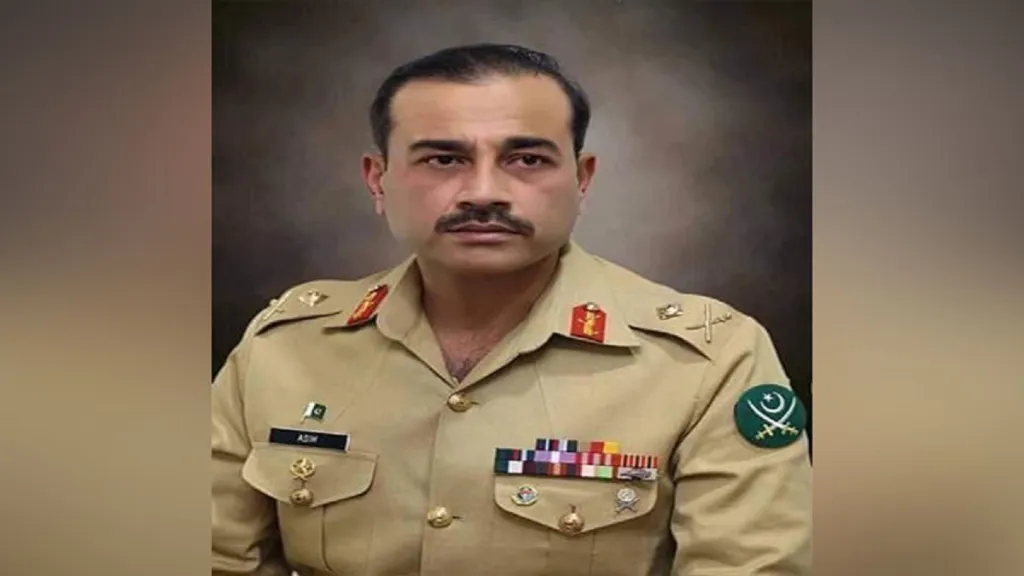
While drawing from Zia’s playbook, Munir’s approach incorporates newer features:
-
Unlike a full-blown martial law regime, this appears to operate within the constitutional framework (via amendments) and seeks to legalise long-term dominance rather than simply seize power temporarily.
-
Control over nuclear command and tri-services is more explicit, signalling that military-dominated governance is moving into more sensitive domains than in Zia’s era (though Zia did oversee nuclear acceleration).
-
The use of lifetime immunity suggests a more entrenched status for the military-chief beyond the conventional term, making the institution of the Army Chief closer to a permanent constitutional actor.
-
The structural innovation of a separate Federal Constitutional Court suggests an adaptation to modern judicial landscapes — weakening the Supreme Court’s ability to challenge the regime, and perhaps circumventing international human rights or constitutional norms.
Hence, the “modern twist” lies in institutionalising control via legal-amendment, expanding into nuclear/strategic domains and embedding permanence rather than temporary emergency.
Implications: Risks and Consequences
These developments carry profound implications for Pakistan’s democracy, constitutional order, civil-military balance, and regional stability.
Erosion of Democratic Governance
When military power is militarily or quasi-constitutionally embedded, popular political accountability is weakened. The legitimacy of elected governments is undermined if the military chief effectively becomes a constitutional actor with supremacy. That echoes Zia’s era, which saw multiple governments dismissed using presidential powers introduced via the Eighth Amendment. The effect may be a de facto “deep state” where civilians rule in name, but strategic and constitutional control rests with the military.
Undermining of Judicial Independence and Rule of Law
The proposed creation of alternate courts or constitutional structures to favour the regime risks further undermining judicial oversight. Zia’s era demonstrated how judiciary could be co-opted or bypassed via PCOs and necessity doctrines.A dual-court system offers more avenues for “legal” immunity and reduces challengers to executive/military power.
Militarisation of the State and Civil-Military Balance
By consolidating tri-service command and linking nuclear command under a singular military figure, the balance between civil authority and the armed forces is greatly tilted toward the latter. This has implications for budgetary control, foreign policy, and internal security. Zia’s legacy is still visible in the prominence of the military in Pakistan’s governance; this development could further entrench that.
Ideological and Structural Continuity of Zia’s Islamisation
While less explicitly discussed in current reporting, the revival of Zia’s legacy also risks a reinforcement of ideological controls, religious policing, and structural favouring of militarised-religious nexus. Zia’s policies shifted the state toward a religio-military fusion; if the military becomes even more dominant, one risk is an intensification of such fusion.
Regional and Strategic Risks
Control over nuclear command under a military figure raises strategic risks: centralising nuclear decision-making outside robust civilian oversight can increase risks of miscalculation, escalate militarised responses, and reduce transparency. The precedent set by Zia’s alignment with the US during the Afghan Jihad and the militarisation of Pakistani foreign policy underscores the danger of an unbalanced security-first state.
Why This Matters Now
The timing of these developments is significant for several reasons:
-
Globally, the norms of democratic governance and separation of powers are under pressure; Pakistan’s move can signal a new phase of institutional militarisation under constitutional cover.
-
Domestically, Pakistan faces economic crisis, governance deficits, and declining public trust in institutions. In such contexts, the military often presents itself as the stable alternative—but institutionalising that can further weaken civil governance and hamper reform.
-
Regionally, the centralisation of power in one figure controlling the military and nuclear assets may reduce checks and balances, increasing volatility in South Asia.
-
Historically, Pakistan has oscillated between civilian rule and military domination; if the military becomes constitutionally embedded rather than just episodically ruling, the space for democracy and plural politics may shrink permanently.
Critiques and Counter-Arguments
It is fair to note that proponents of the proposed amendment might argue the following:
-
The consolidation of command may increase efficiency and clarify chain-of-command, especially in the face of evolving security challenges (terrorism, regional instability).
-
Lifetime immunity or strong constitutional status for military leadership may offer continuity and stability in a state chronically plagued by political instability and frequent government dismissals.
-
Embedding changes via amendment rather than overt coup may offer a more legally-legitimate path, perhaps avoiding the chaotic outcomes of martial law.
However, these arguments tend to underplay the dangers of concentrated power, the weakening of democratic accountability, and the precedent of using “security” as justification for constitutional change. The history of Zia-era Pakistan shows how initial arguments of stability and security quickly gave way to institutional capture, suppression of dissent, and erosion of plural politics.

Concluding Reflections
The proposed constitutional changes under Asim Munir reflect a broader theme: the revival of Zia-ul-Haq’s legacy—in the sense of institutionalising military dominance through constitutional engineering and embedding it as a structural feature rather than an episodic interlude. The “modern twist” is the use of amendments, legal mechanisms, and broader strategic domains (nuclear command) rather than simply martial law.
For Pakistan, the stakes are high. A shift from episodic military intervention to constitutionalised military dominance can fundamentally alter the nature of the state: from one where civilian institutions and democratic politics have at least formal primacy, to one where the military is a permanent, structurally entrenched actor with supra-constitutional reach.
Going forward, key questions will include:
-
Will this amendment process be transparent, engage real parliamentary debate, and allow civil society oversight?
-
Will the judiciary retain independence to check such consolidation of power?
-
Will civilian institutions (parliament, provinces, judiciary, media) retain meaningful autonomy and authority, or be further subordinated to the military-executive complex?
-
How will this affect Pakistan’s governance, reforms, human rights, and regional posture?
In sum: If these changes go through, they could mark not simply a return to a Zia-style dominance, but a new phase of constitutional militarisation in Pakistan. The country may therefore be at a crossroads: will it preserve or restore democratic constitutionalism, or will it move toward a form of hybrid governance where elections exist but the real power rests with a militarised constitutional actor? The answer matters not just for Pakistan, but for regional stability and the global struggle between democratic governance and authoritarian alternatives.