
There’s a quiet tension building in the world of computing. Not the loud, consumer-facing kind driven by smartphone launches or AI chatbots—but something deeper, more foundational. In research labs, corporate think tanks, and government-backed initiatives, a different kind of machine is taking shape. It doesn’t promise faster apps or sleeker interfaces. It promises something far more disruptive: a new way of processing reality itself.
This is where quantum computing explained becomes less about theory and more about transformation.

Quantum Computing Explained: Beyond Bits and Logic
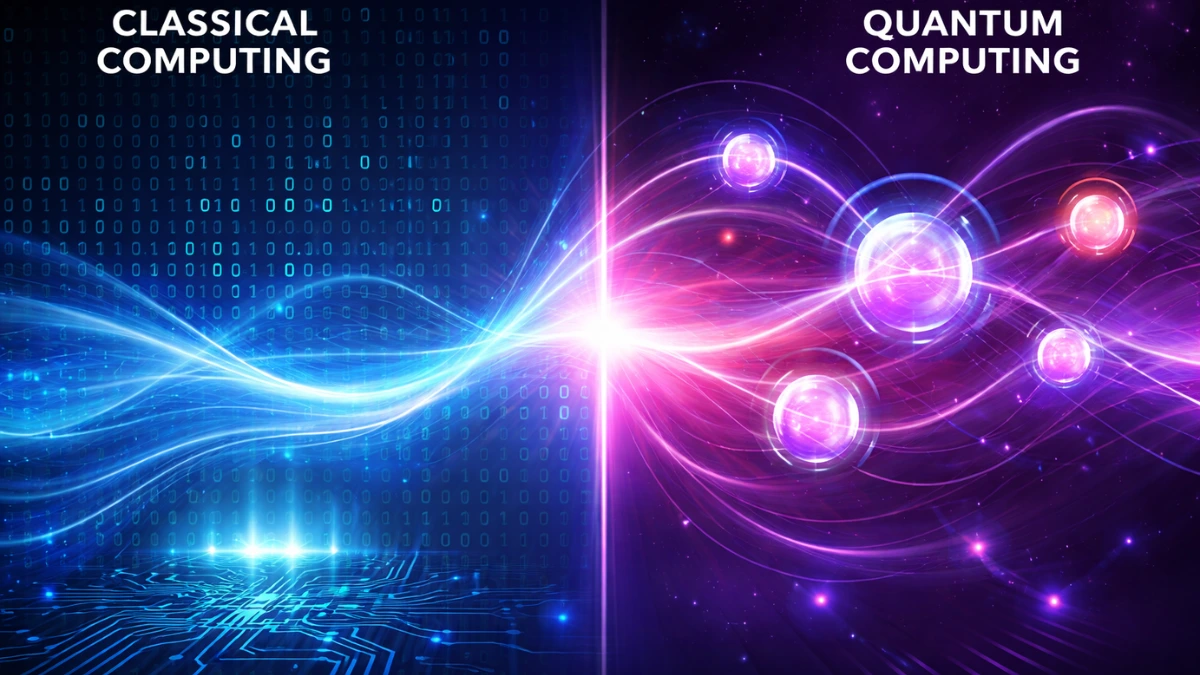
Traditional computers—no matter how advanced—operate on a simple principle: bits. Every operation reduces to zeros and ones, processed through deterministic logic. It’s efficient, scalable, and has powered everything from early mainframes to modern artificial intelligence.
Quantum computing doesn’t reject this model—it sidesteps it entirely.

Instead of bits, it uses qubits. Unlike classical bits, qubits can exist in multiple states simultaneously, thanks to a principle rooted in quantum superposition. Add another layer—quantum entanglement—and suddenly, information isn’t just stored; it’s interconnected in ways that defy classical intuition.
The result? A system capable of exploring multiple solutions at once rather than one at a time.
This isn’t just faster computing. It’s fundamentally different computing.
Where It All Began—and Why It Took So Long
The conceptual roots of quantum computing stretch back to the 1980s, when physicists began questioning whether classical machines could truly simulate quantum systems. One of the early voices in this space, Richard Feynman, suggested that to understand quantum mechanics, we might need machines that obey quantum rules.
It sounded elegant. It also sounded impossible.

For decades, the challenge wasn’t theoretical—it was physical. Qubits are fragile. They lose coherence when exposed to the slightest environmental interference. Temperature fluctuations, electromagnetic noise, even observation itself can collapse their state.
Building a stable quantum system became less about software and more about engineering near-perfect isolation.
Only recently have companies like IBM, Google, and startups such as Rigetti Computing begun to overcome these barriers, pushing quantum machines from theoretical constructs into early-stage reality.

Why Quantum Computing Is Suddenly Everywhere
For years, quantum computing existed in the margins—academic papers, niche conferences, speculative headlines. Now, it’s edging into mainstream discourse.
The shift isn’t accidental.
Three forces are driving this momentum:
1. Limits of Classical Computing
Moore’s Law, once the guiding principle of exponential growth, is slowing. Shrinking transistors further is becoming physically and economically impractical.
Quantum computing offers a different path forward—not incremental improvement, but exponential leap.
2. Complex Problems Demanding New Tools
Certain problems remain stubbornly resistant to classical approaches:
- Molecular simulation for drug discovery
- Optimization in logistics and supply chains
- Cryptographic systems and cybersecurity
These aren’t just technical challenges; they’re economic bottlenecks.
3. Strategic Investment and Global Competition
Governments and corporations alike recognize the stakes. Quantum computing is no longer just a research pursuit—it’s a geopolitical asset.
Whoever leads here doesn’t just gain computational advantage. They gain influence over industries that rely on solving the unsolvable.
The Business Case: More Than Just Speed
It’s tempting to frame quantum computing as “faster computing.” That framing misses the point.
The real value lies in new capability, not just performance.
Consider pharmaceuticals. Simulating molecular interactions at a quantum level could reduce years of trial-and-error experimentation into precise predictions. For finance, complex risk modeling could shift from probabilistic estimates to near-exact simulations.
Even logistics—often overlooked—stands to benefit. Optimizing global supply chains in real time, accounting for countless variables simultaneously, moves from impractical to possible.
This is why companies aren’t just experimenting; they’re positioning.
Quantum computing isn’t replacing classical systems. It’s becoming a specialized layer—called upon when problems exceed traditional limits.
The Strange Psychology of Quantum Computing
There’s something inherently unsettling about quantum mechanics, and that discomfort carries into quantum computing.
We’re used to systems behaving predictably. Input leads to output. Cause leads to effect.
Quantum systems resist that simplicity.
They operate in probabilities, not certainties. Observing a system can change its state. Multiple outcomes can exist until measured. It challenges not just engineering assumptions, but cognitive ones.
And yet, this unpredictability is precisely what gives quantum computing its power.
In a way, adopting quantum computing requires a shift in mindset—from controlling outcomes to navigating possibilities.
Quantum Computing Explained Through Its Risks
Every technological leap comes with unintended consequences. Quantum computing is no exception.
The most discussed risk? Cryptography.
Much of today’s digital security relies on the difficulty of factoring large numbers—a task that classical computers struggle with. Quantum algorithms, however, could solve these problems exponentially faster.
This has serious implications:
- Encrypted data could become vulnerable
- Financial systems may require complete redesign
- National security frameworks could be disrupted
The irony is hard to ignore. The same technology that promises breakthroughs could also dismantle the foundations of digital trust.
This is why parallel efforts in post-quantum cryptography are gaining urgency.
What the Future Might Actually Look Like
There’s a tendency to overhype quantum computing—imagining a near future where laptops are replaced by quantum machines.
That’s unlikely.
A more realistic trajectory looks like this:
- Hybrid systems combining classical and quantum processing
- Cloud-based access to quantum resources
- Industry-specific applications rather than general use
Companies like Microsoft are already exploring quantum-as-a-service models, where businesses can tap into quantum capabilities without owning the hardware.
The transition won’t be sudden. It will be layered, gradual, and often invisible to the average user.
But its impact will be anything but subtle.
Final Insight: A Different Kind of Revolution
The story of computing has always been about abstraction—making complex systems feel simple. Quantum computing breaks that pattern. It doesn’t simplify reality; it mirrors its complexity.
And that’s what makes it powerful.
Understanding quantum computing explained isn’t just about grasping a new technology. It’s about recognizing a shift in how problems are approached, solved, and even defined.
The real question isn’t whether quantum computing will change industries. It’s which industries are prepared for the change—and which will be left trying to catch up.
Conclusion
Quantum computing doesn’t promise convenience. It promises capability. In a world increasingly shaped by data, complexity, and interdependence, that distinction matters.
The systems we’ve relied on for decades are reaching their limits. Quantum computing doesn’t extend those limits—it redraws them.
And once that line moves, everything built around it must adapt.
CTA — The Vue Times
At The Vue Times, we go beyond headlines to decode the technologies shaping tomorrow. Stay ahead with deep insights into innovation, digital transformation, and emerging economies—because the future doesn’t wait to be understood.
Frequently Asked Questions
What is quantum computing in simple terms?
Quantum computing uses qubits instead of traditional bits, allowing systems to process multiple possibilities simultaneously. It’s designed for solving highly complex problems beyond classical computing capabilities.
Why is quantum computing important today?
It addresses challenges that current computers struggle with, such as molecular simulations, advanced encryption, and large-scale optimization problems across industries.
Is quantum computing faster than classical computing?
Not in every case. It’s faster for specific types of problems, especially those involving massive datasets or complex calculations, but not for everyday computing tasks.
Who is leading in quantum computing development?
Major players include companies like IBM, Google, and Microsoft, along with several startups and government-backed research programs.
Will quantum computers replace normal computers?
No. They will likely work alongside classical systems, handling specialized tasks while traditional computers continue managing general operations.
Is quantum computing available to businesses now?
Yes, but in limited form. Many companies offer cloud-based access to early-stage quantum systems for research and experimentation.