

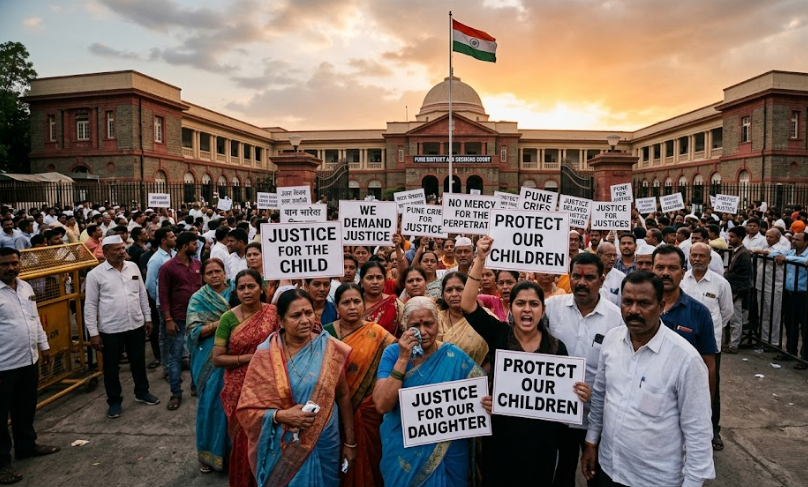
The Pune Rape-Murder Case reached a significant legal milestone on June 29, 2026, when a Pune Sessions Court sentenced 65-year-old Bhimrao Kamble to death by hanging for the rape and murder of a three-and-a-half-year-old girl in Maharashtra’s Nasrapur village. Calling the offence one of the “rarest of rare” cases, the court ruled that the brutality of the crime and the age of the victim warranted the maximum punishment under Indian law. The verdict came just 55 days after the crime, making it one of the fastest concluded trials involving the rape and murder of a minor in Maharashtra.
The judgment has drawn nationwide attention, not only because of the horrifying nature of the offence but also because of the speed with which investigators, prosecutors and the judiciary completed the case. Legal experts have described the proceedings as an example of how fast-track courts can deliver timely justice in cases involving crimes against children while ensuring due process is followed.
Pune Rape-Murder Case: What Happened?
The Pune Rape-Murder Case dates back to May 1, 2026, when the three-and-a-half-year-old victim was staying with her grandparents in Nasrapur village during her summer vacation. According to the prosecution, the child went missing while playing near her grandparents’ home. Police launched an immediate search operation after the family reported her disappearance.
Investigators later alleged that Bhimrao Kamble lured the child to an isolated location before sexually assaulting and murdering her. Her body was subsequently recovered, leading to widespread public outrage across Maharashtra. Police arrested Kamble shortly after the crime, relying on CCTV footage, witness statements and forensic evidence collected during the investigation.
Authorities completed the investigation on priority, submitting the chargesheet within just over two weeks. Prosecutors built the case using DNA evidence, forensic reports, electronic evidence and eyewitness testimonies, allowing the trial to begin before a special fast-track court without significant delay.
Court Calls It a “Rarest of Rare” Crime
The Pune Rape-Murder Case concluded with Additional Sessions Judge S. R. Salunkhe convicting Kamble under provisions of the Bharatiya Nyaya Sanhita and the Protection of Children from Sexual Offences (POCSO) Act. While delivering the sentence, the court observed that the crime demonstrated exceptional brutality against an extremely vulnerable victim and therefore fell within the legal category of the “rarest of rare” cases, a constitutional principle applied by Indian courts when awarding capital punishment.
During the sentencing hearing, the prosecution argued that the accused posed a continuing threat to society and emphasized the gravity of the offence. Court records also noted that the accused had previously faced allegations in similar offences, although earlier cases had not resulted in conviction. The prosecution maintained that the circumstances left little scope for rehabilitation and sought the death penalty.
Why the 55-Day Trial Matters
One of the most remarkable aspects of the Pune Rape-Murder Case is the speed with which the criminal justice system completed the trial. From the filing of the chargesheet to the examination of witnesses and delivery of judgment, the proceedings concluded within 55 days.
The prosecution examined dozens of witnesses and relied on extensive documentary and forensic evidence to establish the chain of events. Maharashtra authorities have described the trial as an example of the effectiveness of dedicated fast-track courts in handling crimes against children. While legal experts welcomed the swift disposal of the case, they also stressed that speed should never come at the cost of fairness or due process.
The case has renewed discussions on whether similar timelines can be achieved in other serious criminal cases, particularly those involving women and children, where victims and families often wait years for justice.
Latest Updates in the Pune Rape-Murder Case
Although the Sessions Court has awarded the death penalty, the legal process is not yet complete. Under Indian law, every death sentence passed by a Sessions Court must be confirmed by the Bombay High Court before it can be carried out.
The High Court will independently examine the evidence, trial records and legal findings before deciding whether to uphold, modify or overturn the sentence. The convicted individual also has the right to appeal before the Supreme Court of India and may subsequently file a mercy petition before the President of India if all judicial remedies are exhausted.
For now, the death sentence remains subject to judicial confirmation.
Child Safety and the Broader Debate
The Pune Rape-Murder Case has once again brought child safety and crimes against minors into national focus. Over the past decade, India has strengthened legal protections through the POCSO Act, which provides a specialised framework for investigating and prosecuting sexual offences involving children.
While legal reforms have introduced stricter punishments and expanded the use of fast-track courts, experts continue to argue that stronger preventive measures are equally important. Greater public awareness, improved community vigilance, timely reporting of missing children and better policing remain critical to reducing crimes against minors.
The case has also reignited discussions on balancing speedy justice with comprehensive investigations, ensuring that victims receive justice while safeguarding the fairness of the legal process.
Conclusion
The Pune Rape-Murder Case has become one of the most closely watched criminal trials in Maharashtra this year. The Sessions Court’s decision to impose the death penalty reflects the judiciary’s view that certain crimes, particularly those involving extreme violence against children, warrant the highest punishment available under the law.
As the case moves to the Bombay High Court for mandatory confirmation, it will continue to be closely followed across the country. Beyond the courtroom, the case serves as a reminder that strengthening child protection, improving law enforcement and ensuring timely justice remain essential to restoring public confidence in the criminal justice system.