Walk into any modern workplace today, and nothing seems dramatically different at first glance. Meetings still start late. Coffee machines still hum in the background. Slack notifications still interrupt moments of focus. But sit with someone for an hour—watch how they draft an email, structure a report, or even brainstorm ideas—and a quieter transformation begins to reveal itself.
The work is happening faster. Not rushed, but accelerated. And often, not entirely by human hands.
Somewhere between a prompt typed into a chatbot and a polished output ready for review, artificial intelligence has slipped into the workflow. Not loudly. Not disruptively. But persistently.
And in an unlikely corner of the internet, a trend known as NPC streaming meaning offers a surprisingly sharp lens into understanding what’s really happening.

NPC Streaming Meaning: A Strange Internet Trend With a Familiar Workplace Echo
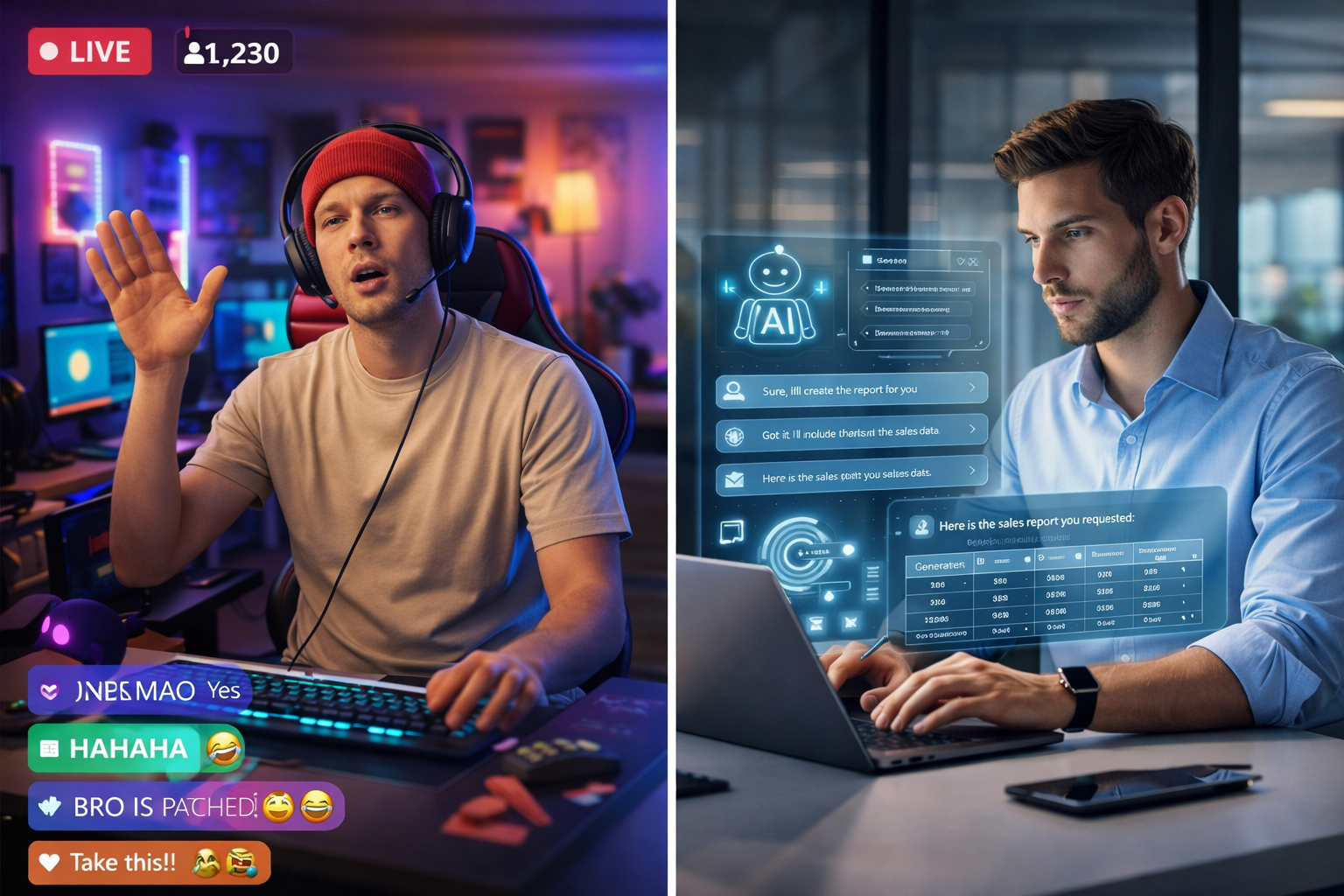
If you’ve heard the term “NPC streaming” and felt a bit lost, you’re definitely not alone. This phrase comes straight from the world of gaming, where NPC means “Non-Playable Character”—basically, the background characters in video games that just follow their set scripts. But lately, this idea has taken on a new life as a type of live content where streamers act out repetitive, automated responses. They often reply to audience comments with pre-planned words and actions.
It’s like a performance, but it’s also like a simulation.
This trend isn’t just popping up out of nowhere. It’s catching on because it taps into something familiar: the way we’re getting used to systems that always respond in predictable, efficient ways without any hiccups.
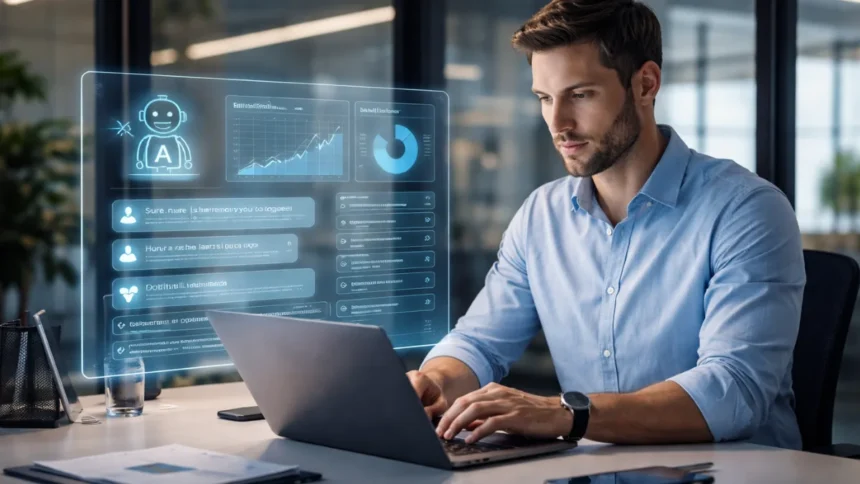
Now, think about the workplace today. An employee opens a document, types in a request, and gets a neatly organized draft right back. They make a few tweaks, polish it up, and send it on its way. The whole process is smooth, almost like it’s following a script. The person is directing things, but the system is the one actually creating the work.
The overlap is subtle but telling.

NPC streaming is entertainment. But its underlying logic—prompt, response, refinement—is increasingly how work itself is being conducted.
The Quiet Integration of AI Into Daily Workflows
Unlike earlier technological revolutions, artificial intelligence hasn’t made its entrance with a sudden, clear disruption. There wasn’t one big moment where everything changed instantly. We didn’t see entire systems being swapped out overnight.
Instead, AI has quietly woven itself into the tools people were already using every day. Email programs now offer to write whole responses. Presentation apps can create slides based on basic ideas. Data tools spot trends with very little help from humans. And even coding platforms can predict the next line of code before you type it.

What’s really different isn’t just that AI is doing tasks automatically—it’s that it’s providing help that feels like teamwork. This brings up an interesting point about the idea behind NPC streaming again. Just like streamers react to what’s happening live, AI systems are getting better at responding to human instructions with more complexity. The way we interact with it feels lively and back-and-forth, but it’s all based on underlying, organized systems.
For many, work has turned into a kind of conversation between what people want to do and what the machines actually do.
From Creation to Direction: A Subtle but Significant Shift
One of the biggest impacts AI has had is on speed. Things that used to take a lot of time and effort can now be done in just minutes. Whether it’s writing reports, creating summaries, designing visuals, or even mapping out strategies—tasks that once took hours are now done in a fraction of that time.
But it’s not just about how fast things can be done. Something much more fundamental is changing: the very nature of work itself.
Instead of starting from scratch, professionals are now starting with something already created. Marketers aren’t writing the first draft anymore; they’re refining what’s already there. Developers aren’t coding every single line; they’re reviewing and tweaking existing code. Researchers aren’t sifting through raw data; they’re making sense of insights that have already been processed.
This means the role is shifting—from being the creator to being the director. And this shift comes with new expectations. Being able to produce things isn’t the most important skill anymore. Instead, being able to evaluate, guide, and improve what’s already there is becoming much more crucial. And this is where human judgment really shows its worth.
Why NPC Streaming Meaning Reflects a Larger Cultural Shift
At first glance, NPC streaming might seem like just another quirky online trend. But its growing popularity suggests something much bigger: it reflects a cultural shift in how we’re learning to connect with systems that mimic real interaction.
We’re getting used to engaging with things that aren’t fully human, yet act as if they are.
This change is also playing out in the workplace, where there’s a growing acceptance of AI as a collaborator. It’s not quite a traditional tool, but it’s not exactly a human colleague either.
The comparison is quite telling.
In NPC streams, viewers send messages and get responses that are predictable but still satisfying. In professional settings, employees give instructions and receive organized results. In both situations, the way we interact is guided by expectations, familiar patterns, and gradual improvements.
The key difference lies in the setting. One is purely for fun, while the other is all about getting things done.
But the underlying way we behave during these interactions is becoming strikingly similar.
The New Skill: Discernment Over Execution
With AI handling the initial steps of getting things done, a whole new set of skills is becoming crucial—especially discernment. It’s about knowing the right questions to ask, figuring out what information you can actually rely on, and identifying what needs tweaking. These aren’t just technical know-how; they’re more about sharp thinking, careful analysis, and often, a gut feeling.
Think about using AI to whip up a business report. The AI can churn out a logical document in no time. But it might still have small mistakes, use ideas that are a bit dated, or offer insights that aren’t very specific.
This doesn’t mean the human’s job disappears—it just changes. Instead of crafting every single sentence, the professional now steps in to review what the AI produced. They refine it, question its points, and make sure it fits the situation perfectly.
In this setup, the focus moves from creating content to making smart decisions. And making good decisions? That’s something much harder for machines to master.
Productivity Is No Longer the Differentiator
There was a time when working faster was a competitive advantage. Efficiency signaled competence. The ability to produce more in less time was rewarded.
AI has complicated that equation.
If everyone has access to tools that accelerate work, speed becomes the baseline. Not the advantage.
This creates a quiet but significant tension.
Professionals may feel more productive than ever. Tasks are completed quickly. Workflows are smoother. Output is consistent.
But at the same time, there is an underlying question: if everyone can do this, what makes my contribution unique?
The answer increasingly lies in interpretation, creativity, and decision-making.
Not what you produce—but how you shape it.
Jobs Are Not Disappearing—They’re Fragmenting
One of the more persistent fears around AI is job loss. While automation does replace certain tasks, the reality is more nuanced.
Roles are not vanishing as much as they are fragmenting.
A single job description now includes multiple layers:
- Tool management
- Output evaluation
- Strategic oversight
- Creative refinement
Take writing, for instance. It’s no longer just about composing text. It involves prompting AI systems effectively, editing generated content, verifying facts, and maintaining a distinct voice.
Similarly, in design, coding, analytics—across industries—the pattern repeats.
AI handles parts of the process. Humans handle the integration.
This hybrid model is becoming the new normal.
The Psychological Shift: Comfort and Uncertainty Coexisting
There is a psychological dimension to all of this that often goes unspoken.
On one hand, AI reduces friction. It makes work easier, faster, and in many cases, more enjoyable. There’s a sense of momentum—of getting more done with less strain.
On the other hand, it introduces uncertainty.
If systems can generate high-quality output quickly, what defines expertise? If the barrier to entry lowers, how do professionals maintain distinction?
This duality—comfort and unease—defines the current moment.
It’s not resistance to AI. Most professionals have already accepted its presence. It’s a question of positioning within a changing landscape.
And that landscape is still evolving.
What the Future of Work Is Quietly Becoming
Looking ahead, the influence of AI on work is likely to deepen—not through dramatic disruption, but through continued integration.
Teams may become leaner, relying on AI to handle tasks that once required additional personnel. At the same time, new roles will emerge—focused on managing, interpreting, and optimizing AI-driven systems.
The tools themselves will become more intuitive, more embedded, and less visible.
Work will feel the same on the surface.
But underneath, it will operate differently.
The concept behind NPC streaming meaning—structured response systems interacting with human prompts—may become even more relevant as AI systems grow more conversational, more adaptive, and more integrated into daily workflows.
The boundary between human-driven and machine-assisted work will blur further.
A Subtle Redefinition of Contribution
The most significant impact of AI may not be what it automates, but what it redefines.
Work is no longer measured solely by effort or time. It is increasingly measured by clarity of thought, quality of decisions, and the ability to guide outcomes.
The human role is not disappearing. It is becoming more focused.
Less about doing everything.
More about knowing what matters.
And perhaps that’s the quiet truth behind both workplace AI and trends like NPC streaming: we are learning to operate in systems where response is instant, output is abundant, and value lies not in generating more—but in choosing better.
That shift is already underway.
Most people just haven’t paused long enough to notice it.
Call to Action: Stay Ahead of the Shift with The Vue Times
The way we work is evolving quietly—but its impact is anything but small. As AI continues to reshape everyday tasks and redefine professional value, staying informed is no longer optional—it’s essential.
At The Vue Times, we go beyond surface-level trends to bring you sharp, meaningful insights on technology, work culture, and the future of digital transformation. If you want to understand not just what is changing, but why it matters, you’re in the right place.
👉 Follow The Vue Times for in-depth analysis, real-world perspectives, and forward-thinking stories that keep you ahead of the curve.
👉 Share this article with colleagues and professionals navigating the same shift—because the future of work is something we’re all shaping together.
👉 Have thoughts on AI in your workplace?
Join the conversation and be part of a community that’s actively decoding the changes around us.
The future isn’t arriving with noise—it’s unfolding quietly. Make sure you don’t miss it.
More Read

Conclusion: The Workday Has Changed—Even If It Doesn’t Feel Like It
It’s surprisingly easy to miss just how much the workday has transformed because, well, it still feels so familiar. There hasn’t been some dramatic reshuffle—no sudden replacement of people with machines, for instance. The tools we use are still right there on our screens, and the deadlines we face haven’t changed. Yet, under this surface of normalcy, the way work actually gets done has quietly shifted.
AI hasn’t taken over work by removing us; it’s simply changed where our real value lies within the process.
The growing trend of people watching AI-generated content, like NPC streaming, isn’t just a passing internet fad. It actually signals something important—it reflects how we’re all getting used to systems that react instantly, predictably, and on a massive scale. This is starting to happen in the workplace too, where what we put in and what comes out is increasingly guided by smart systems.
But here’s the crucial difference: unlike the repetitive, programmed actions of NPCs, human input is meant to be so much more than just following a script.
That’s the key distinction that will really count from here on out.
Frequently Asked Questions
What is NPC streaming meaning?
NPC streaming meaning refers to a trend where content creators act like “non-playable characters,” responding to audience prompts with repetitive, scripted behaviors. It reflects structured, predictable interaction patterns.
How is NPC streaming connected to AI in the workplace?
Both involve prompt-response systems. In workplaces, AI tools respond to human inputs with generated outputs, similar to how NPC streamers react to audience cues in real time.
Is AI replacing jobs or just changing them?
AI is mostly changing jobs rather than replacing them entirely. Tasks are being automated, but roles are evolving to focus more on oversight, decision-making, and refinement.
Why is AI making productivity less valuable as a skill?
Because AI tools allow everyone to work faster, productivity becomes a baseline expectation. What stands out now is judgment, creativity, and the ability to guide AI effectively.
What skills are important in an AI-driven workplace?
Key skills include critical thinking, prompt design, editing, decision-making, and the ability to evaluate AI-generated outputs for accuracy and relevance.
Will AI continue to reshape work in the future?
Yes, but gradually. AI will become more integrated into everyday tools, further shifting work toward strategy, interpretation, and human-centered decision-making.