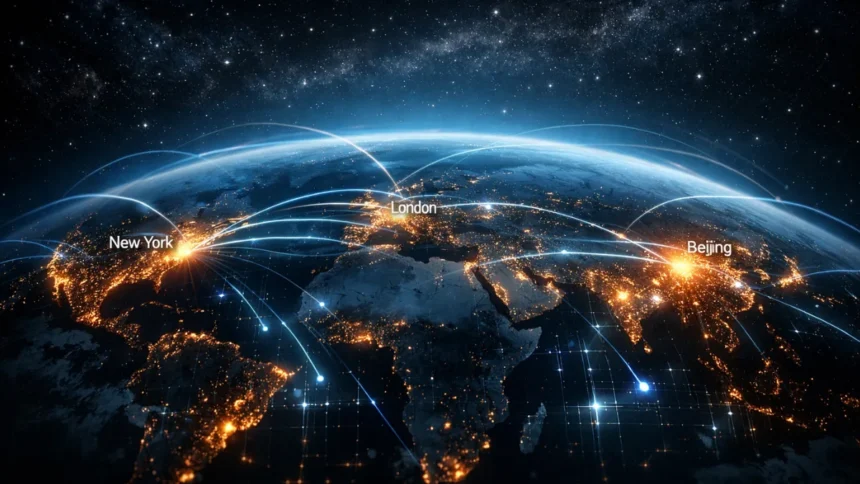
There’s a quiet shift happening in the world—one that doesn’t make noise like wars or elections, but may define both. In government corridors, corporate boardrooms, and research labs, a different kind of competition is unfolding. It’s not about territory or resources anymore. It’s about intelligence itself.
The Global AI Race isn’t just a tech story. It’s a power story.
From Silicon Valley to Beijing, from startups in Bengaluru to policy desks in Brussels, artificial intelligence has moved from experimental to essential. And unlike previous technological revolutions, this one feels less predictable, more strategic—and far more consequential.
The Global AI Race Is Not Just About Technology
At first glance, it looks like a competition between companies building smarter tools. But look closer, and the picture expands.

Countries are investing billions not just to innovate, but to dominate. Governments are treating AI like nuclear capability once was—strategic, sensitive, and central to national strength.
The United States continues to lead in foundational AI models and private sector innovation. China, meanwhile, is pushing aggressively with state-backed programs, aiming to integrate AI across governance, surveillance, and industry. Europe is carving its own path, focusing on regulation and ethical frameworks.
What makes The Global AI Race different from previous technological competitions is its reach. AI is not a single sector—it touches everything: defense, healthcare, finance, education, and even culture.
And that’s where things get complicated.
Why The Global AI Race Is Accelerating Now
The timing isn’t accidental. Several forces have converged to push AI into the spotlight.

First, data. The world is producing more data than ever before, and AI thrives on it. Every click, search, transaction, and interaction feeds the system.
Second, computing power. Advanced chips and cloud infrastructure have made it possible to train massive models at unprecedented scale.
Third, business pressure. Companies are no longer asking whether to adopt AI—they’re asking how fast they can integrate it before competitors do.

But beneath all of this lies a deeper driver: fear of falling behind.
No country or company wants to be second in a race where the winner may set the rules for decades.
The Business Battlefield of The Global AI Race
Walk into any major company today, and you’ll notice a subtle shift. AI is no longer a department—it’s becoming the backbone.
Tech giants are racing to build ecosystems. Startups are trying to disrupt them. Traditional industries are scrambling to adapt.
The competition isn’t just about who builds the best AI model. It’s about who integrates it most effectively.
A logistics company using AI for route optimization gains efficiency. A bank using AI for fraud detection reduces risk. A media company using AI for content personalization captures attention.
Multiply this across industries, and you start to see why The Global AI Race is as much about economic dominance as it is about technology.
There’s also a psychological layer. Businesses don’t just want AI—they feel they need it to survive. That urgency is accelerating adoption, sometimes faster than understanding.
The Human Layer: Fear, Fascination, and Dependency
Beyond strategy and economics lies a more subtle dimension—the human response.
AI triggers two opposite reactions at the same time. Fascination and anxiety.
On one hand, there’s excitement. Smarter tools, faster decisions, personalized experiences. AI promises convenience and capability.
On the other, there’s unease. Job displacement, algorithmic bias, loss of control.
This duality is shaping how societies respond to The Global AI Race. Some embrace it aggressively. Others approach it cautiously, focusing on safeguards and regulations.
What’s interesting is how quickly dependency is forming. People are already relying on AI for writing, coding, decision-making—even thinking shortcuts.
The question is no longer whether AI will influence human behavior. It already does.
The real question is: how much influence is too much?

Power, Policy, and the Rules of The Global AI Race
Every race eventually leads to rules. The challenge with AI is that the race is global, but regulation is local.
Countries are trying to balance innovation with control. Too many restrictions, and you risk slowing progress. Too few, and you risk unintended consequences.
Europe has leaned toward strict regulatory frameworks, aiming to set global standards. The United States has taken a more flexible approach, allowing innovation to lead. China has focused on strategic implementation with centralized oversight.
This divergence creates a complex landscape. Companies operating globally must navigate different rules, expectations, and risks.
And then there’s the question of ethics.
Who decides what AI should or shouldn’t do? Who is accountable when it makes mistakes? And how do you enforce rules on a technology that evolves faster than policy?
These are not technical questions. They are political ones.
The Global AI Race and the Future of Work
Perhaps the most immediate impact of AI is being felt in the workforce.
Automation isn’t new. But AI changes its scale and scope.
It’s not just repetitive tasks anymore. AI is entering domains that require judgment, creativity, and analysis.
Writers, designers, analysts, even developers—roles once considered safe are now being redefined.
But the story isn’t entirely about loss. It’s also about transformation.
New roles are emerging. Skills are shifting. The ability to work with AI is becoming as important as technical expertise itself.
The challenge is speed.
The pace of change in The Global AI Race is faster than the pace at which education systems and workforce training can adapt. That gap could define the next decade.
Where The Global AI Race Is Headed
If the current trajectory continues, the next phase of The Global AI Race will be less about building models and more about controlling ecosystems.
We’re likely to see:
- Consolidation of power among a few dominant players
- Increased regulation and global policy debates
- Deeper integration of AI into everyday life
- More visible societal impact—both positive and disruptive
There’s also a possibility that the race becomes less competitive and more cooperative, especially around safety and standards. But that depends on trust—and trust is rarely abundant in global competition.
What’s certain is this: AI will not remain a background technology. It will shape how decisions are made, how economies function, and how societies organize themselves.
More Read

Conclusion
The Global AI Race is not just about who builds the smartest machines. It’s about who defines the future.
Technology has always been a tool of power. AI amplifies that power in ways we are only beginning to understand.
The race is already underway. The outcomes are still uncertain.
And for the first time, intelligence itself is the battleground.
Final Insight
The future of power will not belong to those who simply adopt AI—but to those who understand its direction. Stay ahead with deeper insights on The Vue Times, where trends are not just reported—they are decoded.
Frequently Asked Questions
What is The Global AI Race?
→ The Global AI Race refers to the competition between countries and companies to develop and dominate artificial intelligence technologies for economic, strategic, and technological advantage.
Which countries are leading The Global AI Race?
→ The United States and China are currently leading, with strong investments, research capabilities, and AI ecosystems. Europe is influential in regulation and ethics.
Why is AI considered a strategic asset?
→ AI impacts defense, economy, and governance. Countries with advanced AI can gain advantages in decision-making, automation, and global influence.
How does The Global AI Race affect jobs?
→ It is transforming jobs by automating tasks and creating new roles. The demand is shifting toward skills that complement AI rather than compete with it.
Will The Global AI Race lead to strict regulations?
→ Yes, many countries are already working on AI regulations to balance innovation with safety, ethics, and accountability.