
Why BRICS Matters in a Changing Global Order
The global system that governed politics, trade, and finance for decades is undergoing a slow but unmistakable transformation. Power is no longer concentrated in a small group of advanced Western economies. Instead, influence is diffusing across regions, driven by demographic shifts, economic growth in emerging markets, and changing geopolitical priorities.
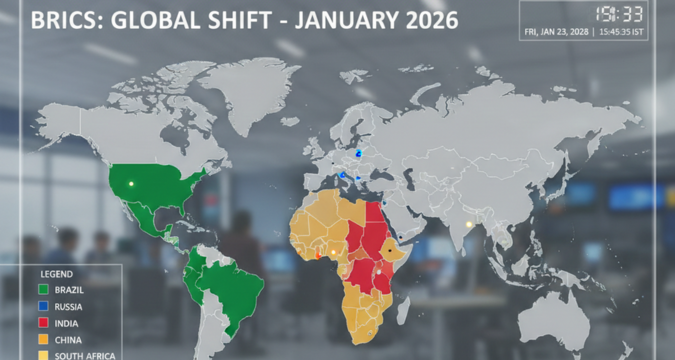
In this environment, BRICS has gained renewed relevance. Once viewed largely as a symbolic grouping of large developing economies, BRICS today reflects a deeper structural shift in how global cooperation is organised. It represents an attempt by emerging economies to assert greater influence in international decision-making without dismantling the existing global order.
For India, BRICS is not about opposition or alignment. It is about participation, leverage, and strategic choice. As India navigates economic development, geopolitical competition, and global governance reform, BRICS functions as one of several platforms through which it advances national interests.
Understanding BRICS, therefore, is not just about knowing who its members are. It requires examining how the grouping works, why it persists despite internal differences, and what role India plays within it.
Read More: Why Greenland Is Back in Global Headlines: Politics, Security, and What’s Really Happening
Core Explanation: What Is BRICS?
BRICS is a multilateral grouping of five major emerging economies:
- Brazil
- Russia
- India
- China
- South Africa
The acronym originated in 2001, when economist Jim O’Neill identified these economies as future drivers of global growth. At the time, it was a purely analytical term with no political intent.
Over the following years, governments of these countries recognised the value of coordinated engagement. What began as informal dialogue gradually evolved into a structured platform for cooperation.
BRICS is not a formal international organisation. It does not operate under a binding charter, nor does it impose legal obligations on its members. Instead, it functions as a consensus-based coordination forum, where cooperation occurs only in areas of shared interest.
This loose structure is deliberate. It allows countries with different political systems, economic models, and foreign policy priorities to collaborate without surrendering autonomy.
How BRICS Functions: Institutions and Processes
BRICS cooperation is organised across multiple levels, each serving a specific purpose.
Leaders’ Summits
Annual summits bring together heads of state and government. These meetings set the broad political direction of the grouping and issue joint declarations outlining shared priorities.
Ministerial-Level Engagement
Ministers responsible for finance, foreign affairs, trade, health, education, agriculture, and energy meet regularly. These engagements translate political intent into sector-specific cooperation.
Working Groups and Expert Forums
At the technical level, BRICS operates through working groups composed of officials, regulators, and subject experts. These groups focus on practical issues such as:
- Financial stability
- Digital public infrastructure
- Climate adaptation
- Disaster management
- Public health coordination
This layered structure allows BRICS to move beyond rhetoric, even if progress remains gradual.
Historical Evolution: From Concept to Coordination
Early Phase: Shared Dissatisfaction
In the early 2000s, emerging economies faced a common frustration. Despite contributing a growing share of global output, they remained underrepresented in institutions such as the IMF and World Bank.
Voting rights, leadership positions, and policy influence continued to favour advanced economies. BRICS emerged as a forum to articulate this shared dissatisfaction in a coordinated manner.
Post-2008 Shift
The global financial crisis of 2008 marked a turning point. As Western economies struggled, emerging markets played a stabilising role. This reinforced the argument that global governance structures no longer reflected economic realities.
BRICS cooperation intensified during this period, moving from dialogue to institution-building.
Read More: Repo Rate and Reverse Repo Rate Explained for Competitive Exams
The New Development Bank: A Practical Outcome
One of the most concrete outcomes of BRICS cooperation is the New Development Bank (NDB).
Established in 2015, the NDB was created to finance infrastructure and sustainable development projects in member countries.
Key characteristics include:
- Equal voting power among founding members
- Focus on long-term development needs
- Emphasis on environmental sustainability
- Increasing use of local currency lending
For India, the NDB has supported projects in renewable energy, urban infrastructure, and transport connectivity. While the scale is modest compared to global institutions, its strategic value lies in diversification rather than replacement.
Why BRICS Matters for India: Strategic Considerations
India’s engagement with BRICS must be understood through the principle of strategic autonomy. This doctrine emphasises independent decision-making, flexibility, and issue-based partnerships.
Expanding Diplomatic Space
BRICS gives India an additional platform to engage major powers, including countries with which it may have complex bilateral relationships. This engagement occurs within a multilateral setting that reduces diplomatic friction.
Avoiding Binary Choices
In an era of intensifying great-power competition, India has resisted pressure to align exclusively with any single bloc. BRICS allows India to maintain engagement across geopolitical divides.
India as a Balancing Actor Within BRICS
India’s position within BRICS is distinct from other members.
Navigating Power Asymmetry
China’s economic size and global reach far exceed those of other BRICS members. India’s participation ensures that the grouping does not become dominated by a single narrative.
Promoting Development-Centric Cooperation
India has consistently emphasised themes such as inclusive growth, capacity-building, and technology for development. These priorities resonate with other emerging economies and reinforce India’s leadership credentials.
Read More: How Government Borrows Money: Treasury Bills and Bonds Explained
Economic Dimensions: Trade, Finance, and Growth
Trade Diversification
BRICS provides opportunities for India to expand trade links beyond traditional markets. While intra-BRICS trade remains uneven, the strategic objective is diversification rather than volume alone.
Financial Cooperation
BRICS discussions increasingly focus on financial stability, development finance, and cross-border investment. These conversations complement India’s broader economic diplomacy.
The role of BRICS in global growth debates is also significant, as member economies collectively contribute a substantial share of global GDP growth.
BRICS and Global Governance Reform
A central objective of BRICS is reforming international institutions to reflect contemporary economic realities.
Key areas of concern include:
- Representation of emerging economies
- Voting rights in financial institutions
- Leadership selection processes
- Rule-setting authority
For India, these issues are directly linked to its aspiration for a larger role in global decision-making.
Current Trends: How BRICS Is Changing
Membership Expansion
BRICS has explored expanding its membership to include other emerging economies. This reflects growing interest in alternative platforms for global cooperation.
India’s approach to expansion is cautious. While broader representation can enhance legitimacy, excessive expansion may complicate decision-making.
Financial Innovation Discussions
Recent years have seen discussions on improving trade settlement mechanisms and financial cooperation. While these remain exploratory, they signal evolving priorities.
Broader Context: BRICS in a Fragmented World
The global environment today is characterised by:
- Geopolitical competition
- Supply chain reconfiguration
- Economic uncertainty
- Institutional fatigue
In this context, BRICS functions as a stabilising forum rather than a disruptive force. It allows emerging economies to coordinate without dismantling existing systems.
For India, this complements engagement with platforms such as the G20 and regional groupings.
Common Misconceptions About BRICS
“BRICS Is an Anti-West Bloc”
BRICS does not seek confrontation. Its members maintain strong bilateral ties with Western economies while advocating institutional reform.
“Internal Differences Make BRICS Ineffective”
BRICS was never designed for uniformity. Its value lies in selective cooperation, not consensus on all issues.
“BRICS Has No Real Impact”
While progress is incremental, institutions like the NDB demonstrate that BRICS delivers practical outcomes.
Read More: Revenue Deficit, Fiscal Deficit, and Primary Deficit Explained
Implications for India’s Economy and Society
Although BRICS operates at the diplomatic level, its outcomes influence domestic priorities over time.
These include:
- Access to development finance
- Infrastructure investment
- Enhanced global bargaining power
For Indian businesses and policymakers, BRICS offers long-term strategic value rather than immediate returns.
What to Watch Next
Key developments that will shape BRICS relevance include:
- Decisions on expansion and governance
- Effectiveness of financial cooperation mechanisms
- India’s ability to shape agendas and outcomes
The future of BRICS will depend on execution, not declarations.
Why BRICS Continues to Matter for India
BRICS is neither a rigid alliance nor an abstract concept. It is a pragmatic platform that reflects the realities of a multipolar world.
For India, BRICS matters because it expands strategic options, strengthens diplomatic leverage, and supports long-term economic and political objectives.
Its relevance lies in what it enables, not what it opposes.
More Read

Frequently Asked Questions
Why is BRICS important for India today?
BRICS provides India with diplomatic flexibility and a platform to engage emerging economies while advocating reforms in global governance.
Does BRICS directly boost India’s economy?
The benefits are structural and long-term, including development finance access, trade diversification, and stronger global influence.
How does India handle differences within BRICS?
India separates bilateral issues from multilateral cooperation, focusing on shared interests rather than alignment.
Will BRICS expansion reduce India’s influence?
Expansion can strengthen representation but may complicate consensus. India supports calibrated growth to preserve effectiveness.
Is BRICS likely to become a formal alliance?
BRICS is expected to remain a flexible coordination forum rather than a binding alliance, preserving sovereignty and adaptability.
Understand the shifts shaping India’s global influence. Follow The Vue Times for sharp, context-driven analysis beyond the headlines.